造型分析部分
Form Analysis Section
0 / 3 cards mastered (0%)
Summary 概要
本课讲解复制紫砂作品时的四个关键步骤:观察分析作品的流派风格和优缺点,考虑工艺工序和工具,制作时一气呵成,以及通过实践总结经验。课程以王寅春的艳形肩线壶为例,详细分析其优点和改进建议。
This lesson covers four key steps in replicating Yixing pottery: observing and analyzing the style and characteristics of the original work, considering crafting processes and tools, executing the work efficiently, and learning through practice. The lesson uses Wang Yinchun's Elegant Shoulder Line teapot as a case study.
Key Concepts 关键概念
- form analysis
- replication techniques
- style observation
- crafting workflow
- Wang Yinchun
=== Page 558 - Chinese ===
第四课 造型分析部分 1981.12.21
复制一件产品应该注意哪些事情 :
一、复制一件作品 ,首先要看 ,先看一看这件作品是和否和人样 、好看 ,
识别清楚作品的流派及风格 ,要分析出优点、长处及不足之处 。 分析作品要
从多方面看,比如气势、形式 、比例、协调等多方面, 在复制时做到去粗取
精, 使之有所提高 。
分析作品要集思广益,要敢于谈自己的见解,善于听取别人的意见 ,
同时要注意克服自己的痊好 ( 准好是一种恶习 ,有交好的人是不可能做到博
采众长的 ), 不断提高自己的审美能力 艺术素养 。
二、在对产品进行分析后 ,就要考虑工艺工序及采用的技术手段 、所
需要的工具, 要尽量考虑周到,避免返工 。
三、做生活要尽量做到一气呵成,也就是说安排要合理 , 不要随随便便 。
四、一萌生活既然打了,不论好坏,就一定做下来 ,通过实践进行分
析、和研究, 并要做好心得, 总结出成功与失败之处 ,以利于今后的提高 ,这
就是“实践论”中所说的实践 一一认识 一一实践 。
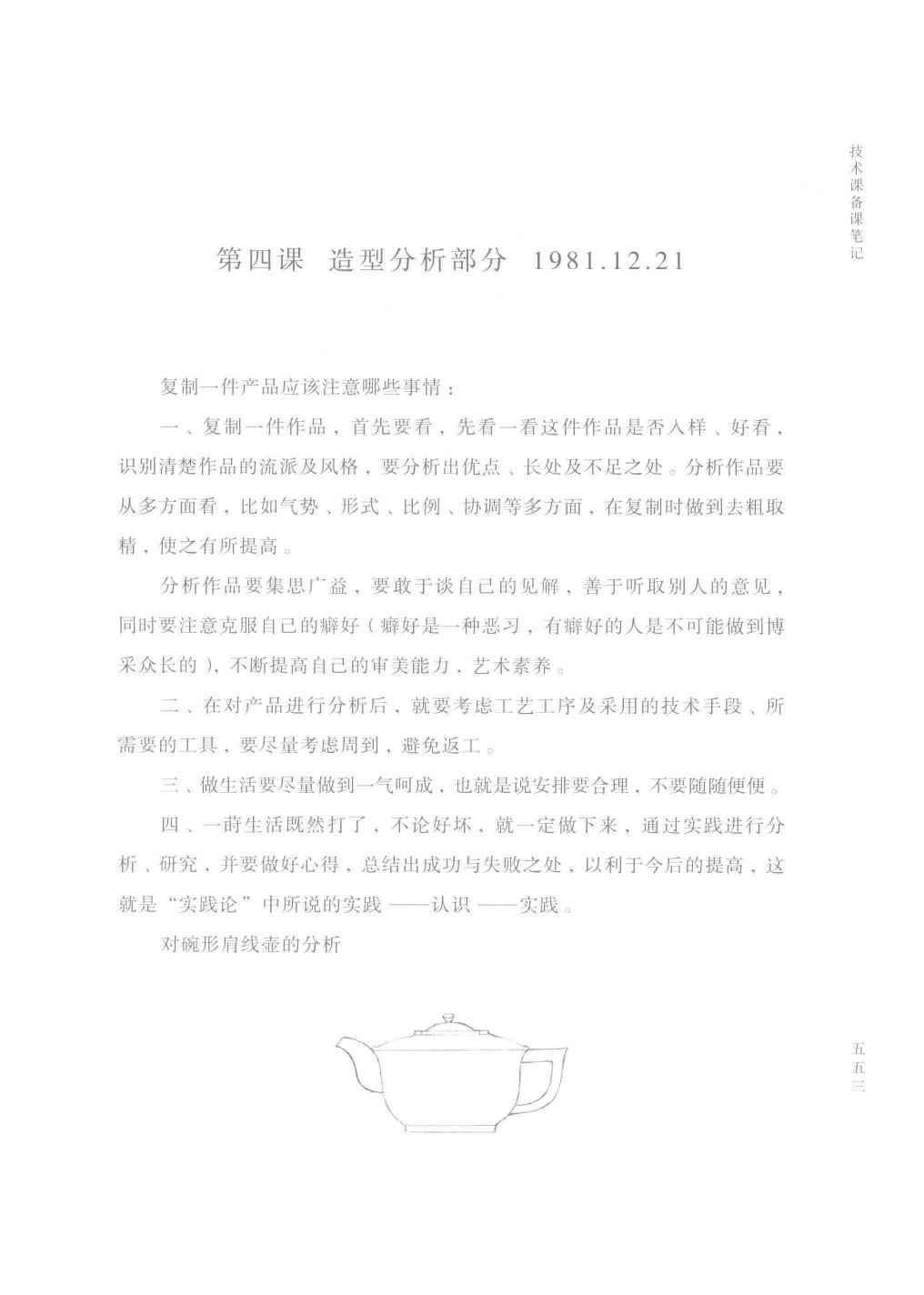
对克形肩线索的分析
性黄共
=== Page 559 - Chinese ===
避郝下姜
五
四
“艳形肩线”: 王寅春创作 。
优点 : 生活挺括 , 交代清楚 , 肩线装饰得好 。
不足处 :
. 嘴、权落下 ,特别是鬼只有章肩 ,显得无力 ,嘴也觉得略触出〈 伸
出略长 )。
2. 大只略薄也太阔 。
3., 最不合理之处是盖 : 虚片太小,在盖板上做一条四线,茶壶盖上盖
头以后 ,更加增加了大只的阔度 ,结果费了工反而不美观 。如果不要盖边
线,, 或者不做撕盖,改做虚克盖,效果就好得多 。嘴宜缩短一点,嘴背高起
一些就显得神气 ,睁应提高 ,抠大头根部不动 , 上部按身简的轮廓线飞起 ,
这样的效果就会好得多 。
# Lesson Four: Form Analysis Section, December 21, 1981
## What to Pay Attention to When Replicating a Product:
**First**, when replicating a work, you must first observe—look carefully to see whether this piece is harmonious with human proportions and aesthetically pleasing. Clearly identify the school and style of the work, and analyze its strengths, merits, and shortcomings. Analysis of a work should be conducted from multiple perspectives, such as momentum, form, proportion, coordination, and other aspects. When replicating, strive to discard the crude and retain the refined, so as to achieve improvement.
Analysis of a work should draw on collective wisdom. One must dare to express one's own views and be good at listening to others' opinions. At the same time, pay attention to overcoming one's own biases (bias is a bad habit; those with biases cannot possibly draw on the strengths of many). Continuously improve your aesthetic ability and artistic cultivation.
**Second**, after analyzing the product, you must consider the technical processes and methods to be employed, as well as the tools needed. Think things through as thoroughly as possible to avoid rework.
**Third**, when making the clay body, strive to complete it in one continuous effort—that is to say, arrangements should be reasonable; don't be careless or haphazard.
**Fourth**, once a clay body has been started, regardless of whether it turns out well or poorly, you must see it through to completion. Through practice, conduct analysis and research, and be sure to record your insights, summarizing what succeeded and what failed, so as to facilitate future improvement. This is what *On Practice* refers to as: practice—understanding—practice.
## Analysis of the Shoulder Line Clues of the Ke Form
[Signature: Huang Yulin]
# Avoiding Hao, Descending to Jiang
## Five
## Four
**"Elegant Form Shoulder Line"**: Created by Wang Yinchun.
Advantages: The form is crisp and well-defined, clearly articulated, with excellent decorative treatment of the shoulder line.
Deficiencies:
1. The spout and handle droop downward. Especially the handle, which only has a shoulder chapter, appears weak. The spout also feels slightly protruding (extending slightly too long).
2. The opening is slightly thin and too wide.
3. The most unreasonable aspect is the lid: the flange is too small, and adding a ridge line on the lid plate—after the teapot lid is placed on top—further increases the width of the opening. The result is that extra effort produces an unattractive effect. If the lid rim line were eliminated, or if instead of making a pressed lid, a recessed lid were made instead, the effect would be much better. The spout should be shortened a bit, and the spout back raised somewhat to give it more spirit. The handle should be elevated, keeping the base of the large head stationary while the upper portion rises following the contour line of the body. This approach would produce a much better effect.