Chapter 10
附录
Appendix
558
of 659
English Translation
## What to Pay Attention to When Replicating a Product:
**First**, when replicating a work, you must first observe—look carefully to see whether this piece is harmonious with human proportions and aesthetically pleasing. Clearly identify the school and style of the work, and analyze its strengths, merits, and shortcomings. Analysis of a work should be conducted from multiple perspectives, such as momentum, form, proportion, coordination, and other aspects. When replicating, strive to discard the crude and retain the refined, so as to achieve improvement.
Analysis of a work should draw on collective wisdom. One must dare to express one's own views and be good at listening to others' opinions. At the same time, pay attention to overcoming one's own biases (bias is a bad habit; those with biases cannot possibly draw on the strengths of many). Continuously improve your aesthetic ability and artistic cultivation.
**Second**, after analyzing the product, you must consider the technical processes and methods to be employed, as well as the tools needed. Think things through as thoroughly as possible to avoid rework.
**Third**, when making the clay body, strive to complete it in one continuous effort—that is to say, arrangements should be reasonable; don't be careless or haphazard.
**Fourth**, once a clay body has been started, regardless of whether it turns out well or poorly, you must see it through to completion. Through practice, conduct analysis and research, and be sure to record your insights, summarizing what succeeded and what failed, so as to facilitate future improvement. This is what *On Practice* refers to as: practice—understanding—practice.
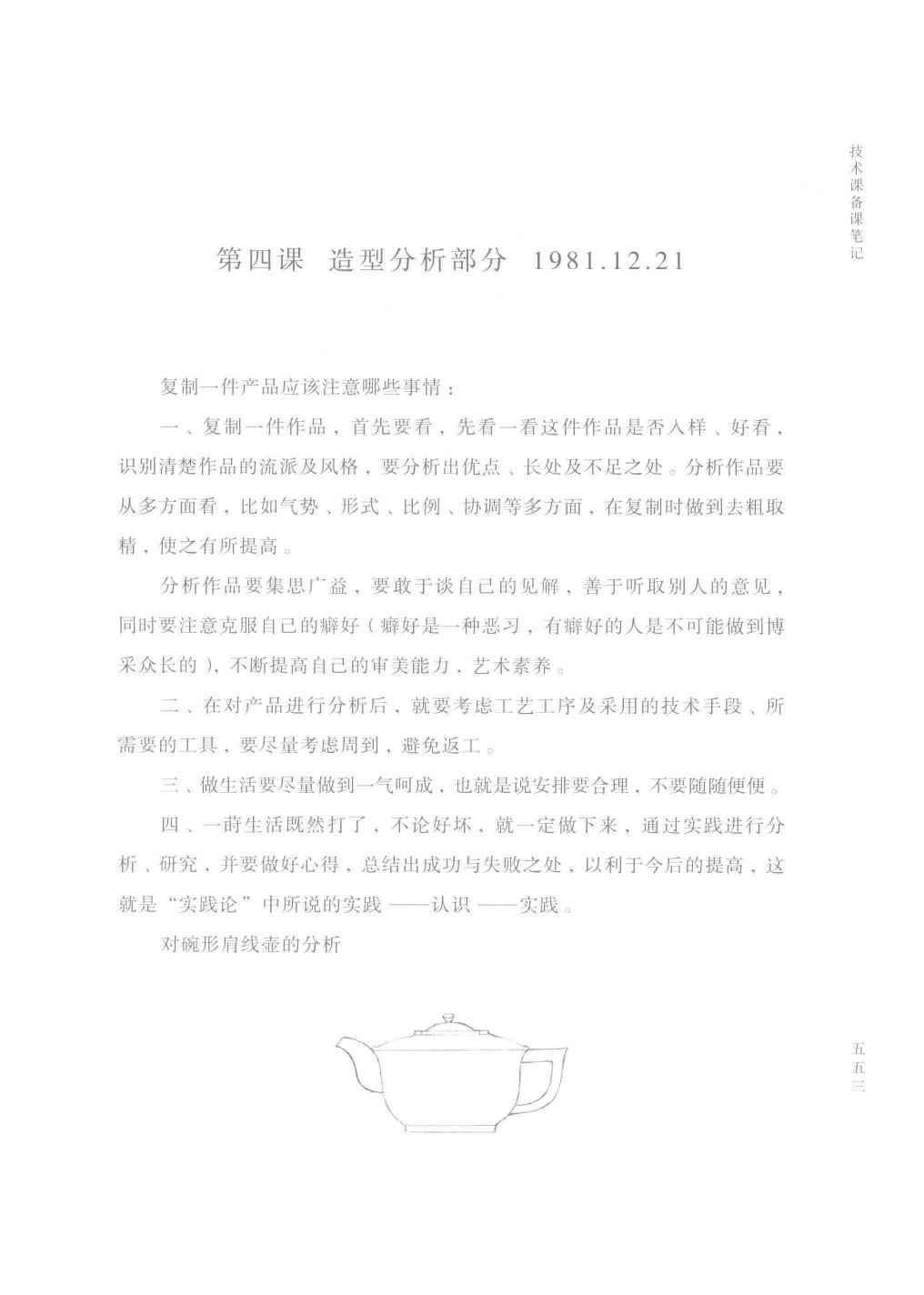
## Analysis of the Shoulder Line Clues of the Ke Form
[Signature: Huang Yulin]
Chapter 10
附录
Appendix
Pages 526-651
View Chapter →
English Translation
## What to Pay Attention to When Replicating a Product:
**First**, when replicating a work, you must first observe—look carefully to see whether this piece is harmonious with human proportions and aesthetically pleasing. Clearly identify the school and style of the work, and analyze its strengths, merits, and shortcomings. Analysis of a work should be conducted from multiple perspectives, such as momentum, form, proportion, coordination, and other aspects. When replicating, strive to discard the crude and retain the refined, so as to achieve improvement.
Analysis of a work should draw on collective wisdom. One must dare to express one's own views and be good at listening to others' opinions. At the same time, pay attention to overcoming one's own biases (bias is a bad habit; those with biases cannot possibly draw on the strengths of many). Continuously improve your aesthetic ability and artistic cultivation.
**Second**, after analyzing the product, you must consider the technical processes and methods to be employed, as well as the tools needed. Think things through as thoroughly as possible to avoid rework.
**Third**, when making the clay body, strive to complete it in one continuous effort—that is to say, arrangements should be reasonable; don't be careless or haphazard.
**Fourth**, once a clay body has been started, regardless of whether it turns out well or poorly, you must see it through to completion. Through practice, conduct analysis and research, and be sure to record your insights, summarizing what succeeded and what failed, so as to facilitate future improvement. This is what *On Practice* refers to as: practice—understanding—practice.
## Analysis of the Shoulder Line Clues of the Ke Form
[Signature: Huang Yulin]
章节导航 Chapter Navigation
Chapter 1
序文
Pages 6-6
Chapter 2
引言
Pages 28-31
Chapter 3
达变
Pages 32-133
Chapter 3
开宗立派
Pages 46-66
Chapter 3
传道授业
Pages 67-98
Chapter 3
大师淳友
Pages 99-120
Chapter 3
学艺谋生
Pages 121-133
Chapter 4
化神
Pages 134-141
Chapter 5
独妙
Pages 142-405
Chapter 5
匠心独运 不苟丝毫
Pages 142-179
Chapter 5
器利善事 物尽其用
Pages 180-199
Chapter 5
紫泥春华 研精究微
Pages 200-405
Chapter 6
驾简
Pages 406-427
Chapter 6
精雕细刻 文质合一
Pages 406-410
Chapter 6
师法自然 妙趣横生
Pages 411-415
Chapter 6
丝来线去 曲尽其妙
Pages 416-427
Chapter 7
明志
Pages 463-485
Chapter 7
高山仰止 淡泊明志
Pages 463-472
Chapter 7
啜墨看茶 气定神闲
Pages 473-478
Chapter 7
齿少心锐 怡志抒情
Pages 479-485
Chapter 8
存真
Pages 428-462
Chapter 8
规圆矩方 弃伪存真
Pages 428-436
Chapter 8
有物有则 钻尖仰高
Pages 437-462
Chapter 9
心营
Pages 506-525
Chapter 9
坚守传统 艺立潮头
Pages 506-513
Chapter 9
新型师承 桃李满园
Pages 514-525
Chapter 10
附录
Pages 526-651
Chapter 10
顾景舟紫艺论文
Pages 526-535
Chapter 10
技术课备课笔记
Pages 536-543
Chapter 10
顾景舟艺术年表
Pages 544-651
Chapter 11
参考文献
Pages 652-657
Chapter 12
鸣谢
Pages 658-659