仿鼓壶
Fǎng Gǔ Hú
Pages 201-202
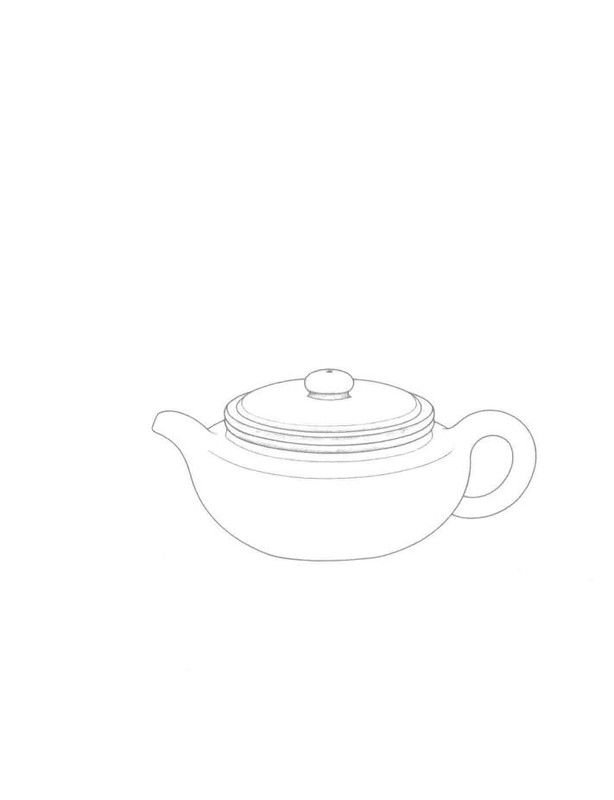
详细描述 Description
中文 Chinese
化
神
追赶和超越自己心中的紫砂敬峰自然成为他酝酿许久的创作冲动 。
“仿鼓壶”的形制简洁,线条流畅 ,是紫砂传统造型的基本款形之一 ,
几乎每位从业人员最初学做的都是这种壶型 。 虽然人人都学过 ,人人都会
做,但能做得好 、得到世人妃捧的却凤毛麟角 。历史上邵大享的“仿鼓者”
堪称杰作 。邵氏的壶最明显的就是星现一种古拙之美,古而不泥 ,拙而不
条 ,有“力度”有“气度”, 这正是紫砂传统工艺的凡力所在 。
顾景舟的作品较之大享的原器, 一脉相承的是“厚重”、是“气度”
不同的是,顾景舟的作品通过进一步压肩盖面和肩线,加宽盖板线, 使流的
上部自肩线平缓沿出,下部与扁鼓的身简昌线相切 ,显得短而不促,为整体
扁平的空间造型引出了力度舒展点 ,攀圆缓舒展 ,内侧宽厚扁平 ,因此 ,虽
然壶身届平,重心靠外,加之容量约半升 ,盛满水单手持拿 ,亦不觉吃力 ,
实用性极强 。纵观通体 , 壶身扁而不塌,流 、厄和舒出自然, 体现了一份律动
的清秀之美 。 这种审美的取向 ,贯穿顾景舟的整个创作生涯 , 逐渐形成了顾
景舟壶艺鲜明的个人风格 。
从存世基和不同印坎的使用来看,在一段时期内顾景舟曾多次制作过
“大口肩腹索”, 总体数量不下十把 。 顾景舟之所以翻来覆去重复此款造型 ,
似乎是在寻找一种感党,寻找他心目之中对紫砂的理解 ,寻找一种属于自己
的诸言
English
# Transformation and Spirit
Chasing and surpassing the pinnacle of Yixing pottery in his own heart naturally became a creative impulse he had been nurturing for a long time.
The form of the "Imitation Drum Teapot" is simple and clean, with flowing lines. It is one of the basic traditional shapes in Yixing pottery, and almost every practitioner initially learns to make this type of teapot. Although everyone has studied it and everyone can make it, those who can make it well and earn widespread acclaim are as rare as phoenix feathers and unicorn horns. Historically, Shao Daheng's "Imitation Drum" is considered a masterpiece. The most distinctive feature of Shao's teapots is their presentation of an archaic and unadorned beauty—ancient without being rigid, simple without being crude, possessing both "strength" and "bearing." This is precisely where the extraordinary power of traditional Yixing craftsmanship lies.
Compared to Daheng's original work, Gu Jingzhou's pieces inherit the same "weightiness" and "bearing." The difference is that Gu Jingzhou's work, through further compressing the shoulder and lid surface and shoulder line, and widening the lid rim line, allows the upper part of the spout to extend smoothly and gently from the shoulder line, while the lower part is tangent to the curved line of the flattened drum body. This makes it appear short without being cramped, introducing a point of powerful extension to the overall flattened spatial form. The handle curves and extends gracefully, with a wide, thick, and flat interior. Therefore, although the body is flat with the center of gravity toward the outside, and with a capacity of about half a liter, holding it full of water with one hand does not feel strenuous—its practicality is extremely strong. Viewing the whole piece, the body is flat without collapsing, and the spout, handle, and knob extend naturally, embodying a rhythmic and refined beauty. This aesthetic orientation permeated Gu Jingzhou's entire creative career, gradually forming the distinctive personal style of Gu Jingzhou's teapot artistry.
Judging from surviving works and the use of different seal marks, Gu Jingzhou made the "Large Mouth Shoulder and Belly Teapot" multiple times over a period, with a total number of no fewer than ten pieces. The reason Gu Jingzhou repeatedly returned to this particular form seems to be that he was searching for a feeling, searching for his understanding of Yixing pottery in his mind, searching for a language that belonged to himself alone.