茄段壶
Qié Duàn Hú
Pages 207-208
详细描述 Description
中文 Chinese
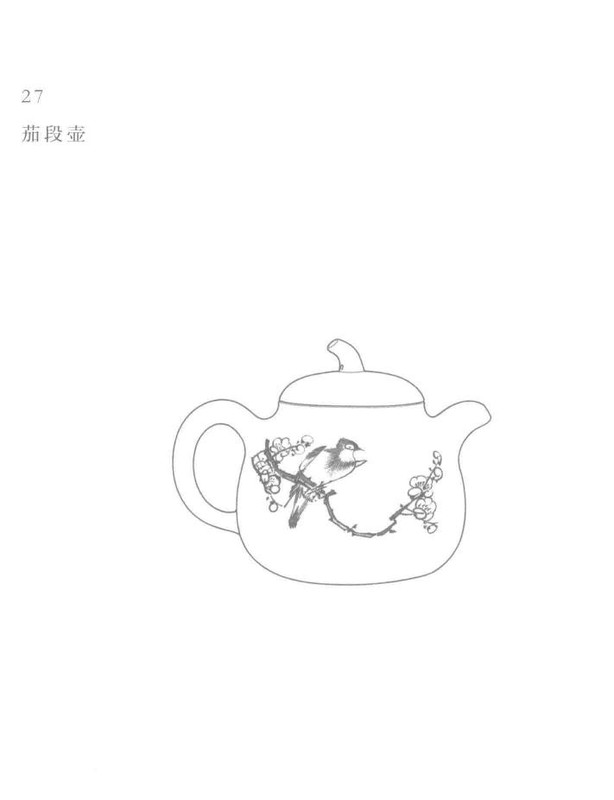
“茄段毒”的造型取材于枝头成熟的茄子 , 生动巧妙,饱满俊挺,结实
丰美而不流于肥硕 。
,化繁为易,一一逐步讲解要领,以利掌握 。
理
顾景舟在教学培训中将制作“茄段过”作为紫砂入门的基本功 ,从泥
泥片拍打、身简的围合 ,到“一捧底”的处理办法,口部及颈肩的处
弟子葛陶中曾回忆老师教授“茄段壳”制作过程 :“那几年,我们亲身感
受了顾景舟严阐的治学和严格的执教态度 。 记得顾老为我们选定的第一个品
种是荔段壶 ,要求全手工制作 。 一张泥幕放在中间,我们五人围在四周 ,顾
老边示范边讲解 ,从最基本的成型手法开始 ,如泥条、泥片如何打得薄厚均
匀
,人怎样掌握力度围好壶身 ,“一捧底 ”的处理方法 ,怎样收口 ,壶的肩部又
要怎样才能有力,他边做边讲 ,耐心细致,一丝不苟,反复强调操作的要求 ,
并全神贯注地示范制作 ; 接着让我们动手 ,要求每天多打壶身 ,做到全部合格
了
1
, 才教我们上大只、搓嘴抠,同盖头,循序渐进,合格一步,前进一步。”
他公斋宛训
肾菜大水卫生
茄段壶的正面图
高英姿著 :《中国工艺美术大师顾景舟 》 南京 : 江苏美术出版社 .2010年7月版. 第32页
ULGILI
English
# The Eggplant Segment Teapot
The form of the "Eggplant Segment Teapot" draws inspiration from ripe eggplants on the branch—vivid and ingenious, full and upright, solid and abundant without becoming overly plump.
In his teaching and training, Gu Jingzhou made the creation of the "Eggplant Segment Teapot" a fundamental exercise for beginners in Yixing pottery. He simplified complexity into manageable steps, explaining each key point systematically to facilitate mastery—from kneading the clay and beating clay slabs, to forming the body cylinder, handling the "single-palm base," and treating the mouth, neck, and shoulder.
His disciple Ge Taozhong once recalled the teacher's instruction on making the "Eggplant Segment Teapot": "During those years, we personally experienced Gu Jingzhou's rigorous scholarship and strict teaching approach. I remember the first piece Master Gu selected for us was the Eggplant Segment Teapot, requiring entirely handmade construction. A clay table was placed in the center, with the five of us gathered around. Master Gu demonstrated while explaining, starting from the most basic forming techniques—how to beat clay coils and slabs to uniform thickness, how to control one's strength to properly form the teapot body, the method for handling the 'single-palm base,' how to close the mouth, and how to give the shoulder strength. He worked while teaching, patient and meticulous, utterly conscientious, repeatedly emphasizing operational requirements and demonstrating with complete concentration. Then he had us practice, requiring us to form multiple teapot bodies daily until all were qualified. Only then would he teach us to attach the handle, shape the spout, and fit the lid—progressing step by step, advancing only when each stage met standards."[1]
> Front view of the Eggplant Segment Teapot
---
[1] Gao Yingzi, *Gu Jingzhou: Master of Chinese Arts and Crafts* (Nanjing: Jiangsu Fine Arts Publishing House, July 2010), p. 32.