仿鼓如意壶
Fǎng Gǔ Rúyì Hú
Pages 218-219
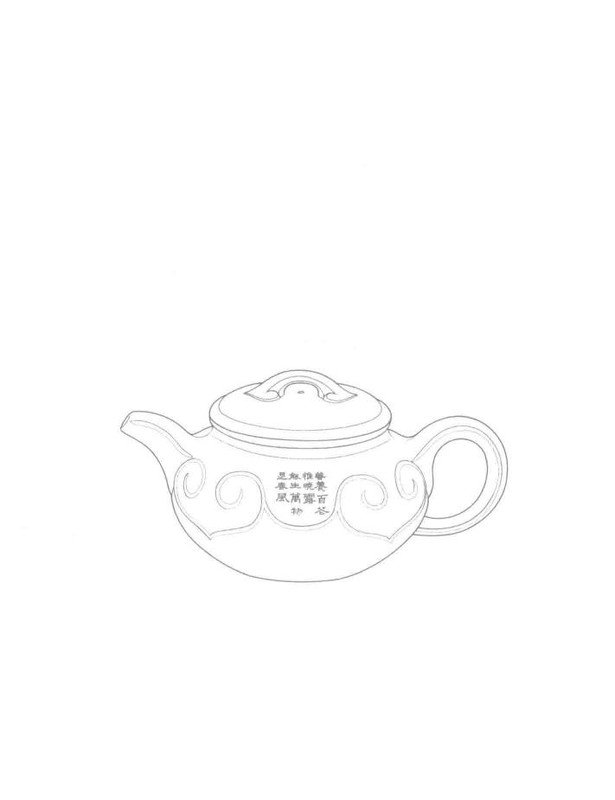
详细描述 Description
中文 Chinese
孙孝下泪
四
顾名思义 ,“仿鼓如意壶”是以传统的“仿鼓壶”为本 ,再加饰如意纹
而成 。壶身按压四组心形如意纹 ,中间以自然流体线过渡 ,两边分延至流 、
把, 配以盖部如意纹桥钮,纹饰起伏和舒展,通贯一气 。下部以一捧收底, 更
衬身简饱满气势 。
志盖边缘压线,与身简口沿截面呈半圆状契合,口 、盖分占半强与半
弱,喻“天包地”之意。两体相合 ,即现人饱满完整半圆弧线 。分则各为一
体,合则缘聚天成,作者的用心和工艺的难度在不经意间示于品者眼帘 。紫
的装饰线条虽无定式规版 ,但繁杂和宛余易现刻意呆板 ,要至言简意达
繁而不杂之效,实是对作者的知识面与审美观的综合考察,在这一点上,如
意纹饰在“仿鼓如意壶”上的妙用,确实体现了顾景舟的过人功力 。
“仿鼓如意壳”是顾景舟较为满意的壶品,在不同时期曾多次制作 。 时
在上世纪 40 年代,顾景表就创作过多把“仿鼓如意壶”, 底部铃盖“荆南山
English
# Sun Xiao's Tears
## Four
As the name suggests, the "Imitation Drum Ruyi Teapot" is based on the traditional "Imitation Drum Teapot," with the addition of ruyi pattern decorations. Four groups of heart-shaped ruyi patterns are pressed into the body of the pot, with natural flowing lines transitioning between them. These extend on both sides to the spout and handle, complemented by a ruyi pattern bridge knob on the lid. The patterns rise and fall, stretch and flow in unified harmony. The lower portion tapers to a gathered base, further accentuating the full and imposing presence of the body.
The edge of the lid is pressed with lines that form a semicircular cross-section matching the rim of the body. The mouth and lid each occupy half-strong and half-weak positions, symbolizing the concept of "heaven embracing earth." When the two parts come together, they present a full and complete semicircular arc. Separated, each stands as its own entity; united, they merge as if destined by nature. The maker's intention and the difficulty of the craftsmanship are revealed inadvertently before the viewer's eyes.
Although decorative lines on Yixing teapots follow no fixed rules or templates, excessive complexity and redundancy easily appear deliberate and rigid. To achieve the effect of being concise yet meaningful, complex yet not chaotic, truly tests the maker's breadth of knowledge and aesthetic sensibility. In this regard, the ingenious application of ruyi patterns on the "Imitation Drum Ruyi Teapot" genuinely demonstrates Gu Jingzhou's exceptional skill.
The "Imitation Drum Ruyi Teapot" was one of Gu Jingzhou's more satisfying works, which he created multiple times in different periods. As early as the 1940s, Gu Jingzhou had already created several "Imitation Drum Ruyi Teapots," with the base stamped "Jingnan Mountain..."