三足高腰线提梁壶
Sān Zú Gāo Yāo Xiàn Tí Liáng Hú
Pages 223-224
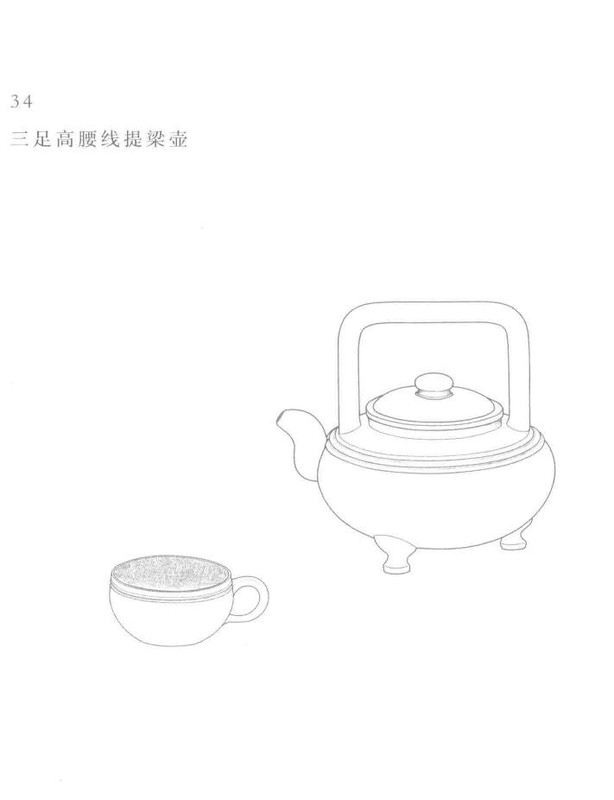
详细描述 Description
中文 Chinese
“三足高腰线提梁壶”造型源自古代青铜礼器,身简扇圆敦厚 ,洗圆亿
满, 象足流线起伏变化 ,呈瞻状支撑 ,霜气中不失礼乐之赴 ; 索盖内嵌 ,上
饰宝珠钮,纽型与盖面弧度及身简外廓过渡衔接自然 。
两弯流半切式骨入壶身,厚拙而不显突元 。圆线提梁折成方状,与过
身方圆相呼 ,虚实相应,三道半圆线依次环于索身肩部 , 有效地平衡了提梁
线折弯后上部空间的视觉重心 。
此壶造型光素简洁 , 古意内然, 具备典型的民国后期特征,传统而不失时
代气息,, 这与顾景舟师古不泥 ,把创新融于传统的一贯坚持密不可分,他说 :
我们应该认真学习优良传统 ,取其精华 ,以充实自己的设计构
思 ,始能创作出更新的作品 。
探索壶艺之创新 ,既要有取舍地保持传统基础上的优良特色 ,又
要能吸收其他姐妹艺术中可以借鉴的东西 。如古代的青铜 、玉器 、石
刻、砖驹,现代工艺美术和建筑艺术,都能有息息相通之处 。'
=弯嘴的三足高腰线提梁过
1 。顾景舟、高海庚著 :《壶艺的继承与创新 》 载史俊党 、盛畔松主编《紫砂春秋 》 上海 : 文汇
出版社 ,1991 年10 月版, 第187 页
English
# The Three-Legged High-Waisted Overhead Handle Teapot
The form of the "Three-Legged High-Waisted Overhead Handle Teapot" originates from ancient bronze ritual vessels. Its body is simple, rounded, and substantial, with a full and complete belly. The elephant-foot spout features flowing, undulating lines that form a tripod-like support, maintaining the dignity of ritual and music within its imposing presence. The flat lid is inset, adorned with a jewel-shaped knob on top. The knob's form transitions naturally with the arc of the lid surface and the outer contour of the body.
The curved spout is half-cut and integrated into the body of the pot, appearing thick and solid without seeming abrupt or clumsy. The round overhead handle is bent into a square shape, echoing the square and round forms of the body, creating a harmonious interplay of solid and void. Three semi-circular lines encircle the shoulder of the body in succession, effectively balancing the visual center of gravity in the upper space after the handle's angular bend.
This teapot's form is plain and simple, with an inherent ancient elegance. It possesses the typical characteristics of the late Republican period—traditional yet not lacking in contemporary spirit. This is inseparable from Gu Jingzhou's consistent principle of learning from the ancients without being bound by them, integrating innovation into tradition. He said:
> We should earnestly study excellent traditions, extract their essence, and enrich our own design concepts, so that we can create even newer works.
> In exploring innovation in teapot art, we must selectively preserve the excellent characteristics based on traditional foundations, while also being able to absorb what can be learned from other sister arts. Ancient bronzes, jade, stone carvings, brick sculptures, modern arts and crafts, and architectural art—all can have interconnected elements.[1]
---
[1] Gu Jingzhou and Gao Haigeng, "The Inheritance and Innovation of Teapot Art," in *Annals of Purple Clay*, ed. Shi Jundang and Sheng Pansong (Shanghai: Wenhui Publishing House, October 1991), 187.