方钟壶
Fāng Zhōng Hú
Pages 241-242
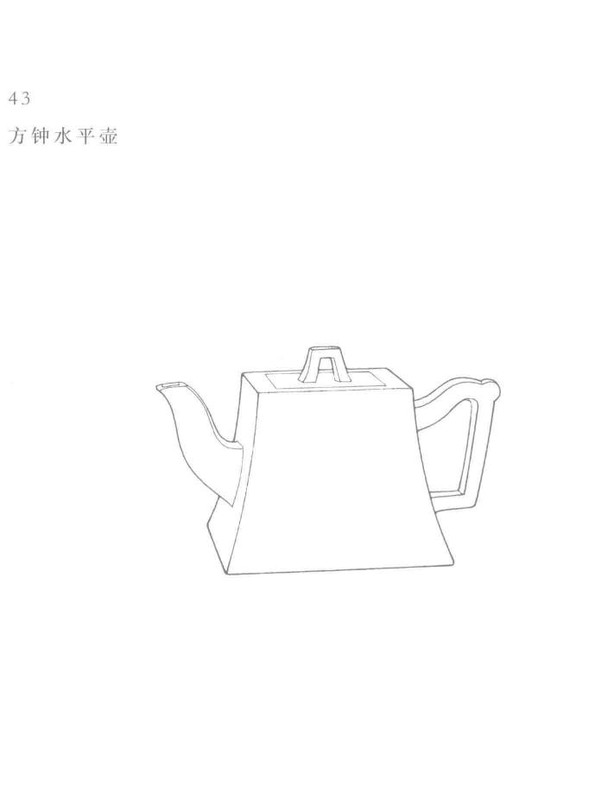
详细描述 Description
中文 Chinese
1
“方钟水平壹”以方钟为型 , 底宽平而稳重,壶身从上往下渐昌渐张 ,
形成钟口开放的效果,挺秀而端庄 。桥钮中空, 形态仿壶身造型 。流 、松截
面缘为四边形,三弯嘴伸曲有度 ,舒展大方 ,和飞轰各相呼应,增加了造型
的动感 。整件回型素洁高雅,尽显风神气骨
“方钟水平索”线条直中有曲,静中有动,在制作技艺上极难把握 。
1981 年 ,紫砂工艺厂成立特艺班 ,顾景舟负责紫砂优秀人才的培养工作 ,
期间曾亲目指导潘持平做方壶,潘持平回忆跟随顾景舟学习的情形 :“顾老
要求很严,我学做方钟过 ,光是索嘴就改了五次。”'
黄怡嘉主编 :《唐人工艺 紫砂陶艺篇》 台北 : 一记唐人工艺出版社,1992年1月版,第
147 页
English
# Square Bell Water Leveler
The "Square Bell Water Leveler" takes the square bell as its form. The base is wide, flat, and stable, while the body of the pot gradually expands from top to bottom, creating the effect of an open bell mouth—upright and dignified. The bridge-shaped knob is hollow, its form echoing the shape of the pot body. The spout and handle have quadrilateral cross-sections. The three-curved spout extends and bends with measured grace, stretching out generously, echoing the flying handle and adding dynamic movement to the overall form. The entire piece is plain, pure, elegant, and fully displays its spirited character and refined bearing.
The "Square Bell Water Leveler" has lines that curve within straightness, movement within stillness—extremely difficult to master in terms of craftsmanship. In 1981, when the Zisha Craft Factory established a special skills class, Gu Jingzhou was responsible for cultivating outstanding zisha talent. During this period, he personally guided Pan Chiping in making square pots. Pan Chiping recalled the experience of studying under Gu Jingzhou: "Master Gu's requirements were very strict. I learned to make the square bell pot, and the spout alone was revised five times."[1]
---
[1] Huang Yijia, ed., *Tang Ren Craft: Zisha Pottery*, Taipei: Tang Ren Craft Publishing House, January 1992 edition, p. 147.