井栏壶
Jǐng Lán Hú
Pages 245-246
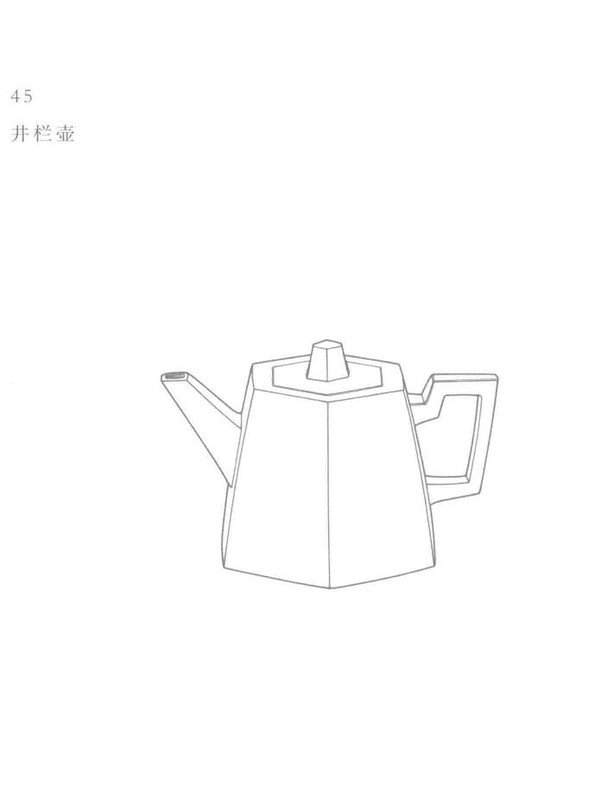
详细描述 Description
中文 Chinese
化
神
井栏 ,水井上方的于栏,《释例 》上日 :“以本为框,周臣于并 ,防人之
陷也 。其用与垣同, 其质则木而非土 。 ”' 井栏与人们的生活息息相关,是紫
砂造型艺术的素材来源之一 。清星期 ,陈曼生以他生活的溧阳风貌物产为创
作旨趣 ,与杨彭年合作创作“并栏过”。
顾景舟共创作“六方井栏水平索”“、“高井栏索”、“铸井栏过”三种式样 。
“六方井栏水平索”创作于 20 世纪 60 年代, 壶以纯净紫泥为胎, 色泽温
润古雅 。 取形六方形井栏 ,呈下大上小的斜坡状,高度仅为 54 毫米,壶
整有力度,线条清晰规整 ,块面弧度过渡自然 ,壶体小巧玲珑 ; 平艇盖与过
身融为一体 ,密合且通转无得,钮取索身造型 ,统一协调 ,四方直流呈向上
收敛式 ,四方折角轰的上部作转折处理 。此壶小巧玲珑,是把玩怡情的佳品 。
1了丁福保编 ;《说文解字庆林 ( 第六册 )》 北京 : 中华书局 ,1988 年版, 第 2348 页
English
# Transformation and Spirit
## Well Curb
A well curb is the protective railing above a water well. The *Shili* states: "Using wood as a frame, surrounding the well, to prevent people from falling in. Its function is the same as a wall, but its material is wood rather than earth."[1] The well curb is closely connected to people's daily lives and serves as one of the sources of inspiration for Yixing pottery art. During the Qing period, Chen Mansheng, drawing creative inspiration from the local scenery and products of Liyang where he lived, collaborated with Yang Pengnian to create the "Well Curb Teapot."
Gu Jingzhou created three variations: the "Hexagonal Well Curb Water Level Teapot," the "Tall Well Curb Teapot," and the "Cast Well Curb Teapot."
The "Hexagonal Well Curb Water Level Teapot" was created in the 1960s. The pot is made from pure purple clay, with a warm and elegantly aged color. Taking the form of a hexagonal well curb, it presents a sloping shape that is larger at the bottom and smaller at the top, with a height of only 54 millimeters. The pot body is powerful and vigorous, with clear and orderly lines, naturally transitioning curved surfaces, and a delicate, exquisite small form. The flat lid integrates seamlessly with the pot body, fitting tightly and rotating smoothly without obstruction. The knob takes the form of a rope body, creating unity and harmony. The square spout converges upward, and the upper portion of the square angled handle is treated with a turning transition. This pot is small and exquisite, an excellent piece for appreciation and enjoyment.
---
[1] Ding Fubao, ed., *Shuowen Jiezi Gulin (Volume 6)* (Beijing: Zhonghua Book Company, 1988), p. 2348.