寿星壶
Shòuxīng Hú
Pages 269-270
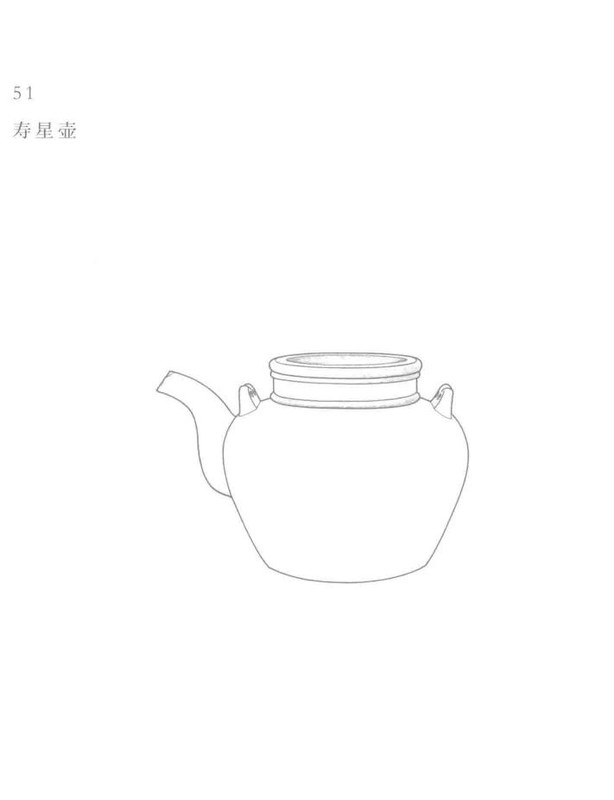
详细描述 Description
中文 Chinese
“寿星壶”是紫砂行货的经典造型 ,流行于北方农村市场,由于体型较
大、物美价廉,, 是农村人田间地头的日用器严, 根据大小,寿星过可分为海
寿星 、放寿星 、中寿星 、小寿星 。“文革 ”时期 ,因避“四旧”,“寿星壶”
曾更名为“圆形壶 ”。
“寿星壹”虽为农村下地干活时携带的水具 ,是大路货 ,但顾景舟认为
制作“寿星壶”并不简单 ,不但要有完美的造型 ,而且也考验制作者的技
艺水平 :
不要小看“寿星壹”,认为它是低俗的粗货 ,农家使用而已 。其
实由于做工的不同 ,既可以做成普通的实用塌,也可以做成一件了不
起的艺术品 ,因为它本身造型很美 。如果做工精致的话 ,整个泥条 、
泥片不会浪费一块 ,可以做得非常完美 。所有制壶的基本功都能通过
“寿星过”体现出来 。
中景舟做的“寿星壶”,端庄俊秀 ,直口展边 ,盘式压盖 ,肩部挺括 ,
极具气度,腹部渐收 , 二索流出水流畅 , 造型简洁敦朴 ,弥足珍
1 史俊棠主编 :《紫砂研究 ( 第二辑 )》 上海 : 上海古籍出版社 ,2007 年 12 月版,第 189 页
化
神
黄冰人
English
# The Shouxing Teapot
The "Shouxing pot" is a classic form among mass-produced Yixing wares, popular in northern rural markets. Due to its relatively large size and excellent quality at affordable prices, it served as an everyday vessel for rural people working in the fields. According to size, Shouxing pots can be divided into: extra-large Shouxing, large Shouxing, medium Shouxing, and small Shouxing. During the "Cultural Revolution" period, to avoid association with the "Four Olds," the "Shouxing pot" was renamed the "Round pot."
Although the "Shouxing pot" was a water vessel carried by rural workers to the fields—a common commodity—Gu Jingzhou believed that making a "Shouxing pot" was far from simple. Not only must it have perfect form, but it also tests the maker's technical skill:
> Do not underestimate the "Shouxing pot" or regard it as vulgar, coarse goods merely for peasant use. In fact, depending on the quality of workmanship, it can be made either as an ordinary practical pot or as a remarkable work of art, because its form itself is very beautiful. If crafted with refinement, not a single clay coil or slab need be wasted, and it can be made absolutely perfect. All the fundamental skills of pot-making can be demonstrated through the "Shouxing pot."[1]
The "Shouxing pot" made by Gu Jingzhou is dignified and handsome, with a straight mouth and flared rim, disc-style fitted lid, and well-defined shoulders that convey great bearing. The body gradually tapers, the two-bend spout pours smoothly, and the form is simple and honest—truly precious.
---
[1] Shi Juntang, ed., *Zisha Research (Volume 2)* (Shanghai: Shanghai Guji Publishing House, December 2007), p. 189.