硬扁壶
Yìng Biǎn Hú
Pages 323-324
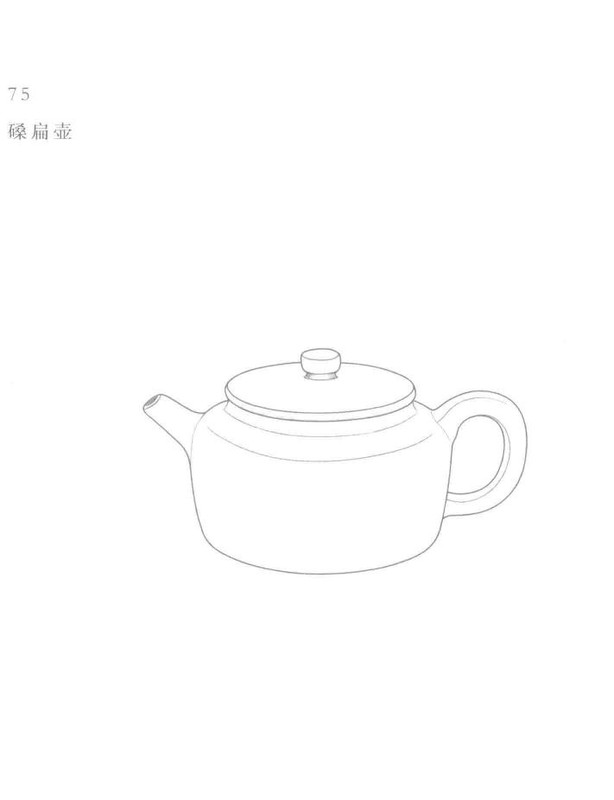
详细描述 Description
中文 Chinese
化
神
傈石 ,即柱础,地基上面安放柱子的石役,在中国传统砖木结构建筑
中用以负荷和防潮,对防止建筑物塌隐有着不可蔡代的作用 。宋李诚《营造
法式 》第三卷记载 :“柱础,其名有六,一目础,三日硕 ,三昌秃 ,四日跨 ,
五日碱,, 六日便,今谓之石古。”傈石有鼓型 、瓜型 、花瓶型 、宫灯型 、六
锤型 、须弥座型等多种式样
“古遍过”为顾景舟晚期作品 ,身简模仿鼓型碌石造型 ,肩周径略宽于
底部,身简略呈斜直状向底部收敛,故在视觉上凸显了壶肩的张力。颈 、流
均为直式,力道十足 。盖的造型别具一格,在平盖的基础上略微向上凸起 ,
使整个过的重心略微上移,增加了造型的均衔感,同时 ,盖微微凸起使得整
个过有一种充气感, 饱满有气度 。
“硬扁过”整体呈现硬朗质朴的特征 ,仅做一件 ,可见是顾景舟精雕细
琢的大看之作 。
English
# Transformation and Spirit
A column base, also known as a plinth stone, is a stone block placed on the foundation to support columns. In traditional Chinese brick-and-wood architecture, it serves to bear loads and prevent moisture, playing an irreplaceable role in preventing building collapse. The third volume of Li Jie's *Yingzao Fashi* (Treatise on Architectural Methods) from the Song Dynasty records: "Column bases have six names: first called chu, second called shuo, third called tu, fourth called kua, fifth called jian, sixth called bian; today they are called stone drums." Column bases come in many styles including drum-shaped, melon-shaped, vase-shaped, palace lantern-shaped, hexagonal, and sumeru pedestal types.
The "Drum-Shaped Teapot" is a late-period work by Gu Jingzhou. The body imitates the form of a drum-shaped column base, with the shoulder circumference slightly wider than the base. The body tapers slightly and straightens as it converges toward the bottom, thus visually emphasizing the tension of the pot's shoulder. Both the neck and spout are straight in style, full of strength. The lid design is distinctive—based on a flat lid but slightly raised upward, causing the entire pot's center of gravity to shift slightly upward, increasing the sense of balance in the form. At the same time, the slightly raised lid gives the entire pot a sense of being inflated, full and dignified.
The "Hard Flat Teapot" presents an overall characteristic of hardness and simplicity. Only one piece was made, demonstrating that this is a masterwork meticulously crafted by Gu Jingzhou.