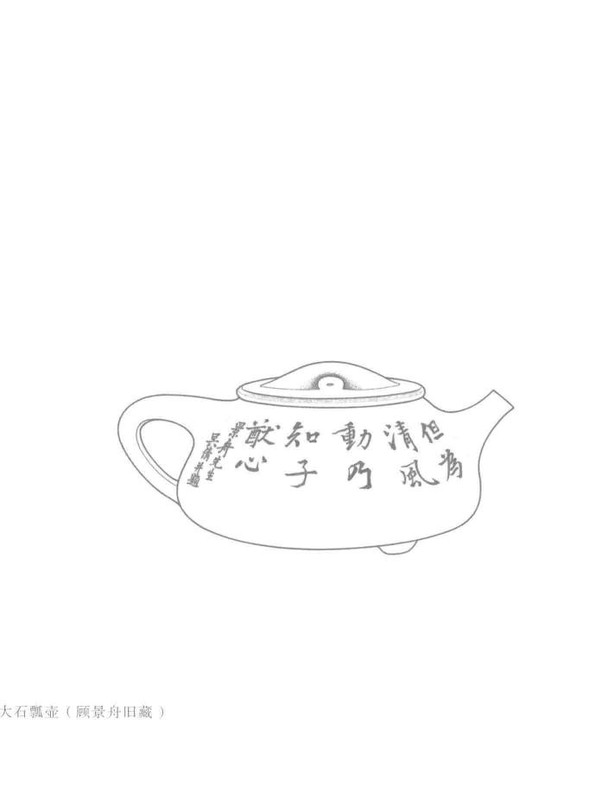
大石瓢壶
Dà Shí Piáo Hú
Pages 141-142
详细描述 Description
中文 Chinese
为吴湖帆画竹一众。“笔伟青欲滴 ,枝枝绿生凉”, 背面诗文亦为前贤咏竹
之作。 最有意思的是属于顾景舟的那把,上刻“但为清风动,旋知子餐心”,
语出唐朝诗人李成用《题友生丛竹 》一诗中的两句 。原诗为“何妨积雪凌 ,
但为清风动 . 万知子责心,不与常人共”,吴湖帆截取上下各一句, 重新组
合, 妙笔天成,意境更佳 。诗中的“子贞 ”是指晋朝大书家王义之之子王
徽之,王微之字子贞, 生性爱竹-《世说新语 》谓 :“王子责党暂寄人空宅
住,便令种竹。 或问 : 暂住何烦尔”王啸屿良久 ,直指竹月 :“何可一日无
此君?“”子餐爱人竹像他的父亲闵之爱忽一样 ,史称绝唱 。
而这里的“子责”又有何指呢? 我们推测吴湖帆寅紫砂为作,把景舟
比作子贞 ,暗赞胸脐玻朗的顾景舟视砂艺为毕生追求的高远志向 ; 同时吴湖
帆可能也是拟把顾景舟比作高洁不届的雅竹,自己似子贞 ,通过和顾景舟的
交往 ,通过顾景舟的砂壶 , 他已把这位艺高品重的年轻人视为自己一生的的
友, 真是“人生交站, 唯知音者聚"。
“大石味壳”的制作者 、书画者 、受赠者均有明确定论 , 但这些壶的外
刻者究竟是堆,却有着不同的看法 。戴佐民是这样描述的 :“画成,仍由戴
相明交货船带送顾家 ,顾景舟锥刻自己的一把, 余四把请其表弟陶刻好手谈
党坤久刻 。 ”也有紫砂艺人认为当属谈惑坤所为 ,其理由非常简单 ,也就是
说顾景舟时年正轻 ,而谈尧坤已在紫砂锥刻上小有心得, 加之二人亲属关系
( 谈是顾的表弟 )、 如此拉易之作 . 定邀力者为之, 非谈莫届 。
1991 年 ,顾景舟在《溯源话艺 谈文人及书画界与砂艺的结合 》一
文中,有这样的表述 :
[|
English
# Wu Hufan's Bamboo Painting Series
"The brush is magnificent, green dripping with vitality, branch by branch generating cool shade." The poetry on the reverse side also consists of works by earlier masters praising bamboo. The most interesting piece is the one belonging to Gu Jingzhou, inscribed with "But moved by the pure breeze, thus knowing Zizhen's heart," lines taken from the Tang Dynasty poet Li Chengyong's poem *Inscribed on a Friend's Bamboo Grove*. The original poem reads: "What harm if snow accumulates and oppresses, but moved by the pure breeze. Knowing Zizhen's heart, not shared with common people." Wu Hufan extracted one line each from the beginning and end, recombining them—a stroke of genius that created an even better artistic conception. The "Zizhen" in the poem refers to Wang Huizhi, son of the great Jin Dynasty calligrapher Wang Xizhi. Wang Huizhi's courtesy name was Zizhen, and he was by nature a lover of bamboo. *A New Account of the Tales of the World* records: "Wang Zizhen once temporarily stayed in someone's empty residence and immediately ordered bamboo to be planted. Someone asked: 'For a temporary stay, why bother?' Wang whistled for a long while, then pointed directly at the bamboo and said: 'How can one go a single day without this gentleman?'" Zizhen's love for bamboo was like his father Xizhi's love for geese—both are celebrated as legendary tales in history.
But what does "Zizhen" refer to here? We speculate that Wu Hufan, in commissioning Yixing pottery, compared Jingzhou to Zizhen, subtly praising Gu Jingzhou's open and upright character and his lofty aspiration of pursuing the art of clay as a lifelong pursuit. At the same time, Wu Hufan may also have been comparing Gu Jingzhou to noble and unbending elegant bamboo, while seeing himself as Zizhen. Through his interactions with Gu Jingzhou, through Gu Jingzhou's clay teapots, he had come to regard this young man of high artistry and noble character as a lifelong friend. Truly, "in the friendships of life, only kindred spirits gather."
The maker, painter, and recipients of the "Great Stone Ladle" teapots are all clearly established, but there are different views on who actually carved the inscriptions on these pots. Dai Zuomin described it this way: "After the painting was completed, Dai Xiangming again entrusted the cargo boat to deliver them to the Gu household. Gu Jingzhou carved his own pot himself, while the remaining four were carved by his cousin Tan Yaokun, a skilled hand at pottery carving." Some Yixing pottery artisans believe it was the work of Tan Yaokun, their reasoning being quite simple: Gu Jingzhou was still young at the time, while Tan Yaokun had already achieved some accomplishment in Yixing pottery carving. Combined with their family relationship (Tan was Gu's cousin), for such a straightforward task, one would naturally invite the capable person to do it—none other than Tan would be suitable.
In 1991, in his essay *Tracing Origins and Discussing Art: On the Integration of Literati and Painting Circles with the Art of Clay*, Gu Jingzhou made the following statement:
[The text appears to end here with an incomplete sentence]