木瓜壶
Mùguā Hú
Pages 153-154
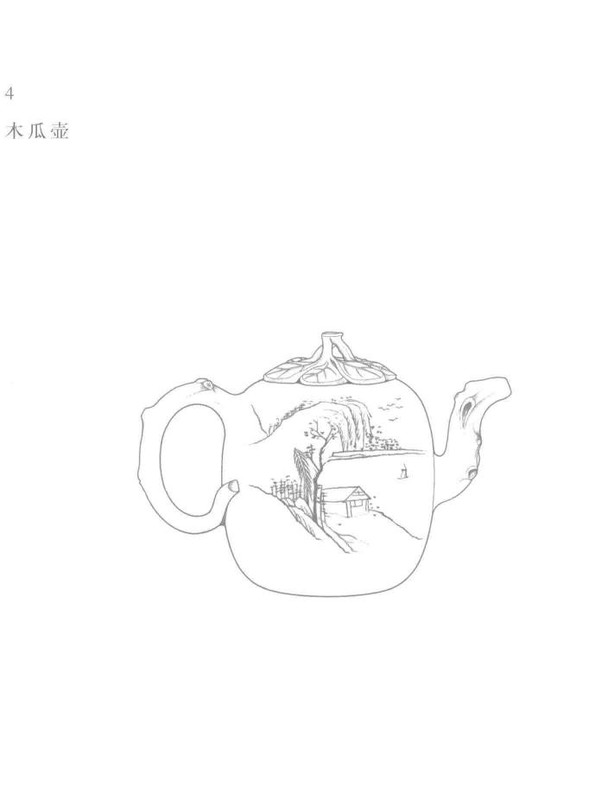
详细描述 Description
中文 Chinese
化
神
木瓜在中国传统文化中属吉祥物 ,题材取自《诗经》:“投我以木瓜 ,
报之以芒据 。 ”隐喻饮水思源 ,知恩善报 .“木瓜索”,民国时期流行款式 ,
“木瓜壶”以瓜为体 , 时为盖 ,蔷为流 、扫,巧妙有度 , 展现田园刁适静说
的氛于 。
顾景舟的“木瓜壶”身简比前人作品骨架略微放高 ,更具亭匀雅致 ,
柔中带刚 。壶嘴则折作疤节状, 布局合理 ; 壶轰 、壶盖上枝叶攀生,叶葵 、
叶脉点组巧妙,透发幽静与含蓄的自然美 ,索身只贴一叶, 简约生动 。
四
九
English
# Transformation of Spirit
In traditional Chinese culture, the wood apple (*mugua*) is considered an auspicious object. The motif derives from the *Book of Songs* (*Shijing*): "You cast me a wood apple, and I repay you with jade." This metaphorically expresses drinking water while remembering its source, and knowing how to repay kindness with gratitude. The "Wood Apple Teapot" was a popular style during the Republican period. The "Wood Apple Teapot" takes the melon as its body, the calyx as its lid, and the vine as its spout and handle—ingeniously proportioned and measured, displaying the tranquil and leisurely atmosphere of pastoral life.
Gu Jingzhou's "Wood Apple Teapot" has a body structure slightly taller than works by his predecessors, making it more upright, elegant, and refined—soft yet with an underlying strength. The spout is bent into a gnarled joint shape with rational composition. Branches and leaves climb over the handle and lid, with leaf veins and textures skillfully dotted and arranged, emanating a quiet and subtle natural beauty. Only a single leaf is attached to the body of the teapot—simple yet vivid.