技法
Techniques
0 / 15 cards mastered (0%)
Summary 概要
本课讲解紫砂壶制作中的工具创新、不同品种的技术结构处理、盖的种类与处理方法,以及梨形壶的成型步骤。强调工艺处理要合理,不能死搬硬套,要在关键处用力。
This lesson covers tool innovation in Yixing teapot production, technical structure treatment for different varieties, types and processing methods of lids, and forming steps for pear-shaped teapots. It emphasizes that craft processing must be reasonable, not mechanically applied, and that skill must be applied at critical points.
Key Concepts 关键概念
- Creative tool-making for detail work
- Lid types and structures (domed, flat, single-mouth, bald-mouth)
- False bottom construction techniques
- Flange and stepped interior treatments
- Domed lid slab attachment methods
- Pear-shaped vessel body forming
- Balancing innovation with production rationality
[Page 560]
=== Page 560 - Chinese ===
蕉器六六
[
第五课 技法 1981.12.23
一、一些加工处理细部的工具,要有创造性的制作 :
我们的生产工具不是一成不变的 ,央为我们的产品比较多,造型也不
相同 相应的工具要求也不同,要做好生活 ,就要会做工具 。会做处理细部
的工具, 这就需要每个人开动脑筋,使做出来的工具在使用时既省工、效果
又好。
二、关于不同品种的技术结构及处理 :
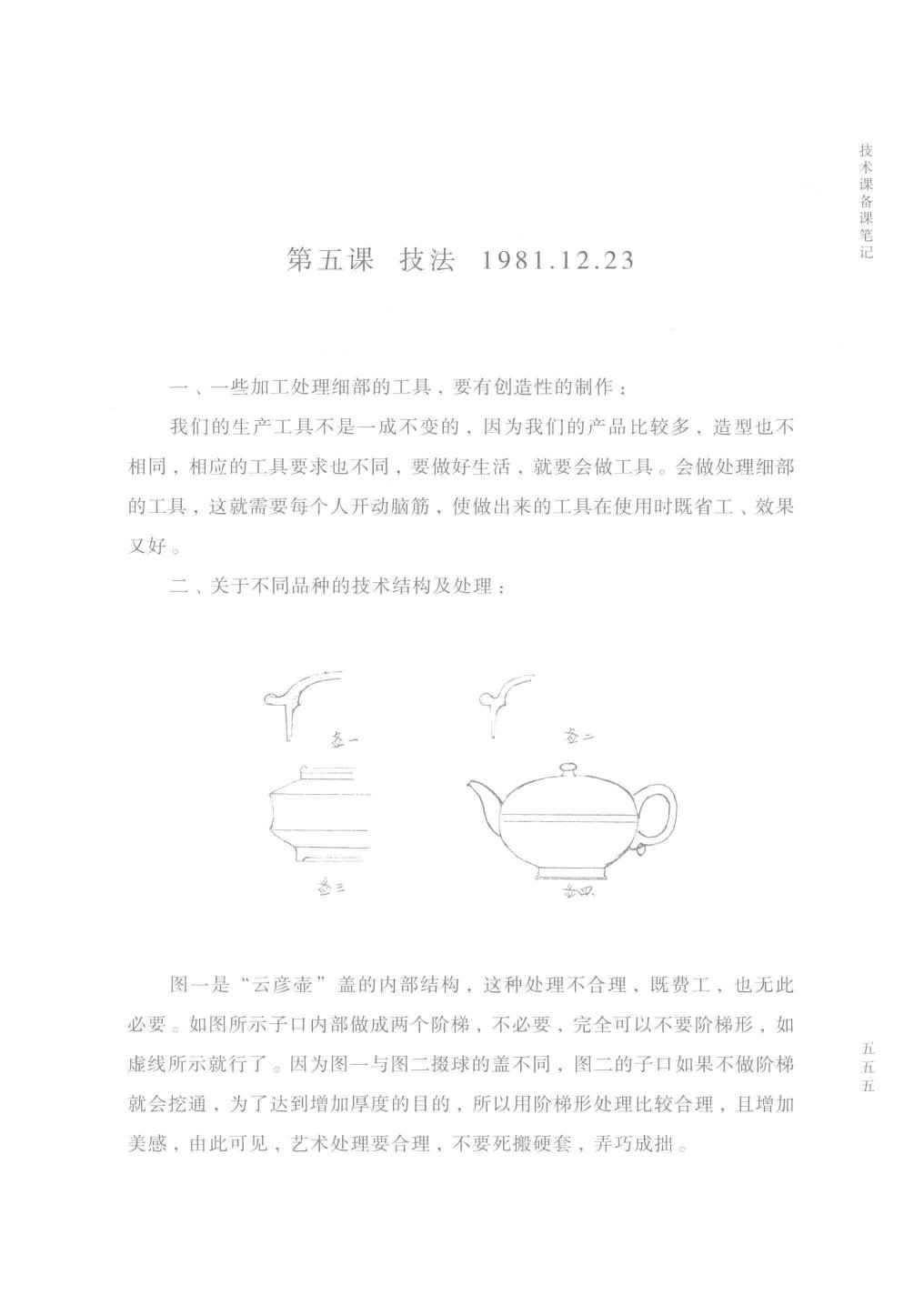
图一是“云彦考”盖的内部结构 ,这种处理不合理 ,既费工 ,也无此
必要 - 如图所示子口内部做成两个阶梯,不必要,完全可以不要阶梯形 ,如
虚线所示就行了 。因为图一与图二手球的盖不同 ,岁二的子口如果不做阶梯
就会挖通,为了达到增加厚度的目的,所以用阶梯形处理比较合理 ,且增加
美感,由此可见,艺术处理要合理,不要死搬硬套 , 弄巧成拙 。
[Page 561]
=== Page 561 - Chinese ===
对喜求洛
五
五
图三“汉平坦”的很底较高 ,现在采用模型提出来的处理手段不合理 ,
一顽泥片要挤出这么高的假底肯定片子要玲通,没有办法只好硬填委泥,何
不挤一层薄一点的假底,然后加上-一块薄片,覆一点滋泥,这样既省工又规
矩 ,效果较好 ,高假底的产品宁可加片子 、不要靠据册来 。
满 一一瞒的种类及区别 、处理 :
瞒有虚瞒、平眶 、单口瞒 、秃口瞒 。虚满是旺弧型的满 ,用产只或者
虚索处理成型,平满是我们一般所见的平正的满 ,秃口满是根据造型无需大
只而只上一块瞒片的,大口满片要比一般的满片厚一些 ,否则口太薄,上且容
易断裂。
图四是“铀盒老",此过的满片是双满片 ,在生产时要先做好合乎要求
4虚索和疡只 .“铅盒”虚满片的半径一定要比盖的半径大 1.5 毫米,二满
的半径比大满的半径小 3 毫米 ,在同满片时 ,先把两块满虚好 ,然后放在呀
只里用滋泥粘接起来,在粘接前 ,要在两块满片的中间放一块小于开口尺寸
薄纸片,起到间隔作用 .利于开盖虚片 。一块虚片的正确与否与虚坨的关
系极大 ,虚索不宜太小,更不可小于虚片,而只能比虚片略为大一线, 虚坨
4顶部宜略平一些
举例“信形户线”的打身简 、上虚广步又;
(1) 竖身简;(2) 收底:;(3) 打上脱(上半部位 )。
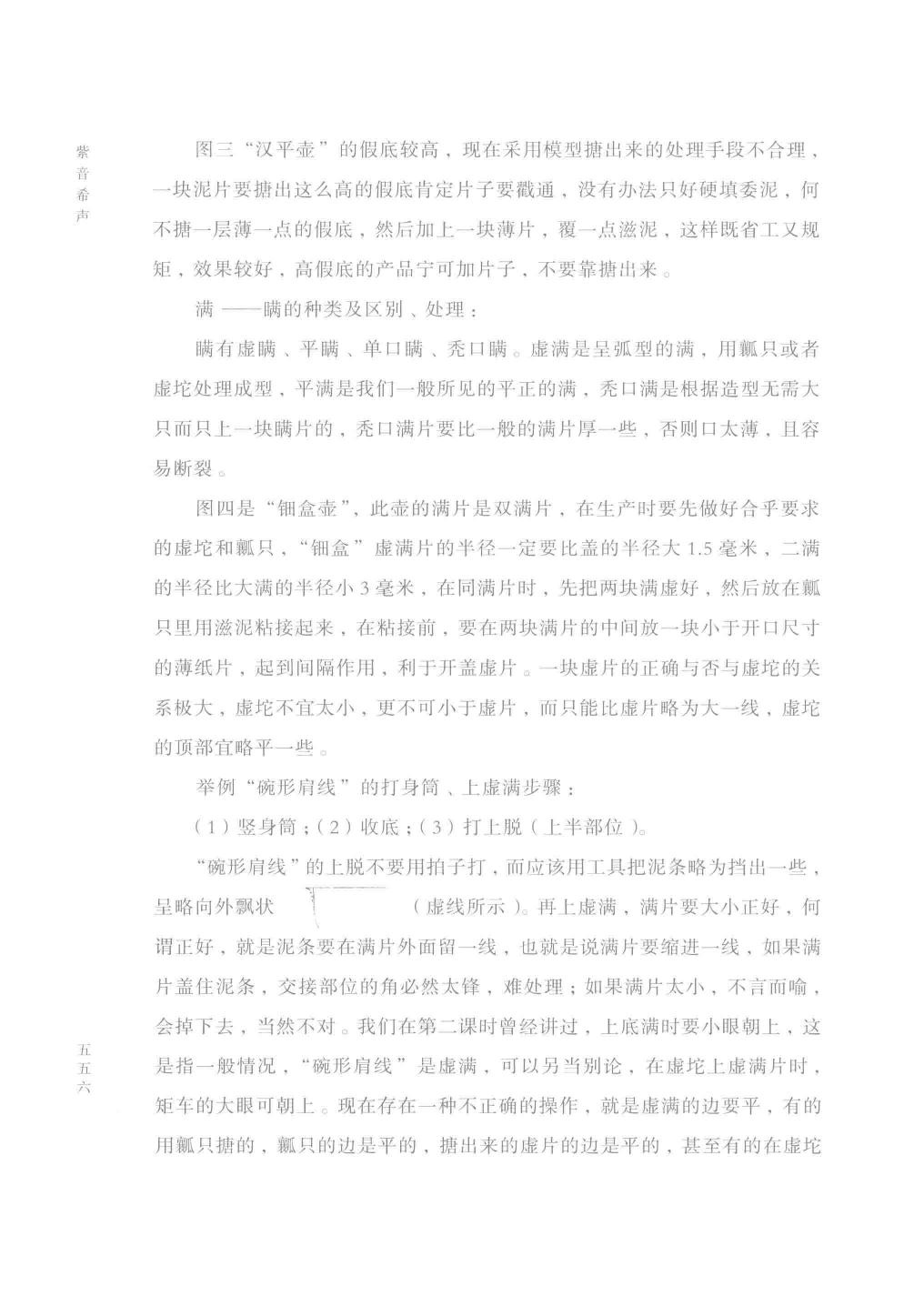
“太形户线” 的上脱不要用折子打, 而应该用工具把泥条略为挡出一些 ,
旺略向外飘状 “| (看线所示 ) 再上虚满,满片要大小正好,向
谓正好 ,就是泥条要在满片外面留一线 ,也就是说满片要缩进一线 如果汪
片盖住泥条 ,交接部位的角必然太锋 ,难处理 ; 如果满片太小,不言而喻,
会掩下去 ,当然不对 , 我们在第二课时曾经讲过 ,上底满时要小眼朝上 , 这
是指一般情况 ,“硫形户线”是虚满 ,可以另当别论 .在虚培上虚满片时 ,
矩车的大眼可朝上 。现在存在一种不正确的操作 ,就是虚满的边要平 ,有的
用半只擅的,邓只的边是平的,扩出来的虚片的边是平的,甚至有的在虚坨
[Page 562]
=== Page 562 - Chinese ===
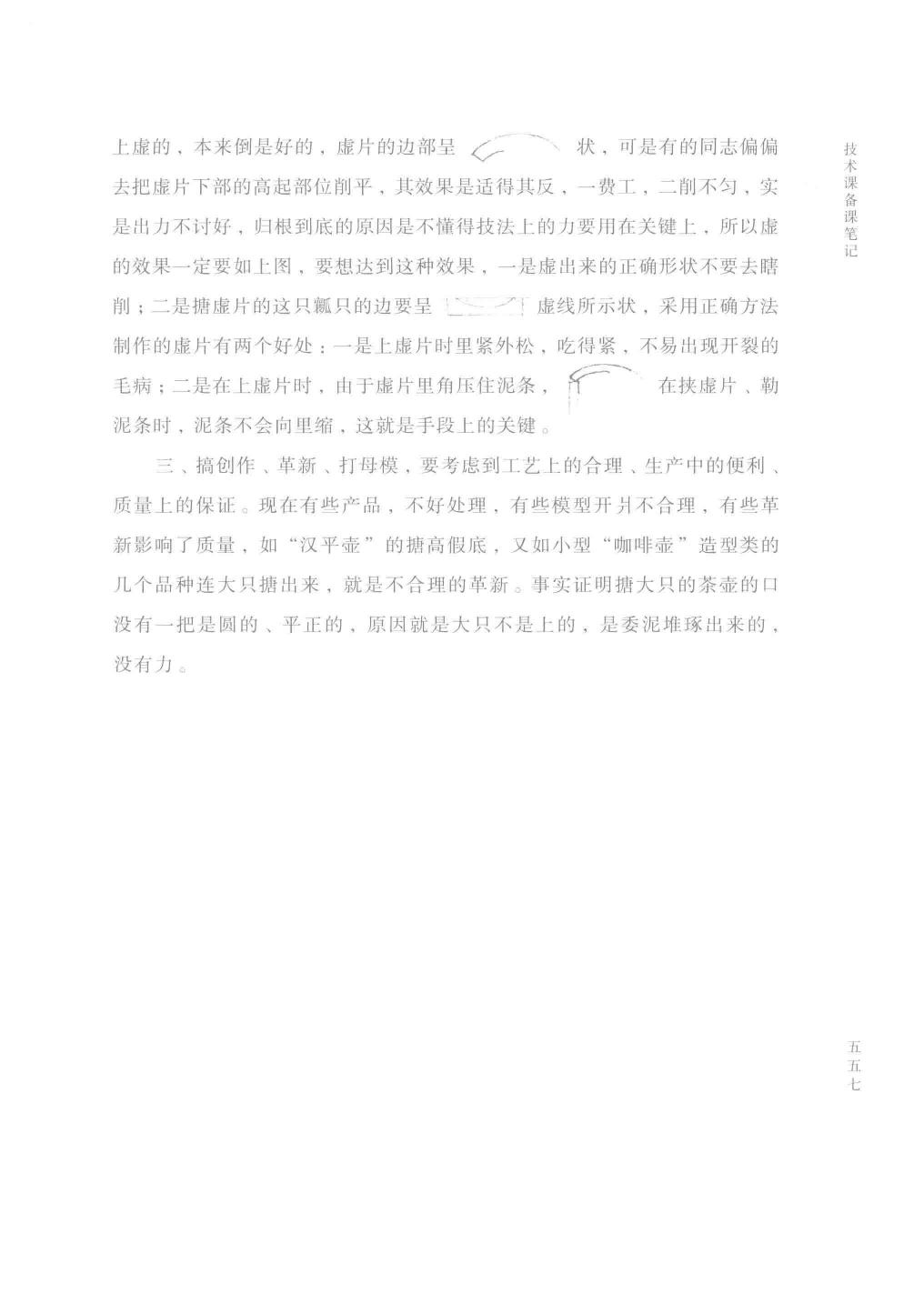
上虚的,本来倒是好的,虚片的边部呈 <一 一、 状, 可是有的同志偏偏
去把虚片下部的高起部位削平 ,其效果是适得其反,一费工,二削不义,实
是出力不讨寻 ,归根到底的原因是不懂得技法上的力要用在关键上 ,所以虚
的效果一定要如上图 , 要想达到这种效果,一是虚出来的正确形状不要去腾
削 ; 二是挤虚片的这只普只的边要呈
制作的虚片有两个好处 : 一是上虚片时里紧外松 ,
毛病 ; 二是在上虚片时,由于虚片里角压住泥条 ,
泥条时 ,泥条不会向里缩 ,这
就是手段上的关键 。
、搞创作、革新、打母模,要考虑到工艺上的合
质量上的保证 。 现在有些产品 ,
新影响了质量 ,如“汉平索”
几个品种连大只扩出来 ,就是不合理的革新 。 事实证
没有一把是圆的、平正的 ,
没有力 。
一 虚线所示状,采用正确方法
吃得紧 ,不易出现开虱的
全 在挟虚片、币
、生产中的便利 、
不好处理 ,有些模型开阁不合理 ,有些革
的提高假底 ,又如小型“咖啡霉 ”造型类的
原因就是大只不是上的 ,
明扩大只的茶壶的口
是委泥堆琢出来的,
下由光或弱沪尝
[Page 560]
# Yixing Pottery Lesson 66
## Lesson Five: Techniques, December 23, 1981
### I. Tools for Processing and Handling Details Must Be Made Creatively:
Our production tools are not fixed and unchanging. Because our products are quite varied and their forms differ, the corresponding tool requirements also differ. To do good work, one must know how to make tools. Knowing how to make tools for handling details requires everyone to use their minds, so that the tools made are both labor-saving and effective when used.
### II. Regarding the Technical Structure and Treatment of Different Varieties:
Figure 1 shows the internal structure of the "Yunyankao" lid. This treatment is unreasonable—it wastes labor and is unnecessary. As shown in the diagram, the interior of the flange is made with two steps, which is unnecessary. It can be done entirely without the stepped form, as shown by the dotted line. This is because Figure 1 differs from the teapot lid in Figure 2. If the flange in Figure 2 were not made with steps, it would be carved through. In order to achieve the purpose of increasing thickness, using a stepped treatment is more reasonable and also adds aesthetic appeal. From this we can see that artistic treatment must be reasonable. One should not mechanically copy and apply methods rigidly, which would be self-defeating through excessive cleverness.
[Page 561]
# On the Pursuit of Excellence in Yixing Pottery
## Section Five
In Figure 3, the false bottom of the "Han Pingtan" is quite high. The current processing method proposed by the model is unreasonable. To press out such a high false bottom from a single clay slab would certainly make the piece too thin, leaving no choice but to forcefully fill it with slip clay. Why not press a thinner false bottom first, then add a thin slab and apply some slip clay? This approach is both labor-saving and more regular, with better results. For products with high false bottoms, it is preferable to add slabs rather than rely on pressing.
## Lids — Types, Distinctions, and Processing
There are several types of lids: domed lids, flat lids, single-mouth lids, and bald-mouth lids. A domed lid is arc-shaped, formed using a mold or a doming tool. A flat lid is the commonly seen flat, level lid. A bald-mouth lid is one where, according to the design, no large mold is needed and only a lid slab is applied. The slab for a large-mouth lid should be thicker than that of a regular lid; otherwise, if the mouth is too thin, it will easily crack when the lid is applied.
Figure 4 shows the "Lead Box Elder." The lid slab for this piece is a double lid slab. During production, one must first prepare doming tools and molds that meet the requirements. For the "Lead Box," the radius of the domed lid slab must be 1.5 millimeters larger than the radius of the lid. The radius of the second lid should be 3 millimeters smaller than that of the large lid. When joining the lid slabs, first dome both slabs, then place them in the mold and bond them together with slip clay. Before bonding, place a thin piece of paper smaller than the opening size between the two lid slabs to serve as a spacer and facilitate the separation of the domed slabs. The correctness of a domed slab is greatly related to the doming tool. The doming tool should not be too small—it certainly cannot be smaller than the domed slab—but should only be slightly larger than the slab by a thin line. The top of the doming tool should be somewhat flat.
## Example: Steps for Forming the Body and Applying the Domed Lid of the "Pear-Shaped Household Ware"
(1) Form the vertical body; (2) Close the bottom; (3) Apply the upper section (upper half portion).
For the upper section of the "Pear-Shaped Household Ware," do not use a rib tool to beat it. Instead, use a tool to slightly push out the clay coil, making it slightly flare outward (as shown by the line), then apply the domed lid. The lid slab should be exactly the right size. By "exactly right," it means the clay coil should extend beyond the lid slab by a thin line—in other words, the lid slab should be recessed by a thin line. If the lid slab covers the clay coil, the angle at the joint will inevitably be too sharp and difficult to handle. If the lid slab is too small, it goes without saying that it will sink in, which is obviously incorrect. As we mentioned in the second lesson, when applying a bottom lid, the small eye should face upward. This refers to the general situation. The "Pear-Shaped Household Ware" has a domed lid, which can be treated as an exception. When applying a lid slab to a doming tool, the large eye of the tool can face upward. There currently exists an incorrect operation, which is that the edge of the domed lid should be flat. Some use half-molds to press it, and since the edge of the mold is flat, the edge of the pressed domed slab is flat. Some even work on the doming tool...
[Page 562]
# Technical Considerations in Yixing Pottery Production
The upper rim attachment, when done properly, is actually quite good. The edge of the rim piece naturally forms a ︿ shape. However, some colleagues insist on filing down the raised portion at the bottom of the rim piece. This approach is counterproductive: first, it wastes effort; second, the filing is unnecessary. It's truly thankless work. The fundamental reason is a lack of understanding that technical skill must be applied at critical points. Therefore, the rim effect must be as shown in the diagram above. To achieve this effect: first, do not file away the correct shape that naturally forms on the rim piece; second, the edge of the tool used to press the rim piece should be shaped as indicated by the dotted line.
Using the correct method to produce rim pieces has two advantages: first, when attaching the rim piece, it's tight on the inside and loose on the outside, making it less prone to cracking; second, when attaching the rim piece, because the inner corner of the rim piece presses down on the clay coil, when you press the clay coil, it won't shrink inward. This is the key technical point.
When engaging in creative work, innovation, or making master molds, one must consider the rationality of the production process and quality assurance. Currently, some products suffer from quality issues due to unreasonable innovations. For example, the raised false bottom of the "Han Ping" style, or the small "coffee pot" shaped varieties—expanding these to larger sizes is an unreasonable innovation. Facts have proven that not a single one of the large-sized teapots produced this way is round or properly level. The reason is that large sizes cannot be attached this way; they are built up by piling clay, which lacks structural integrity.
The spout opening is weak or has insufficient flow...