Chapter 10
附录
Appendix
560
of 659
English Translation
## Lesson Five: Techniques, December 23, 1981
### I. Tools for Processing and Handling Details Must Be Made Creatively:
Our production tools are not fixed and unchanging. Because our products are quite varied and their forms differ, the corresponding tool requirements also differ. To do good work, one must know how to make tools. Knowing how to make tools for handling details requires everyone to use their minds, so that the tools made are both labor-saving and effective when used.
### II. Regarding the Technical Structure and Treatment of Different Varieties:
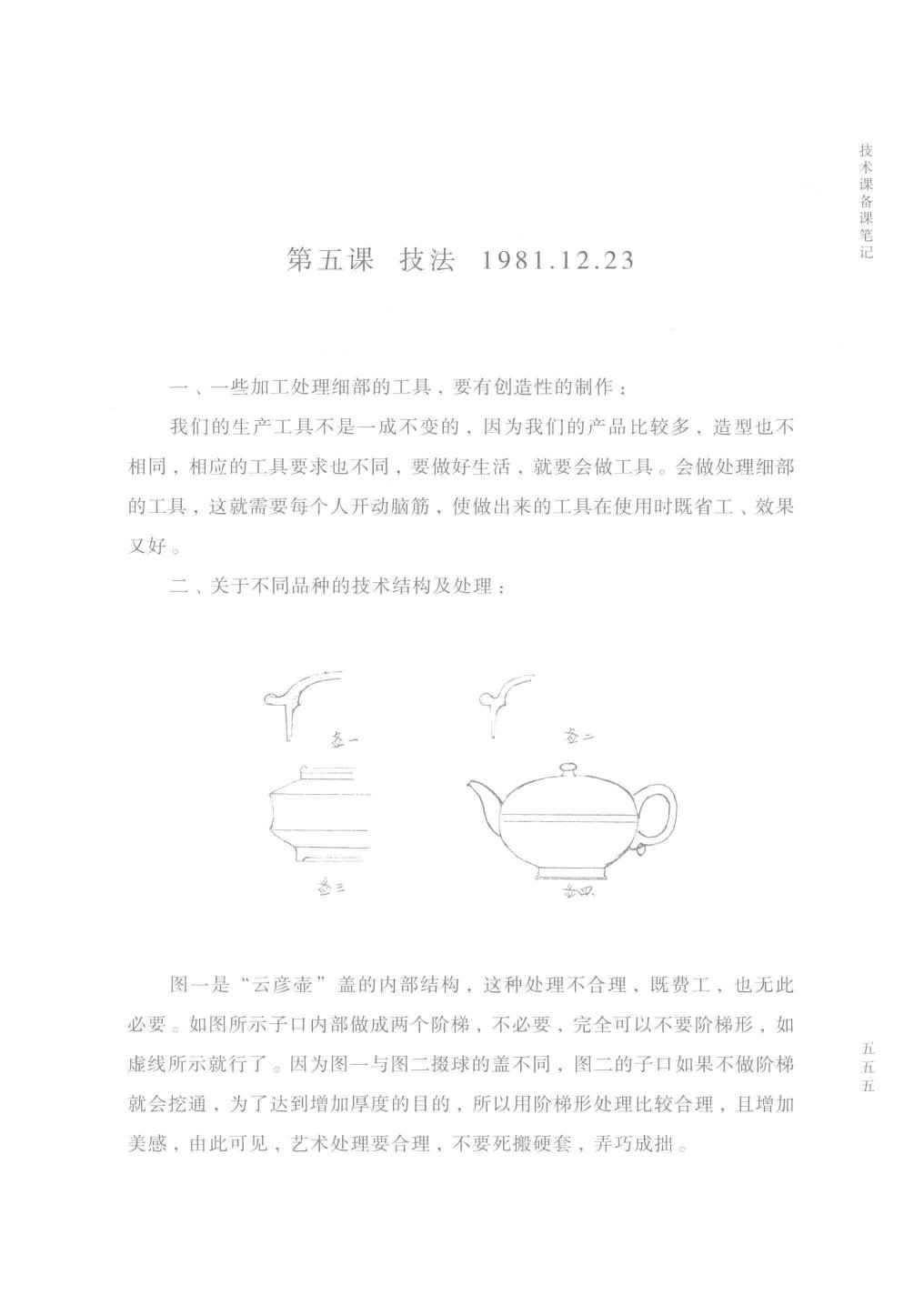
Figure 1 shows the internal structure of the "Yunyankao" lid. This treatment is unreasonable—it wastes labor and is unnecessary. As shown in the diagram, the interior of the flange is made with two steps, which is unnecessary. It can be done entirely without the stepped form, as shown by the dotted line. This is because Figure 1 differs from the teapot lid in Figure 2. If the flange in Figure 2 were not made with steps, it would be carved through. In order to achieve the purpose of increasing thickness, using a stepped treatment is more reasonable and also adds aesthetic appeal. From this we can see that artistic treatment must be reasonable. One should not mechanically copy and apply methods rigidly, which would be self-defeating through excessive cleverness.
Chapter 10
附录
Appendix
Pages 526-651
View Chapter →
English Translation
## Lesson Five: Techniques, December 23, 1981
### I. Tools for Processing and Handling Details Must Be Made Creatively:
Our production tools are not fixed and unchanging. Because our products are quite varied and their forms differ, the corresponding tool requirements also differ. To do good work, one must know how to make tools. Knowing how to make tools for handling details requires everyone to use their minds, so that the tools made are both labor-saving and effective when used.
### II. Regarding the Technical Structure and Treatment of Different Varieties:
Figure 1 shows the internal structure of the "Yunyankao" lid. This treatment is unreasonable—it wastes labor and is unnecessary. As shown in the diagram, the interior of the flange is made with two steps, which is unnecessary. It can be done entirely without the stepped form, as shown by the dotted line. This is because Figure 1 differs from the teapot lid in Figure 2. If the flange in Figure 2 were not made with steps, it would be carved through. In order to achieve the purpose of increasing thickness, using a stepped treatment is more reasonable and also adds aesthetic appeal. From this we can see that artistic treatment must be reasonable. One should not mechanically copy and apply methods rigidly, which would be self-defeating through excessive cleverness.
章节导航 Chapter Navigation
Chapter 1
序文
Pages 6-6
Chapter 2
引言
Pages 28-31
Chapter 3
达变
Pages 32-133
Chapter 3
开宗立派
Pages 46-66
Chapter 3
传道授业
Pages 67-98
Chapter 3
大师淳友
Pages 99-120
Chapter 3
学艺谋生
Pages 121-133
Chapter 4
化神
Pages 134-141
Chapter 5
独妙
Pages 142-405
Chapter 5
匠心独运 不苟丝毫
Pages 142-179
Chapter 5
器利善事 物尽其用
Pages 180-199
Chapter 5
紫泥春华 研精究微
Pages 200-405
Chapter 6
驾简
Pages 406-427
Chapter 6
精雕细刻 文质合一
Pages 406-410
Chapter 6
师法自然 妙趣横生
Pages 411-415
Chapter 6
丝来线去 曲尽其妙
Pages 416-427
Chapter 7
明志
Pages 463-485
Chapter 7
高山仰止 淡泊明志
Pages 463-472
Chapter 7
啜墨看茶 气定神闲
Pages 473-478
Chapter 7
齿少心锐 怡志抒情
Pages 479-485
Chapter 8
存真
Pages 428-462
Chapter 8
规圆矩方 弃伪存真
Pages 428-436
Chapter 8
有物有则 钻尖仰高
Pages 437-462
Chapter 9
心营
Pages 506-525
Chapter 9
坚守传统 艺立潮头
Pages 506-513
Chapter 9
新型师承 桃李满园
Pages 514-525
Chapter 10
附录
Pages 526-651
Chapter 10
顾景舟紫艺论文
Pages 526-535
Chapter 10
技术课备课笔记
Pages 536-543
Chapter 10
顾景舟艺术年表
Pages 544-651
Chapter 11
参考文献
Pages 652-657
Chapter 12
鸣谢
Pages 658-659