荷莲呈祥壶
Hé Lián Chéng Xiáng Hú
Pages 171-172
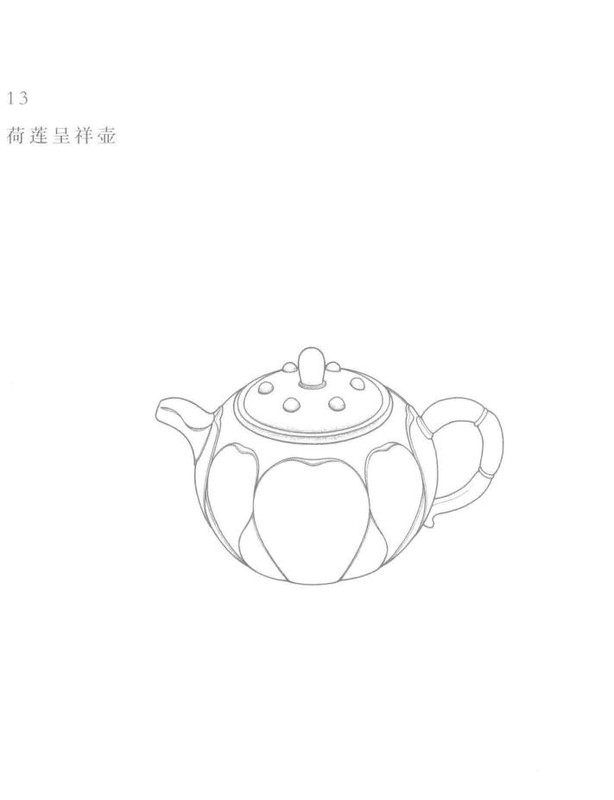
详细描述 Description
中文 Chinese
化
神
荷血 ,中国文化意象的重要表达方式 ,从《诗经 》“山有扶苏 、隐有和荷
华"`《楚酬》"制莹荷以为衣今 , 集美蓉以为党”,到周敦颐的《爱莲说 》,
莲的形象贯穿于中国几千年的文学 、艺术 、宗教作品之中 。
荷划也常用于紫砂造型艺术中 。 顾景舟的这款“荷莲呈祥考”,壶身关
绽放的荷花,盖似饱满的莲莲 ,的子周围内灸六粒莲子 ,灵动可爱 。权做夭
节状, 饱满挺括,一弯流由莲叶包庄,微风徐来,花枝旭婷 。
此壶曾在 1994年10月 16 日“金陵 "94 秋季书画陶网精品拍卖会”
相,创当时陶艺部分的最高成交价 。
训
阔1
ER
English
# Transformation of Spirit
The lotus is an important expressive motif in Chinese culture. From the *Book of Songs* ("On the mountain grows the fusang, in the marsh grows the lotus"), to the *Songs of Chu* ("I fashion lotus petals to make my garment, gather hibiscus to form my sash"), to Zhou Dunyi's *On the Love of Lotus*, the image of the lotus has permeated Chinese literature, art, and religious works for thousands of years.
Lotus motifs are also frequently employed in Yixing pottery art. This "Lotus Presenting Auspiciousness" teapot by Gu Jingzhou features a body shaped like a blooming lotus flower, with a lid resembling a plump lotus seedpod. Around the knob are six lotus seeds arranged in a circle, lively and endearing. The handle is fashioned like a lotus stem, full and upright. The spout curves forth, wrapped in a lotus leaf—as a gentle breeze arrives, the flower sways gracefully.
This teapot appeared at the "Jinling '94 Autumn Calligraphy, Painting, and Ceramics Auction" on October 16, 1994, achieving the highest transaction price in the ceramics section at that time.