合欢壶
Héhuān Hú
Pages 159-160
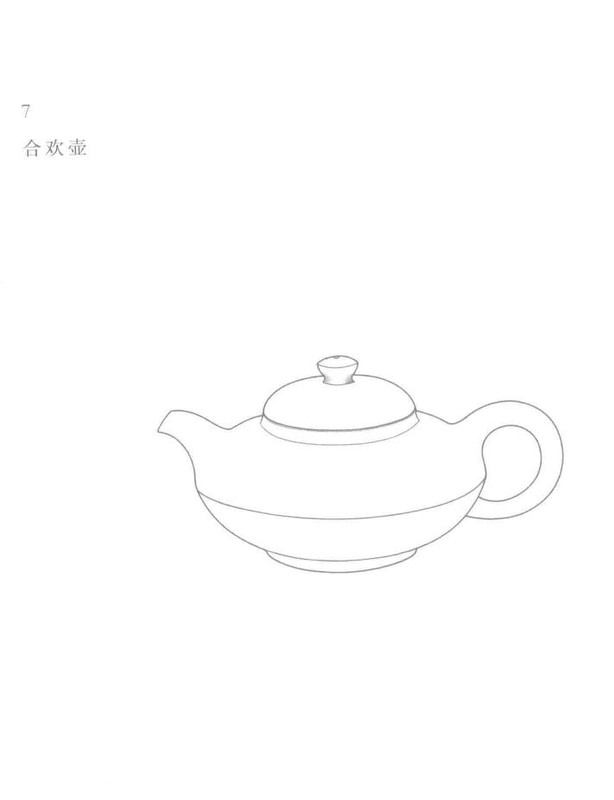
详细描述 Description
中文 Chinese
神
“合欢毒”为紫砂的传统造型 , 也成为“曼生十八式”的经典款式之一
通常,紫侯索是用“拍打身简法”来创作圆形器物 。 但“合欢考”的
制作 ,传统技法是用“和奋头”或“虚坨”等定型工具将泥片“虚”成碗状 ,
然后再上下相接合二为一,因此,身简中部的连接线也就成为此类索型的明
显特征。 用“合欢”命名,是上下两体成型技法的一种具意 。现代紫砂艺
人亦有不借助于“上图头”等工具而直接用手拍打成型 ,再两两相合 ,以凸
显手工的技艺 。虽然两种方法略有区别,, 但“合”这个拼接成形的关键过
程却一脉相承 。
顾景舟的“合欢壶”用传统技法制作 ,上下克状饱满而不腾肿, 线条
简洁精炼 。 流 、色与身简的衔接过渡自然,的子形状也处理成两圆交合状,
与盖、身简形成由小至大的三层台阶状弧线,气息通贯 , 生动雅致,展现了
顾景舟娴熟的功力和技法 , 以及他在莫制经典紫砂款型中的再创作 。
顾景舟早期曾制作过朱泥“小合欢壶 ”, 后期制作过紫泥大品
疼
朱泥小合欢过
English
# Hehuan Teapot
The "Hehuan teapot" is a traditional form in Yixing pottery, and has become one of the classic styles among the "Eighteen Mansheng Forms."
Typically, Yixing teapots are created using the "paddle and anvil body method" to form round vessels. However, the traditional technique for making the "Hehuan teapot" involves using shaping tools such as a "wooden mold" or "convex mold" to form clay slabs into bowl shapes, which are then joined together—top and bottom united as one. Therefore, the joining line at the middle of the body becomes a distinctive feature of this teapot form. The name "Hehuan" (literally "joyful union") is a poetic reference to the technique of forming two separate halves. Modern Yixing artisans also create this form by directly paddle-shaping by hand without relying on tools like wooden molds, then joining the two halves together to highlight the handcrafted skill. Although the two methods differ slightly, the key process of "joining" the pieces together remains consistent throughout.
Gu Jingzhou's "Hehuan teapot" was made using traditional techniques. The upper and lower bowl-shaped sections are full and rounded without being bloated, with clean and refined lines. The spout, handle, and body connect and transition naturally. The knob is also shaped as two circles joined together, forming with the lid and body a three-tiered cascading arc from small to large, with harmonious rhythm—lively and elegant. This demonstrates Gu Jingzhou's masterful skill and technique, as well as his creative reinterpretation of classic Yixing teapot forms.
In his early period, Gu Jingzhou created a "Small Hehuan Teapot" in red clay (*zhuni*), and in his later period, he made large pieces in purple clay (*zini*).
---
*Small Hehuan Teapot in Red Clay*