Chapter 3
达变
Adaptation
116
of 659
English Translation
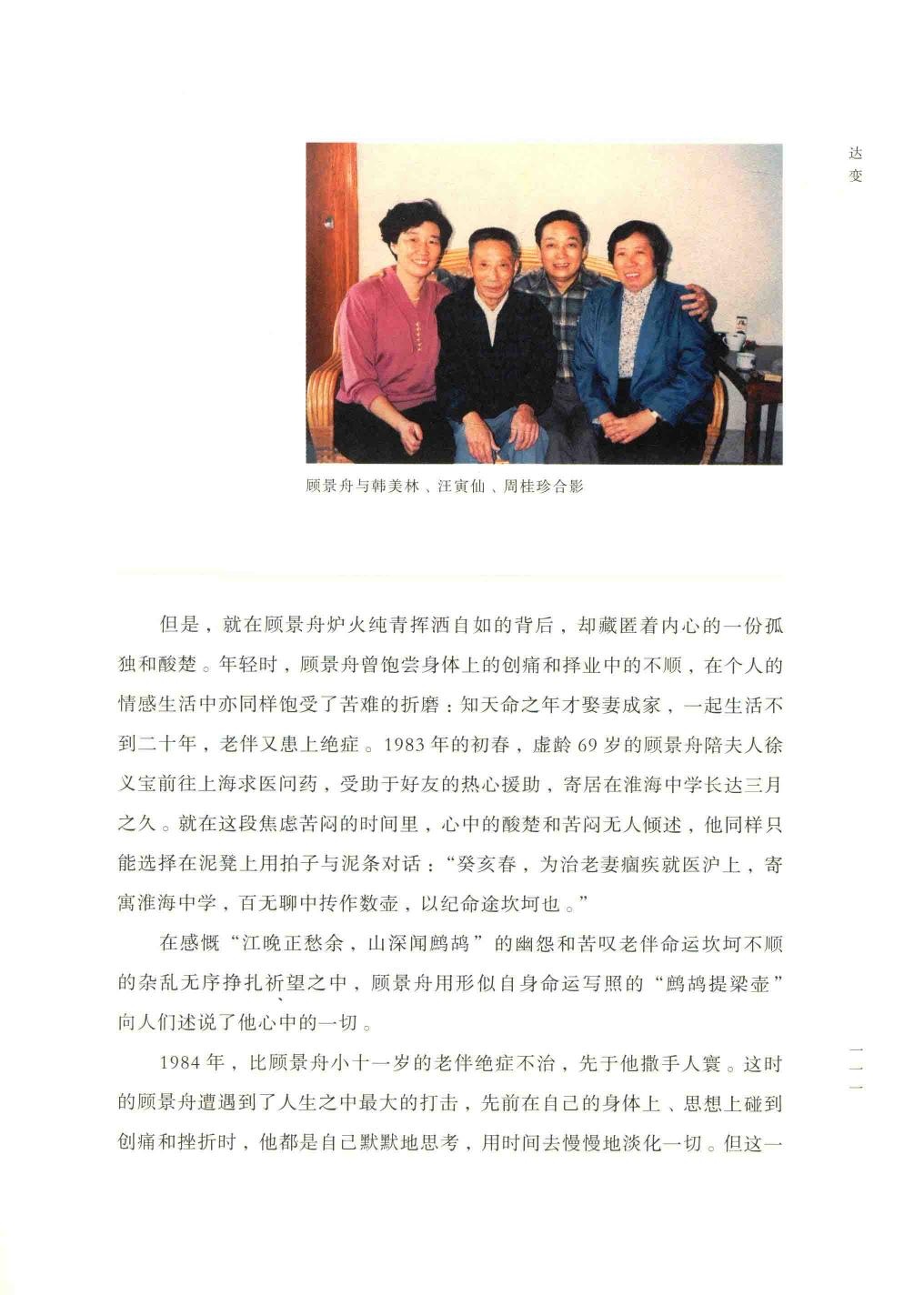
Yet behind Gu Jingzhou's consummate mastery and effortless artistry lay hidden a profound loneliness and bitterness in his heart. In his youth, Gu Jingzhou had endured physical suffering and unwilling career choices. In his emotional life, he likewise suffered torment: he did not marry until the age of knowing destiny[1], and after barely twenty years together, his wife contracted a terminal illness. In early spring of 1983, Gu Jingzhou, then 69 years old by traditional reckoning, accompanied his wife Xu Yibao to Shanghai to seek medical treatment. With the warm assistance of good friends, they lodged at Huaihai Middle School for as long as three months. During this anxious and melancholy period, with no one to confide in about the bitterness and depression in his heart, he could only choose to converse with clay through his paddle and coils:
> "In the spring of the year Guihai, I accompanied my elderly wife to Shanghai for medical treatment of her painful illness. We stayed at Huaihai Middle School. In utter boredom I made several pieces, to commemorate a life's rough journey."
Amid the resentful lament that "the river at dusk deepens my sorrow, in mountain depths I hear the partridge's cry," and the disordered, struggling prayers over his wife's ill-fated misfortunes, Gu Jingzhou used forms resembling reflections of his own destiny to tell people everything in his heart.
In 1984, Gu Jingzhou's wife, eleven years his junior, succumbed to her incurable disease and departed this world before him. At this time, Gu Jingzhou suffered the greatest blow of his life. Previously, when he had encountered physical suffering and setbacks, or obstacles in his thinking, he would always reflect silently on his own, using time to gradually fade everything. But this—
---
[1] Age fifty, according to Confucian tradition
Chapter 3
达变
Adaptation
Pages 32-133
View Chapter →
English Translation
Yet behind Gu Jingzhou's consummate mastery and effortless artistry lay hidden a profound loneliness and bitterness in his heart. In his youth, Gu Jingzhou had endured physical suffering and unwilling career choices. In his emotional life, he likewise suffered torment: he did not marry until the age of knowing destiny[1], and after barely twenty years together, his wife contracted a terminal illness. In early spring of 1983, Gu Jingzhou, then 69 years old by traditional reckoning, accompanied his wife Xu Yibao to Shanghai to seek medical treatment. With the warm assistance of good friends, they lodged at Huaihai Middle School for as long as three months. During this anxious and melancholy period, with no one to confide in about the bitterness and depression in his heart, he could only choose to converse with clay through his paddle and coils:
> "In the spring of the year Guihai, I accompanied my elderly wife to Shanghai for medical treatment of her painful illness. We stayed at Huaihai Middle School. In utter boredom I made several pieces, to commemorate a life's rough journey."
Amid the resentful lament that "the river at dusk deepens my sorrow, in mountain depths I hear the partridge's cry," and the disordered, struggling prayers over his wife's ill-fated misfortunes, Gu Jingzhou used forms resembling reflections of his own destiny to tell people everything in his heart.
In 1984, Gu Jingzhou's wife, eleven years his junior, succumbed to her incurable disease and departed this world before him. At this time, Gu Jingzhou suffered the greatest blow of his life. Previously, when he had encountered physical suffering and setbacks, or obstacles in his thinking, he would always reflect silently on his own, using time to gradually fade everything. But this—
---
[1] Age fifty, according to Confucian tradition
章节导航 Chapter Navigation
Chapter 1
序文
Pages 6-6
Chapter 2
引言
Pages 28-31
Chapter 3
达变
Pages 32-133
Chapter 3
开宗立派
Pages 46-66
Chapter 3
传道授业
Pages 67-98
Chapter 3
大师淳友
Pages 99-120
Chapter 3
学艺谋生
Pages 121-133
Chapter 4
化神
Pages 134-141
Chapter 5
独妙
Pages 142-405
Chapter 5
匠心独运 不苟丝毫
Pages 142-179
Chapter 5
器利善事 物尽其用
Pages 180-199
Chapter 5
紫泥春华 研精究微
Pages 200-405
Chapter 6
驾简
Pages 406-427
Chapter 6
精雕细刻 文质合一
Pages 406-410
Chapter 6
师法自然 妙趣横生
Pages 411-415
Chapter 6
丝来线去 曲尽其妙
Pages 416-427
Chapter 7
明志
Pages 463-485
Chapter 7
高山仰止 淡泊明志
Pages 463-472
Chapter 7
啜墨看茶 气定神闲
Pages 473-478
Chapter 7
齿少心锐 怡志抒情
Pages 479-485
Chapter 8
存真
Pages 428-462
Chapter 8
规圆矩方 弃伪存真
Pages 428-436
Chapter 8
有物有则 钻尖仰高
Pages 437-462
Chapter 9
心营
Pages 506-525
Chapter 9
坚守传统 艺立潮头
Pages 506-513
Chapter 9
新型师承 桃李满园
Pages 514-525
Chapter 10
附录
Pages 526-651
Chapter 10
顾景舟紫艺论文
Pages 526-535
Chapter 10
技术课备课笔记
Pages 536-543
Chapter 10
顾景舟艺术年表
Pages 544-651
Chapter 11
参考文献
Pages 652-657
Chapter 12
鸣谢
Pages 658-659