Chapter 3
达变
Adaptation
67
of 659
English Translation
# Purple Sand
## Sound
Xi
Shang
1 >
|
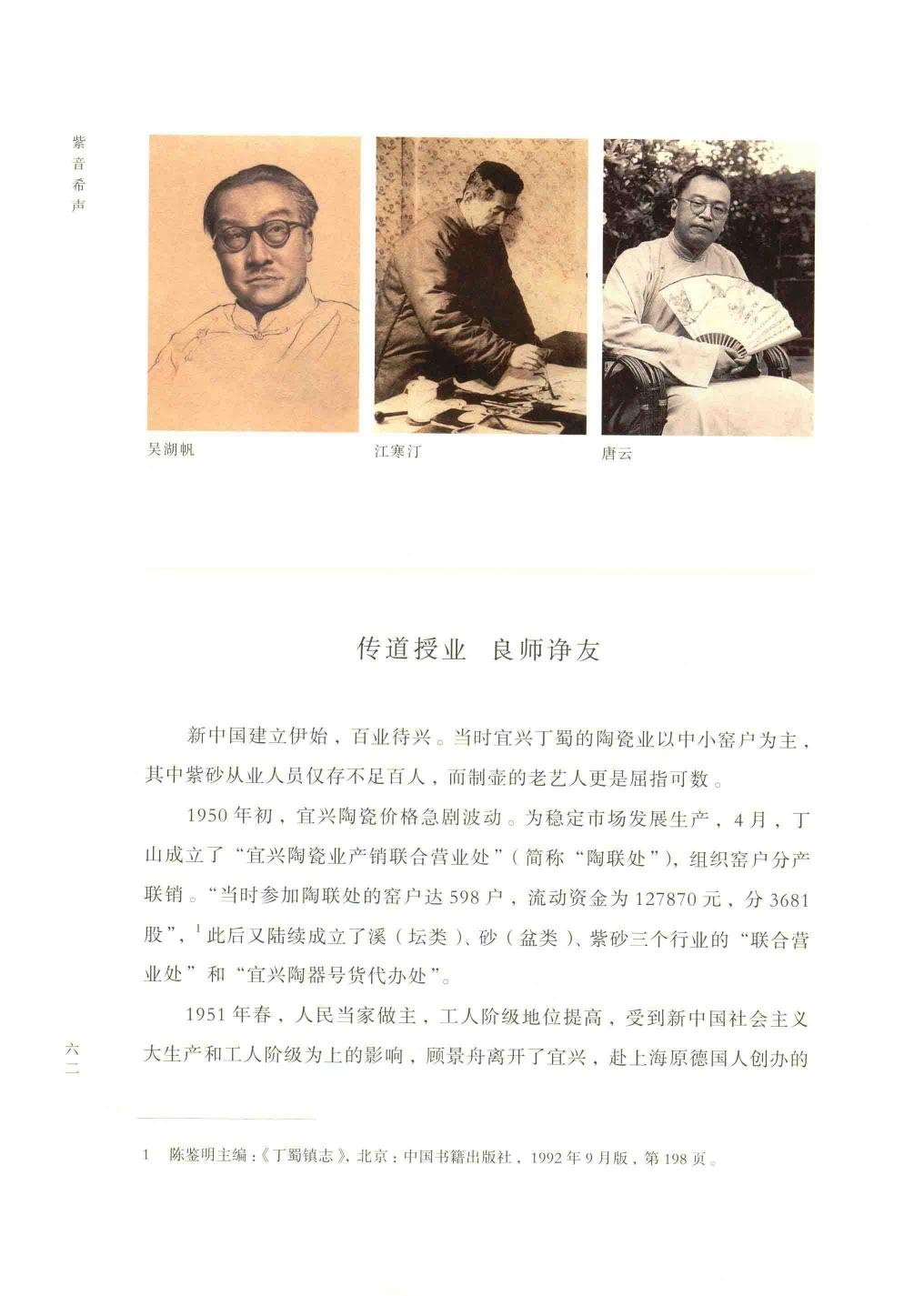
Wu Hufan Jiang Hanting Tang Yun
## Transmitting the Way and Teaching the Craft: Mentors and Friends
At the dawn of the establishment of New China, all industries awaited revival. At that time, the ceramics industry in Yixing's Dingshu was dominated by small and medium-sized workshops, with fewer than one hundred practitioners remaining in the zisha (purple sand) craft, and the number of veteran artisans who made teapots could be counted on one's fingers.
In early 1950, the prices of Yixing ceramics fluctuated dramatically. To stabilize the market and develop production, in April, Dingshu established the "Yixing Ceramics Production and Sales Joint Business Office" (abbreviated as "Taolian Office"), organizing workshops for joint production and sales. "At that time, 598 workshops participated in the Taolian Office, with working capital of 127,870 yuan, divided into 3,681 shares."[1] Subsequently, joint business offices were established for three industries—Xi (altar-type vessels), He Sand (basin-type vessels), and Zisha—as well as the "Yixing Pottery Goods Agency Office."
In the spring of 1951, the people became masters of their own destiny, and the status of the working class was elevated. Influenced by New China's socialist mass production and the supremacy of the working class, Gu Jingzhou left Yixing and went to Shanghai to work at a factory originally established by Germans.
---
[1] Chen Jianming, ed., *Dingshu Town Gazetteer* (Beijing: China Books Publishing House, September 1992 edition), p. 198.
Chapter 3
达变
Adaptation
Pages 32-133
View Chapter →
English Translation
# Purple Sand
## Sound
Xi
Shang
1 >
|
Wu Hufan Jiang Hanting Tang Yun
## Transmitting the Way and Teaching the Craft: Mentors and Friends
At the dawn of the establishment of New China, all industries awaited revival. At that time, the ceramics industry in Yixing's Dingshu was dominated by small and medium-sized workshops, with fewer than one hundred practitioners remaining in the zisha (purple sand) craft, and the number of veteran artisans who made teapots could be counted on one's fingers.
In early 1950, the prices of Yixing ceramics fluctuated dramatically. To stabilize the market and develop production, in April, Dingshu established the "Yixing Ceramics Production and Sales Joint Business Office" (abbreviated as "Taolian Office"), organizing workshops for joint production and sales. "At that time, 598 workshops participated in the Taolian Office, with working capital of 127,870 yuan, divided into 3,681 shares."[1] Subsequently, joint business offices were established for three industries—Xi (altar-type vessels), He Sand (basin-type vessels), and Zisha—as well as the "Yixing Pottery Goods Agency Office."
In the spring of 1951, the people became masters of their own destiny, and the status of the working class was elevated. Influenced by New China's socialist mass production and the supremacy of the working class, Gu Jingzhou left Yixing and went to Shanghai to work at a factory originally established by Germans.
---
[1] Chen Jianming, ed., *Dingshu Town Gazetteer* (Beijing: China Books Publishing House, September 1992 edition), p. 198.
章节导航 Chapter Navigation
Chapter 1
序文
Pages 6-6
Chapter 2
引言
Pages 28-31
Chapter 3
达变
Pages 32-133
Chapter 3
开宗立派
Pages 46-66
Chapter 3
传道授业
Pages 67-98
Chapter 3
大师淳友
Pages 99-120
Chapter 3
学艺谋生
Pages 121-133
Chapter 4
化神
Pages 134-141
Chapter 5
独妙
Pages 142-405
Chapter 5
匠心独运 不苟丝毫
Pages 142-179
Chapter 5
器利善事 物尽其用
Pages 180-199
Chapter 5
紫泥春华 研精究微
Pages 200-405
Chapter 6
驾简
Pages 406-427
Chapter 6
精雕细刻 文质合一
Pages 406-410
Chapter 6
师法自然 妙趣横生
Pages 411-415
Chapter 6
丝来线去 曲尽其妙
Pages 416-427
Chapter 7
明志
Pages 463-485
Chapter 7
高山仰止 淡泊明志
Pages 463-472
Chapter 7
啜墨看茶 气定神闲
Pages 473-478
Chapter 7
齿少心锐 怡志抒情
Pages 479-485
Chapter 8
存真
Pages 428-462
Chapter 8
规圆矩方 弃伪存真
Pages 428-436
Chapter 8
有物有则 钻尖仰高
Pages 437-462
Chapter 9
心营
Pages 506-525
Chapter 9
坚守传统 艺立潮头
Pages 506-513
Chapter 9
新型师承 桃李满园
Pages 514-525
Chapter 10
附录
Pages 526-651
Chapter 10
顾景舟紫艺论文
Pages 526-535
Chapter 10
技术课备课笔记
Pages 536-543
Chapter 10
顾景舟艺术年表
Pages 544-651
Chapter 11
参考文献
Pages 652-657
Chapter 12
鸣谢
Pages 658-659