Chapter 6
驾简
Mastering Simplicity
411
of 659
English Translation
## Linear Decoration
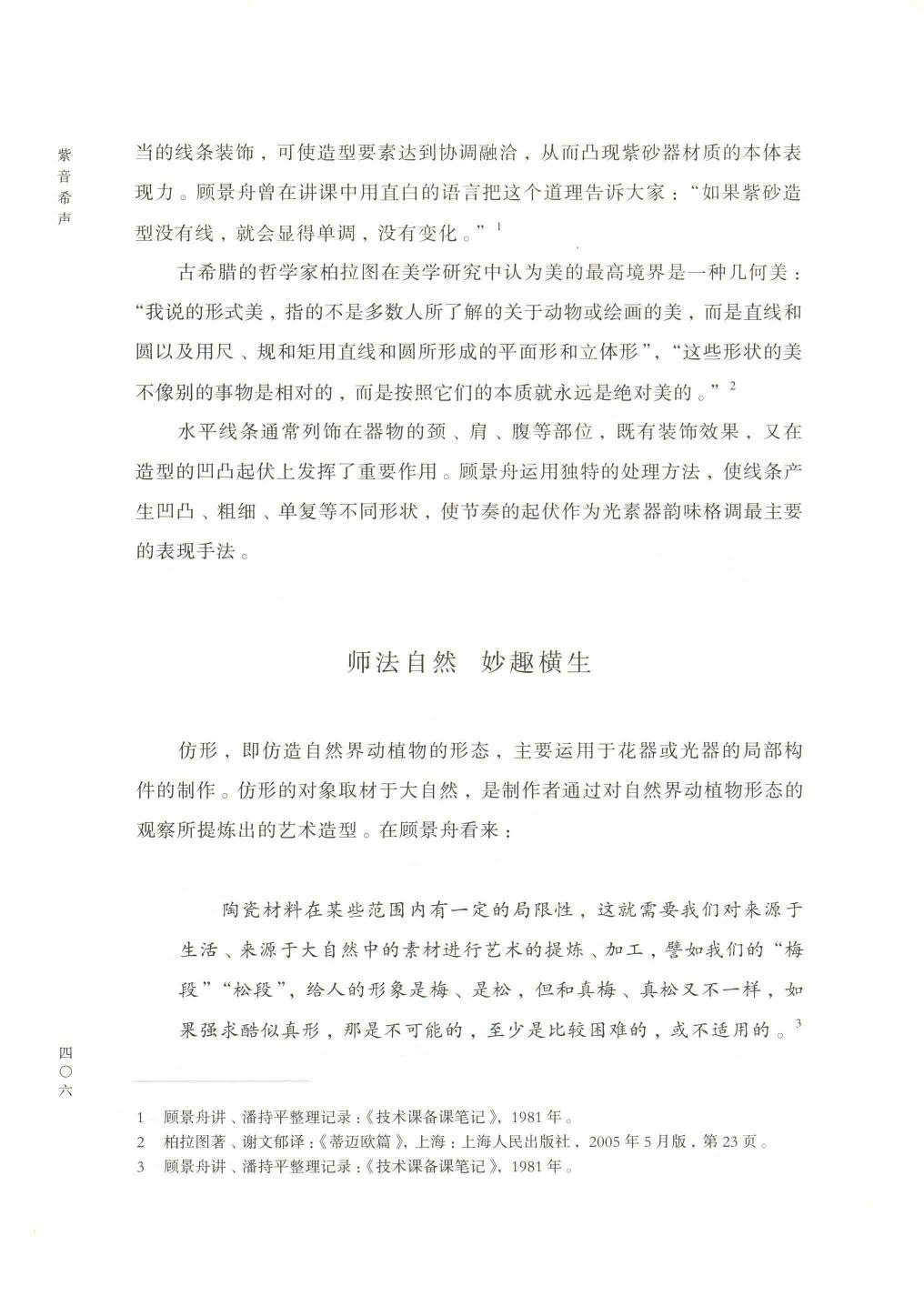
Appropriate linear decoration can harmonize the elements of form, thereby highlighting the inherent expressive power of zisha (purple clay) material. Gu Jingzhou once explained this principle in straightforward language during his lectures: "If zisha forms lack lines, they will appear monotonous, without variation."[1]
The ancient Greek philosopher Plato, in his aesthetic studies, believed that the highest realm of beauty is a kind of geometric beauty: "By beauty of form I mean not what most people would understand by it, such as the beauty of animals or paintings, but rather straight lines and circles, and the plane and solid figures formed from them by rulers, compasses, and squares," "The beauty of these shapes is not relative like other things, but according to their essence is eternally and absolutely beautiful."[2]
Horizontal lines are typically arranged on the neck, shoulder, belly, and other parts of vessels. They not only provide decorative effect but also play an important role in the rises and falls of the form. Gu Jingzhou employed unique treatment methods to create lines of different shapes—convex or flat, thick or thin, single or multiple—using rhythmic undulation as the primary means of expressing the charm and character of plain vessels.
## Learning from Nature: Delightful and Ingenious
Imitative form (*fangxing*) refers to imitating the forms of flora and fauna from the natural world, primarily applied in the creation of flower-form vessels or local components of plain vessels. The objects of imitation are drawn from nature and represent artistic forms refined by makers through observation of natural plant and animal forms. In Gu Jingzhou's view:
> Ceramic materials have certain limitations within specific ranges. This requires us to artistically refine and process materials that come from life and from nature. For example, our "plum segment" and "pine segment" give people the image of plum and pine, but they are not the same as real plum and real pine. If we insist on exact resemblance to the true form, that is impossible, or at least quite difficult, or unsuitable.[3]
---
[1] Gu Jingzhou (lecturer), Pan Chiping (compiled and recorded): *Technical Course Preparation Notes*, 1981.
[2] Plato, translated by Xie Wenyu: *Timaeus*, Shanghai: Shanghai People's Publishing House, May 2005 edition, p. 23.
[3] Gu Jingzhou (lecturer), Pan Chiping (compiled and recorded): *Technical Course Preparation Notes*, 1981.
Chapter 6
驾简
Mastering Simplicity
Pages 406-427
View Chapter →
English Translation
## Linear Decoration
Appropriate linear decoration can harmonize the elements of form, thereby highlighting the inherent expressive power of zisha (purple clay) material. Gu Jingzhou once explained this principle in straightforward language during his lectures: "If zisha forms lack lines, they will appear monotonous, without variation."[1]
The ancient Greek philosopher Plato, in his aesthetic studies, believed that the highest realm of beauty is a kind of geometric beauty: "By beauty of form I mean not what most people would understand by it, such as the beauty of animals or paintings, but rather straight lines and circles, and the plane and solid figures formed from them by rulers, compasses, and squares," "The beauty of these shapes is not relative like other things, but according to their essence is eternally and absolutely beautiful."[2]
Horizontal lines are typically arranged on the neck, shoulder, belly, and other parts of vessels. They not only provide decorative effect but also play an important role in the rises and falls of the form. Gu Jingzhou employed unique treatment methods to create lines of different shapes—convex or flat, thick or thin, single or multiple—using rhythmic undulation as the primary means of expressing the charm and character of plain vessels.
## Learning from Nature: Delightful and Ingenious
Imitative form (*fangxing*) refers to imitating the forms of flora and fauna from the natural world, primarily applied in the creation of flower-form vessels or local components of plain vessels. The objects of imitation are drawn from nature and represent artistic forms refined by makers through observation of natural plant and animal forms. In Gu Jingzhou's view:
> Ceramic materials have certain limitations within specific ranges. This requires us to artistically refine and process materials that come from life and from nature. For example, our "plum segment" and "pine segment" give people the image of plum and pine, but they are not the same as real plum and real pine. If we insist on exact resemblance to the true form, that is impossible, or at least quite difficult, or unsuitable.[3]
---
[1] Gu Jingzhou (lecturer), Pan Chiping (compiled and recorded): *Technical Course Preparation Notes*, 1981.
[2] Plato, translated by Xie Wenyu: *Timaeus*, Shanghai: Shanghai People's Publishing House, May 2005 edition, p. 23.
[3] Gu Jingzhou (lecturer), Pan Chiping (compiled and recorded): *Technical Course Preparation Notes*, 1981.
章节导航 Chapter Navigation
Chapter 1
序文
Pages 6-6
Chapter 2
引言
Pages 28-31
Chapter 3
达变
Pages 32-133
Chapter 3
开宗立派
Pages 46-66
Chapter 3
传道授业
Pages 67-98
Chapter 3
大师淳友
Pages 99-120
Chapter 3
学艺谋生
Pages 121-133
Chapter 4
化神
Pages 134-141
Chapter 5
独妙
Pages 142-405
Chapter 5
匠心独运 不苟丝毫
Pages 142-179
Chapter 5
器利善事 物尽其用
Pages 180-199
Chapter 5
紫泥春华 研精究微
Pages 200-405
Chapter 6
驾简
Pages 406-427
Chapter 6
精雕细刻 文质合一
Pages 406-410
Chapter 6
师法自然 妙趣横生
Pages 411-415
Chapter 6
丝来线去 曲尽其妙
Pages 416-427
Chapter 7
明志
Pages 463-485
Chapter 7
高山仰止 淡泊明志
Pages 463-472
Chapter 7
啜墨看茶 气定神闲
Pages 473-478
Chapter 7
齿少心锐 怡志抒情
Pages 479-485
Chapter 8
存真
Pages 428-462
Chapter 8
规圆矩方 弃伪存真
Pages 428-436
Chapter 8
有物有则 钻尖仰高
Pages 437-462
Chapter 9
心营
Pages 506-525
Chapter 9
坚守传统 艺立潮头
Pages 506-513
Chapter 9
新型师承 桃李满园
Pages 514-525
Chapter 10
附录
Pages 526-651
Chapter 10
顾景舟紫艺论文
Pages 526-535
Chapter 10
技术课备课笔记
Pages 536-543
Chapter 10
顾景舟艺术年表
Pages 544-651
Chapter 11
参考文献
Pages 652-657
Chapter 12
鸣谢
Pages 658-659