Chapter 10
附录
Appendix
600
of 659
English Translation
# The Inheritance and Innovation of Teapot Art
Gu Jingzhou and Gao Haigeng
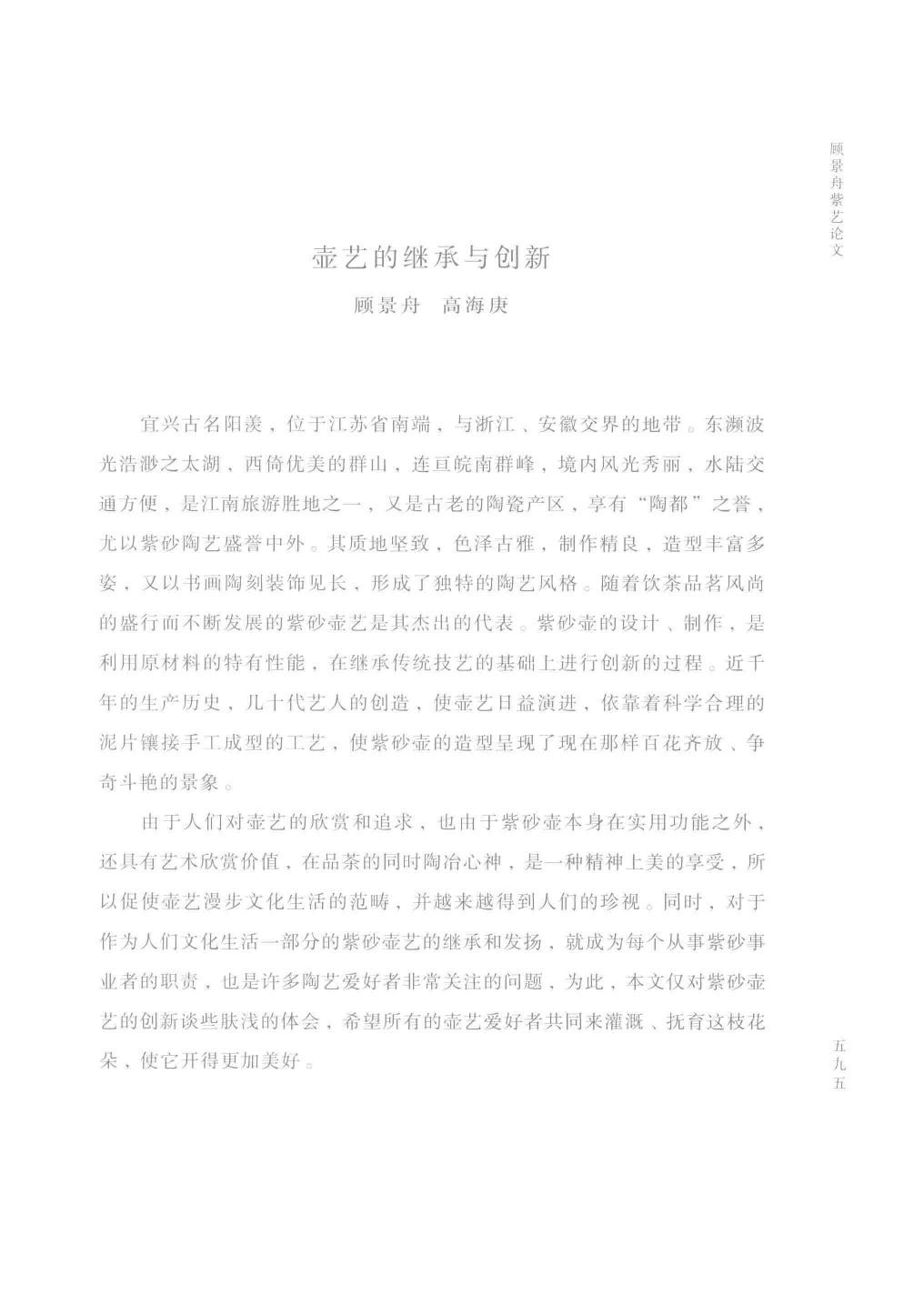
Yixing, anciently known as Yangxian, is located at the southern tip of Jiangsu Province, in the area bordering Zhejiang and Anhui. To the east, it faces the vast and shimmering waters of Lake Tai; to the west, it is backed by beautiful mountain ranges connecting to the peaks of southern Anhui. Within its borders, the scenery is magnificent, and water and land transportation is convenient. It is one of the scenic tourist destinations in the Jiangnan region and also an ancient ceramic production area, enjoying the reputation of "Pottery Capital." It is especially renowned both at home and abroad for its Zisha (purple clay) ceramic art. The material is dense and solid, the colors antique and elegant, the craftsmanship exquisite and refined, and the forms rich and varied. It excels particularly in calligraphy, painting, and carved decoration, forming a unique ceramic art style. Zisha teapot art, which has continuously developed alongside the flourishing custom of tea drinking and appreciation, is its outstanding representative. The design and production of Zisha teapots is a process of innovation based on the inheritance of traditional techniques, utilizing the unique properties of the raw materials. Nearly a thousand years of production history and the creativity of dozens of generations of artisans have caused teapot art to evolve progressively. Relying on the scientifically sound and rational craft of hand-forming through clay slab joining, Zisha teapots now present the spectacular scene of a hundred flowers blooming in competition, each vying in beauty and uniqueness.
Due to people's appreciation and pursuit of teapot art, and because Zisha teapots themselves possess artistic appreciation value beyond their practical function—cultivating the mind and spirit while drinking tea and providing a kind of spiritual aesthetic enjoyment—teapot art has been propelled into the realm of cultural life and has increasingly gained people's cherished regard. At the same time, the inheritance and development of Zisha teapot art as part of people's cultural life has become the responsibility of everyone engaged in the Zisha enterprise, and is also an issue of great concern to many ceramic art enthusiasts. Therefore, this article offers only some superficial reflections on the innovation of Zisha teapot art, hoping that all teapot art enthusiasts will join together to water and nurture this flowering branch, so that it may bloom even more beautifully.
Chapter 10
附录
Appendix
Pages 526-651
View Chapter →
English Translation
# The Inheritance and Innovation of Teapot Art
Gu Jingzhou and Gao Haigeng
Yixing, anciently known as Yangxian, is located at the southern tip of Jiangsu Province, in the area bordering Zhejiang and Anhui. To the east, it faces the vast and shimmering waters of Lake Tai; to the west, it is backed by beautiful mountain ranges connecting to the peaks of southern Anhui. Within its borders, the scenery is magnificent, and water and land transportation is convenient. It is one of the scenic tourist destinations in the Jiangnan region and also an ancient ceramic production area, enjoying the reputation of "Pottery Capital." It is especially renowned both at home and abroad for its Zisha (purple clay) ceramic art. The material is dense and solid, the colors antique and elegant, the craftsmanship exquisite and refined, and the forms rich and varied. It excels particularly in calligraphy, painting, and carved decoration, forming a unique ceramic art style. Zisha teapot art, which has continuously developed alongside the flourishing custom of tea drinking and appreciation, is its outstanding representative. The design and production of Zisha teapots is a process of innovation based on the inheritance of traditional techniques, utilizing the unique properties of the raw materials. Nearly a thousand years of production history and the creativity of dozens of generations of artisans have caused teapot art to evolve progressively. Relying on the scientifically sound and rational craft of hand-forming through clay slab joining, Zisha teapots now present the spectacular scene of a hundred flowers blooming in competition, each vying in beauty and uniqueness.
Due to people's appreciation and pursuit of teapot art, and because Zisha teapots themselves possess artistic appreciation value beyond their practical function—cultivating the mind and spirit while drinking tea and providing a kind of spiritual aesthetic enjoyment—teapot art has been propelled into the realm of cultural life and has increasingly gained people's cherished regard. At the same time, the inheritance and development of Zisha teapot art as part of people's cultural life has become the responsibility of everyone engaged in the Zisha enterprise, and is also an issue of great concern to many ceramic art enthusiasts. Therefore, this article offers only some superficial reflections on the innovation of Zisha teapot art, hoping that all teapot art enthusiasts will join together to water and nurture this flowering branch, so that it may bloom even more beautifully.
章节导航 Chapter Navigation
Chapter 1
序文
Pages 6-6
Chapter 2
引言
Pages 28-31
Chapter 3
达变
Pages 32-133
Chapter 3
开宗立派
Pages 46-66
Chapter 3
传道授业
Pages 67-98
Chapter 3
大师淳友
Pages 99-120
Chapter 3
学艺谋生
Pages 121-133
Chapter 4
化神
Pages 134-141
Chapter 5
独妙
Pages 142-405
Chapter 5
匠心独运 不苟丝毫
Pages 142-179
Chapter 5
器利善事 物尽其用
Pages 180-199
Chapter 5
紫泥春华 研精究微
Pages 200-405
Chapter 6
驾简
Pages 406-427
Chapter 6
精雕细刻 文质合一
Pages 406-410
Chapter 6
师法自然 妙趣横生
Pages 411-415
Chapter 6
丝来线去 曲尽其妙
Pages 416-427
Chapter 7
明志
Pages 463-485
Chapter 7
高山仰止 淡泊明志
Pages 463-472
Chapter 7
啜墨看茶 气定神闲
Pages 473-478
Chapter 7
齿少心锐 怡志抒情
Pages 479-485
Chapter 8
存真
Pages 428-462
Chapter 8
规圆矩方 弃伪存真
Pages 428-436
Chapter 8
有物有则 钻尖仰高
Pages 437-462
Chapter 9
心营
Pages 506-525
Chapter 9
坚守传统 艺立潮头
Pages 506-513
Chapter 9
新型师承 桃李满园
Pages 514-525
Chapter 10
附录
Pages 526-651
Chapter 10
顾景舟紫艺论文
Pages 526-535
Chapter 10
技术课备课笔记
Pages 536-543
Chapter 10
顾景舟艺术年表
Pages 544-651
Chapter 11
参考文献
Pages 652-657
Chapter 12
鸣谢
Pages 658-659