Chapter 10
附录
Appendix
650
of 659
English Translation
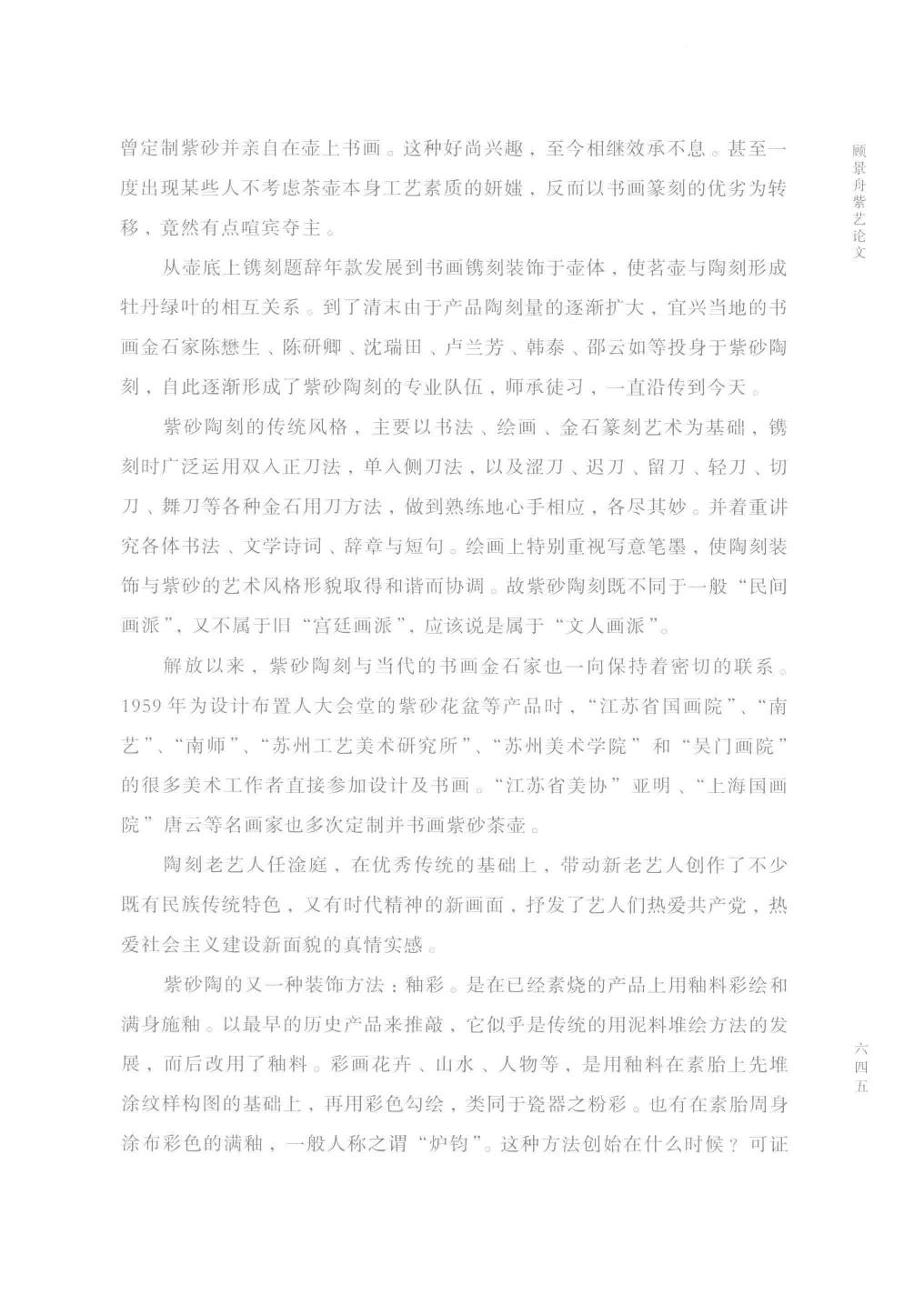
[They] commissioned purple clay teapots and personally inscribed calligraphy and paintings on them. This refined interest has been continuously inherited and practiced to this day. At one point, certain individuals even disregarded the inherent craftsmanship and aesthetic quality of the teapots themselves, instead judging them solely by the merit of their calligraphy, painting, and seal carving—a case of the guest overshadowing the host.
From the development of inscribing commemorative dates and signatures on the bottom of teapots to decorating the body with calligraphy, painting, and engraving, the relationship between pottery and carving became like that of peony and green leaves complementing each other. By the late Qing dynasty, as the volume of engraved products gradually expanded, local Yixing calligraphers and painters such as Chen Gusheng, Chen Yanwei, Shen Ruitian, Lu Lanfang, Han Tai, and Shao Yunru devoted themselves to purple clay pottery engraving. From this point forward, a professional corps of purple clay pottery engravers gradually formed, with master-apprentice transmission continuing to the present day.
The traditional style of purple clay pottery engraving is primarily based on the arts of calligraphy, painting, and seal carving. During engraving, various knife techniques from seal carving are widely employed, including the double-entry straight knife method, single-entry side knife method, as well as beam knife, slow knife, retention knife, light knife, cutting knife, and dancing knife techniques—all executed with skilled coordination of mind and hand, each technique achieving its own excellence. Particular emphasis is placed on various calligraphic styles, literary poetry, prose, and short phrases. In painting, special attention is given to expressive brushwork, ensuring that the engraved decoration harmonizes and coordinates with the artistic style and appearance of purple clay ware. Therefore, purple clay pottery engraving differs from the general "folk school" and does not belong to the old "court painting school"—it should be considered part of the "literati painting school."
Since Liberation, purple clay pottery engraving has maintained close ties with contemporary calligraphers, painters, and seal carvers. In 1959, when designing and decorating purple clay flowerpots and other products for the Great Hall of the People, many art workers from the Jiangsu Provincial Chinese Painting Academy, Nanjing Arts Institute, Nanjing Normal University, Suzhou Arts and Crafts Research Institute, Suzhou Academy of Fine Arts, and Wumen Painting Academy directly participated in design and painting. Famous painters such as Ya Ming from the Jiangsu Provincial Artists Association and Tang Yun from the Shanghai Chinese Painting Academy also commissioned and inscribed purple clay teapots on multiple occasions.
The veteran engraving artisan Ren Ganting, building upon excellent traditions, led both veteran and new artisans in creating numerous new designs that possess both national traditional characteristics and the spirit of the times, expressing the artisans' genuine feelings of love for the Communist Party and enthusiasm for socialist construction's new prospects.
Another decorative method for purple clay pottery is glazed enamel. This involves applying glaze painting and full glazing on already bisque-fired products. Judging from the earliest historical products, it appears to be a development of the traditional clay paste relief method, later modified to use glaze materials. Painting flowers and birds, landscapes, figures, and other subjects involves first building up the pattern composition with glaze material on the bisque body, then outlining with colors—similar to the *fencai* (famille rose) technique on porcelain. There is also full glazing where colored glaze is applied over the entire bisque body, commonly referred to as "furnace transmutation glaze" (*lujun*). When was this method first created? Evidence can be found...
Chapter 10
附录
Appendix
Pages 526-651
View Chapter →
English Translation
[They] commissioned purple clay teapots and personally inscribed calligraphy and paintings on them. This refined interest has been continuously inherited and practiced to this day. At one point, certain individuals even disregarded the inherent craftsmanship and aesthetic quality of the teapots themselves, instead judging them solely by the merit of their calligraphy, painting, and seal carving—a case of the guest overshadowing the host.
From the development of inscribing commemorative dates and signatures on the bottom of teapots to decorating the body with calligraphy, painting, and engraving, the relationship between pottery and carving became like that of peony and green leaves complementing each other. By the late Qing dynasty, as the volume of engraved products gradually expanded, local Yixing calligraphers and painters such as Chen Gusheng, Chen Yanwei, Shen Ruitian, Lu Lanfang, Han Tai, and Shao Yunru devoted themselves to purple clay pottery engraving. From this point forward, a professional corps of purple clay pottery engravers gradually formed, with master-apprentice transmission continuing to the present day.
The traditional style of purple clay pottery engraving is primarily based on the arts of calligraphy, painting, and seal carving. During engraving, various knife techniques from seal carving are widely employed, including the double-entry straight knife method, single-entry side knife method, as well as beam knife, slow knife, retention knife, light knife, cutting knife, and dancing knife techniques—all executed with skilled coordination of mind and hand, each technique achieving its own excellence. Particular emphasis is placed on various calligraphic styles, literary poetry, prose, and short phrases. In painting, special attention is given to expressive brushwork, ensuring that the engraved decoration harmonizes and coordinates with the artistic style and appearance of purple clay ware. Therefore, purple clay pottery engraving differs from the general "folk school" and does not belong to the old "court painting school"—it should be considered part of the "literati painting school."
Since Liberation, purple clay pottery engraving has maintained close ties with contemporary calligraphers, painters, and seal carvers. In 1959, when designing and decorating purple clay flowerpots and other products for the Great Hall of the People, many art workers from the Jiangsu Provincial Chinese Painting Academy, Nanjing Arts Institute, Nanjing Normal University, Suzhou Arts and Crafts Research Institute, Suzhou Academy of Fine Arts, and Wumen Painting Academy directly participated in design and painting. Famous painters such as Ya Ming from the Jiangsu Provincial Artists Association and Tang Yun from the Shanghai Chinese Painting Academy also commissioned and inscribed purple clay teapots on multiple occasions.
The veteran engraving artisan Ren Ganting, building upon excellent traditions, led both veteran and new artisans in creating numerous new designs that possess both national traditional characteristics and the spirit of the times, expressing the artisans' genuine feelings of love for the Communist Party and enthusiasm for socialist construction's new prospects.
Another decorative method for purple clay pottery is glazed enamel. This involves applying glaze painting and full glazing on already bisque-fired products. Judging from the earliest historical products, it appears to be a development of the traditional clay paste relief method, later modified to use glaze materials. Painting flowers and birds, landscapes, figures, and other subjects involves first building up the pattern composition with glaze material on the bisque body, then outlining with colors—similar to the *fencai* (famille rose) technique on porcelain. There is also full glazing where colored glaze is applied over the entire bisque body, commonly referred to as "furnace transmutation glaze" (*lujun*). When was this method first created? Evidence can be found...
章节导航 Chapter Navigation
Chapter 1
序文
Pages 6-6
Chapter 2
引言
Pages 28-31
Chapter 3
达变
Pages 32-133
Chapter 3
开宗立派
Pages 46-66
Chapter 3
传道授业
Pages 67-98
Chapter 3
大师淳友
Pages 99-120
Chapter 3
学艺谋生
Pages 121-133
Chapter 4
化神
Pages 134-141
Chapter 5
独妙
Pages 142-405
Chapter 5
匠心独运 不苟丝毫
Pages 142-179
Chapter 5
器利善事 物尽其用
Pages 180-199
Chapter 5
紫泥春华 研精究微
Pages 200-405
Chapter 6
驾简
Pages 406-427
Chapter 6
精雕细刻 文质合一
Pages 406-410
Chapter 6
师法自然 妙趣横生
Pages 411-415
Chapter 6
丝来线去 曲尽其妙
Pages 416-427
Chapter 7
明志
Pages 463-485
Chapter 7
高山仰止 淡泊明志
Pages 463-472
Chapter 7
啜墨看茶 气定神闲
Pages 473-478
Chapter 7
齿少心锐 怡志抒情
Pages 479-485
Chapter 8
存真
Pages 428-462
Chapter 8
规圆矩方 弃伪存真
Pages 428-436
Chapter 8
有物有则 钻尖仰高
Pages 437-462
Chapter 9
心营
Pages 506-525
Chapter 9
坚守传统 艺立潮头
Pages 506-513
Chapter 9
新型师承 桃李满园
Pages 514-525
Chapter 10
附录
Pages 526-651
Chapter 10
顾景舟紫艺论文
Pages 526-535
Chapter 10
技术课备课笔记
Pages 536-543
Chapter 10
顾景舟艺术年表
Pages 544-651
Chapter 11
参考文献
Pages 652-657
Chapter 12
鸣谢
Pages 658-659