Chapter 9
心营
Heart's Cultivation
514
of 659
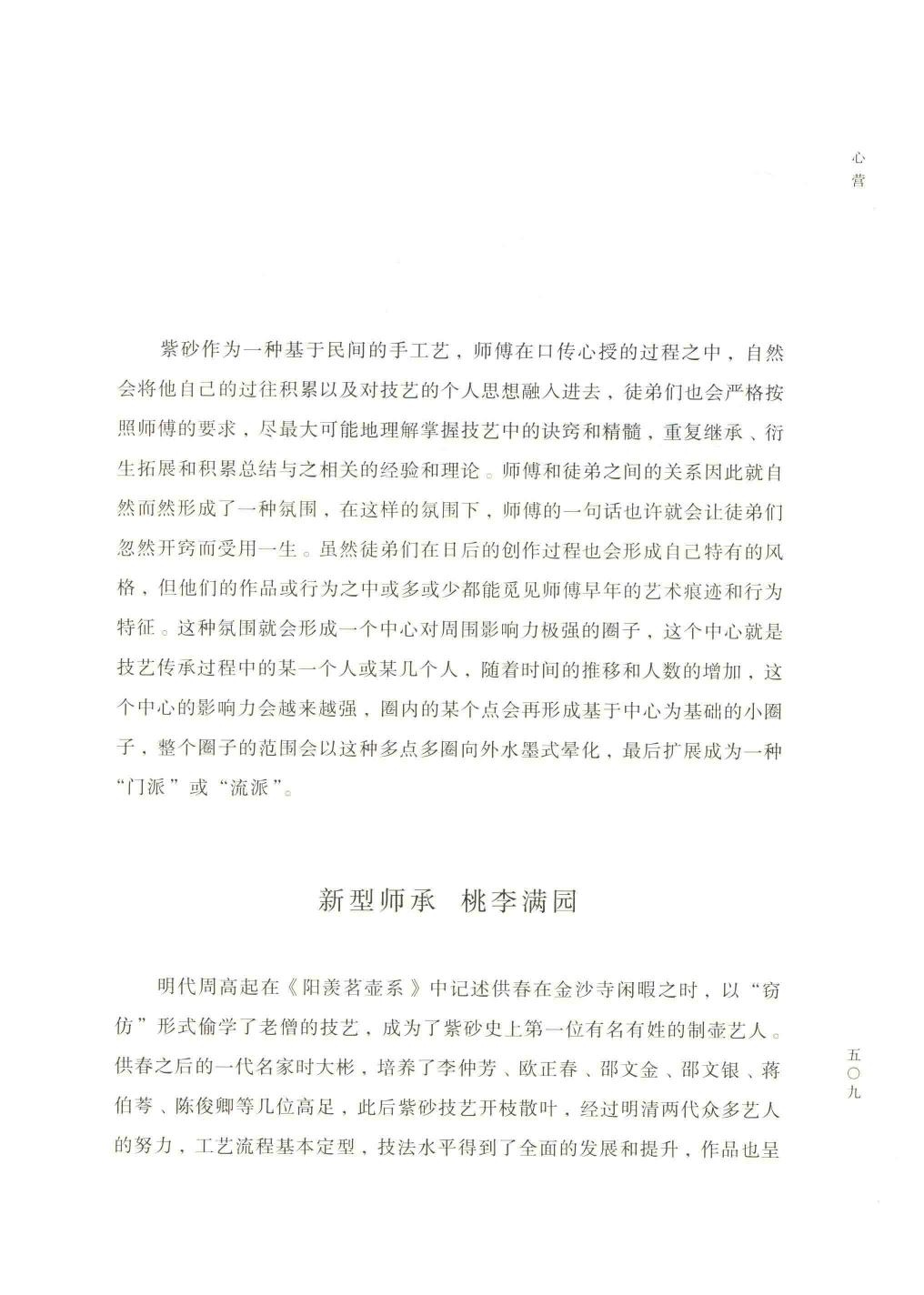
English Translation
As a folk handicraft, Yixing pottery naturally incorporates the master's accumulated experience and personal understanding of the craft through oral transmission and hands-on teaching. Apprentices strictly follow their master's requirements, striving to comprehend and master the techniques' secrets and essence to the fullest extent possible. They repeatedly inherit, expand upon, and accumulate related experience and theory. The relationship between master and apprentice naturally forms a particular atmosphere. Within this atmosphere, a single word from the master may suddenly enlighten the apprentices and influence them for life. Although apprentices will eventually develop their own distinctive styles in their later creative work, traces of their master's early artistic marks and behavioral characteristics can be seen to varying degrees in their works and conduct. This inherent characteristic of craft transmission creates a circle with extremely strong influence radiating from a central point—this center being one person or several people in the transmission process. As time passes and numbers increase, this center's influence grows stronger. Certain points within the circle form smaller circles based on the central foundation. The entire circle's scope expands outward in this multi-point, multi-circle manner, like ink diffusing in water, ultimately developing into a "school" or "style."
## Ming Dynasty Innovation: Master-Apprentice Lineages Flourish
Zhou Gaoqi recorded in *Yangxian Ming Pot System* that Gong Chun, during his leisure time at Jinsha Temple, learned the old monk's techniques through "secret imitation," becoming the first named craftsman in Yixing pottery history. Shi Dabin, a master of the generation following Gong Chun, trained several outstanding disciples including Li Zhongfang, Ou Zhengchun, Shao Wenjin, Shao Wenyin, Jiang Boya, and Chen Junqing. Thereafter, Yixing pottery techniques branched out and flourished. Through the efforts of numerous craftsmen during the Ming and Qing dynasties, the production process became essentially standardized, technical proficiency achieved comprehensive development and improvement, and works displayed remarkable diversity.
Chapter 9
心营
Heart's Cultivation
Pages 506-525
View Chapter →
English Translation
As a folk handicraft, Yixing pottery naturally incorporates the master's accumulated experience and personal understanding of the craft through oral transmission and hands-on teaching. Apprentices strictly follow their master's requirements, striving to comprehend and master the techniques' secrets and essence to the fullest extent possible. They repeatedly inherit, expand upon, and accumulate related experience and theory. The relationship between master and apprentice naturally forms a particular atmosphere. Within this atmosphere, a single word from the master may suddenly enlighten the apprentices and influence them for life. Although apprentices will eventually develop their own distinctive styles in their later creative work, traces of their master's early artistic marks and behavioral characteristics can be seen to varying degrees in their works and conduct. This inherent characteristic of craft transmission creates a circle with extremely strong influence radiating from a central point—this center being one person or several people in the transmission process. As time passes and numbers increase, this center's influence grows stronger. Certain points within the circle form smaller circles based on the central foundation. The entire circle's scope expands outward in this multi-point, multi-circle manner, like ink diffusing in water, ultimately developing into a "school" or "style."
## Ming Dynasty Innovation: Master-Apprentice Lineages Flourish
Zhou Gaoqi recorded in *Yangxian Ming Pot System* that Gong Chun, during his leisure time at Jinsha Temple, learned the old monk's techniques through "secret imitation," becoming the first named craftsman in Yixing pottery history. Shi Dabin, a master of the generation following Gong Chun, trained several outstanding disciples including Li Zhongfang, Ou Zhengchun, Shao Wenjin, Shao Wenyin, Jiang Boya, and Chen Junqing. Thereafter, Yixing pottery techniques branched out and flourished. Through the efforts of numerous craftsmen during the Ming and Qing dynasties, the production process became essentially standardized, technical proficiency achieved comprehensive development and improvement, and works displayed remarkable diversity.
章节导航 Chapter Navigation
Chapter 1
序文
Pages 6-6
Chapter 2
引言
Pages 28-31
Chapter 3
达变
Pages 32-133
Chapter 3
开宗立派
Pages 46-66
Chapter 3
传道授业
Pages 67-98
Chapter 3
大师淳友
Pages 99-120
Chapter 3
学艺谋生
Pages 121-133
Chapter 4
化神
Pages 134-141
Chapter 5
独妙
Pages 142-405
Chapter 5
匠心独运 不苟丝毫
Pages 142-179
Chapter 5
器利善事 物尽其用
Pages 180-199
Chapter 5
紫泥春华 研精究微
Pages 200-405
Chapter 6
驾简
Pages 406-427
Chapter 6
精雕细刻 文质合一
Pages 406-410
Chapter 6
师法自然 妙趣横生
Pages 411-415
Chapter 6
丝来线去 曲尽其妙
Pages 416-427
Chapter 7
明志
Pages 463-485
Chapter 7
高山仰止 淡泊明志
Pages 463-472
Chapter 7
啜墨看茶 气定神闲
Pages 473-478
Chapter 7
齿少心锐 怡志抒情
Pages 479-485
Chapter 8
存真
Pages 428-462
Chapter 8
规圆矩方 弃伪存真
Pages 428-436
Chapter 8
有物有则 钻尖仰高
Pages 437-462
Chapter 9
心营
Pages 506-525
Chapter 9
坚守传统 艺立潮头
Pages 506-513
Chapter 9
新型师承 桃李满园
Pages 514-525
Chapter 10
附录
Pages 526-651
Chapter 10
顾景舟紫艺论文
Pages 526-535
Chapter 10
技术课备课笔记
Pages 536-543
Chapter 10
顾景舟艺术年表
Pages 544-651
Chapter 11
参考文献
Pages 652-657
Chapter 12
鸣谢
Pages 658-659