Chapter 6
驾简
Mastering Simplicity
406
of 659
English Translation
triangular, hooked and connected, as well as rhomboid, square, and many other variations. During the Han and Tang dynasties, accompanying the decline of bronze vessels and the prevalence of floral patterns, the key-fret pattern temporarily withdrew from the historical stage. It was not until the rise of the archaistic movement in the Song dynasty that the key-fret pattern, with its continuous repetition and unbroken extension, returned to public view due to its inherent rustic beauty. During the Ming and Qing dynasties, the key-fret pattern was widely applied in the production of clothing, furniture, architecture, ceramics, and other items because of its auspicious meanings of "endless vitality," "unceasing wealth and honor," and "prolonged fortune and longevity."
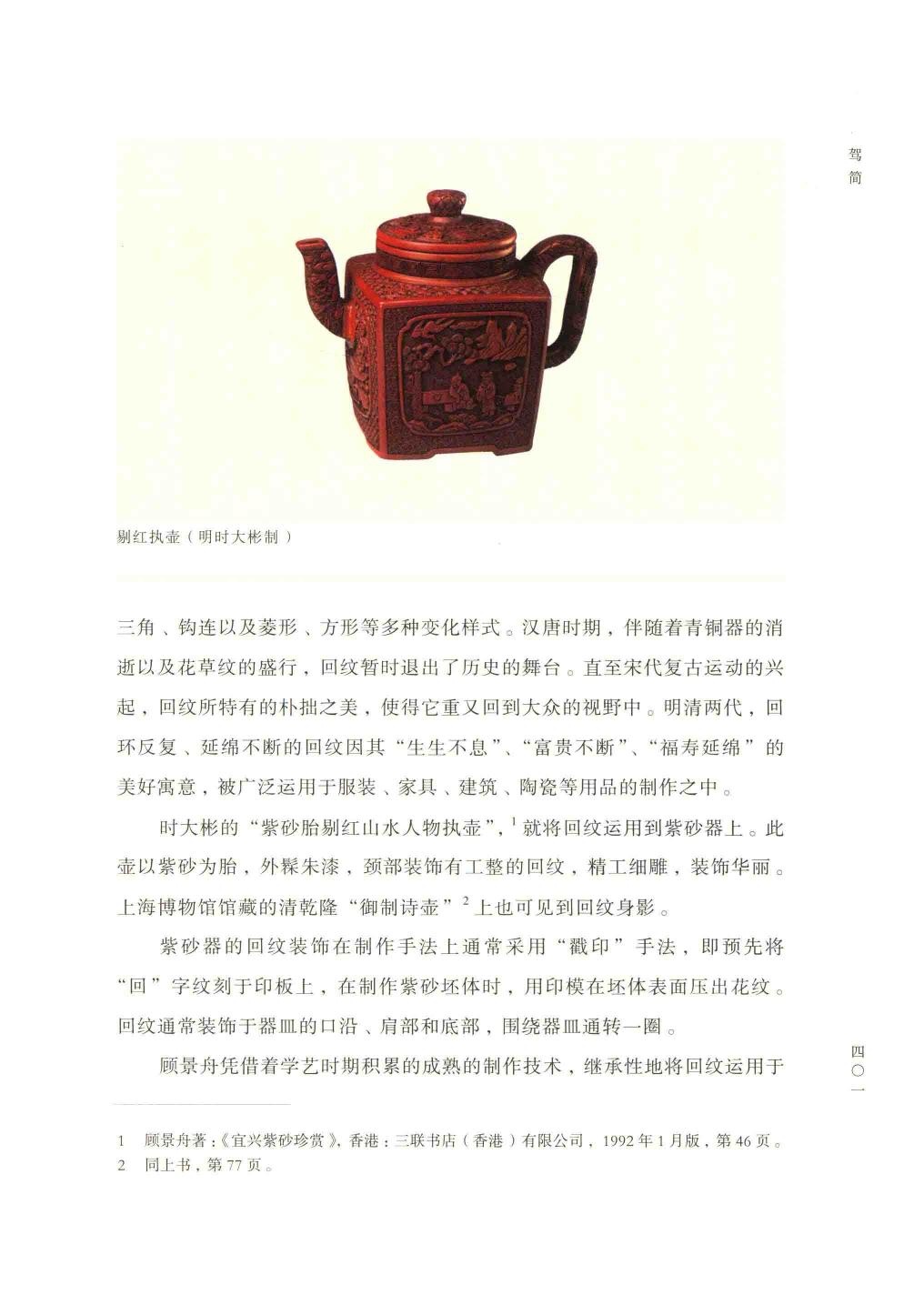
Shi Dabin's "carved red lacquer on Yixing clay body" applied the key-fret pattern to Yixing ware. The ewer uses Yixing clay as its body, coated with red vermillion lacquer on the exterior, with neat key-fret patterns decorating the neck area, finely carved with elaborate ornamentation. The Qing Qianlong period "Ewer with Figures in Landscape" housed in the Shanghai Museum also features the key-fret pattern in its "inscribed poem" section.
The decorative key-fret pattern on Yixing ware typically employs the "stamping" technique in its craftsmanship, where the "回" (hui) character pattern is carved onto a stamp board in advance, and during the making of the Yixing clay body, the pattern is pressed onto the surface of the clay body from the stamp mold. The key-fret pattern is usually decorated on the rim, shoulder, and base of the vessel, encircling the entire piece. Gu Jingzhou, drawing upon the mature production techniques accumulated during his apprenticeship period, inherited the tradition of applying the key-fret pattern.
---
[1] Gu Jingzhou, *Appreciation of Yixing Zisha Treasures*, Hong Kong: Joint Publishing (Hong Kong) Co., Ltd., January 1992 edition, p. 46.
[2] Ibid., p. 77.
Chapter 6
驾简
Mastering Simplicity
Pages 406-427
View Chapter →
English Translation
triangular, hooked and connected, as well as rhomboid, square, and many other variations. During the Han and Tang dynasties, accompanying the decline of bronze vessels and the prevalence of floral patterns, the key-fret pattern temporarily withdrew from the historical stage. It was not until the rise of the archaistic movement in the Song dynasty that the key-fret pattern, with its continuous repetition and unbroken extension, returned to public view due to its inherent rustic beauty. During the Ming and Qing dynasties, the key-fret pattern was widely applied in the production of clothing, furniture, architecture, ceramics, and other items because of its auspicious meanings of "endless vitality," "unceasing wealth and honor," and "prolonged fortune and longevity."
Shi Dabin's "carved red lacquer on Yixing clay body" applied the key-fret pattern to Yixing ware. The ewer uses Yixing clay as its body, coated with red vermillion lacquer on the exterior, with neat key-fret patterns decorating the neck area, finely carved with elaborate ornamentation. The Qing Qianlong period "Ewer with Figures in Landscape" housed in the Shanghai Museum also features the key-fret pattern in its "inscribed poem" section.
The decorative key-fret pattern on Yixing ware typically employs the "stamping" technique in its craftsmanship, where the "回" (hui) character pattern is carved onto a stamp board in advance, and during the making of the Yixing clay body, the pattern is pressed onto the surface of the clay body from the stamp mold. The key-fret pattern is usually decorated on the rim, shoulder, and base of the vessel, encircling the entire piece. Gu Jingzhou, drawing upon the mature production techniques accumulated during his apprenticeship period, inherited the tradition of applying the key-fret pattern.
---
[1] Gu Jingzhou, *Appreciation of Yixing Zisha Treasures*, Hong Kong: Joint Publishing (Hong Kong) Co., Ltd., January 1992 edition, p. 46.
[2] Ibid., p. 77.
章节导航 Chapter Navigation
Chapter 1
序文
Pages 6-6
Chapter 2
引言
Pages 28-31
Chapter 3
达变
Pages 32-133
Chapter 3
开宗立派
Pages 46-66
Chapter 3
传道授业
Pages 67-98
Chapter 3
大师淳友
Pages 99-120
Chapter 3
学艺谋生
Pages 121-133
Chapter 4
化神
Pages 134-141
Chapter 5
独妙
Pages 142-405
Chapter 5
匠心独运 不苟丝毫
Pages 142-179
Chapter 5
器利善事 物尽其用
Pages 180-199
Chapter 5
紫泥春华 研精究微
Pages 200-405
Chapter 6
驾简
Pages 406-427
Chapter 6
精雕细刻 文质合一
Pages 406-410
Chapter 6
师法自然 妙趣横生
Pages 411-415
Chapter 6
丝来线去 曲尽其妙
Pages 416-427
Chapter 7
明志
Pages 463-485
Chapter 7
高山仰止 淡泊明志
Pages 463-472
Chapter 7
啜墨看茶 气定神闲
Pages 473-478
Chapter 7
齿少心锐 怡志抒情
Pages 479-485
Chapter 8
存真
Pages 428-462
Chapter 8
规圆矩方 弃伪存真
Pages 428-436
Chapter 8
有物有则 钻尖仰高
Pages 437-462
Chapter 9
心营
Pages 506-525
Chapter 9
坚守传统 艺立潮头
Pages 506-513
Chapter 9
新型师承 桃李满园
Pages 514-525
Chapter 10
附录
Pages 526-651
Chapter 10
顾景舟紫艺论文
Pages 526-535
Chapter 10
技术课备课笔记
Pages 536-543
Chapter 10
顾景舟艺术年表
Pages 544-651
Chapter 11
参考文献
Pages 652-657
Chapter 12
鸣谢
Pages 658-659