Chapter 3
达变
Adaptation
46
of 659
English Translation
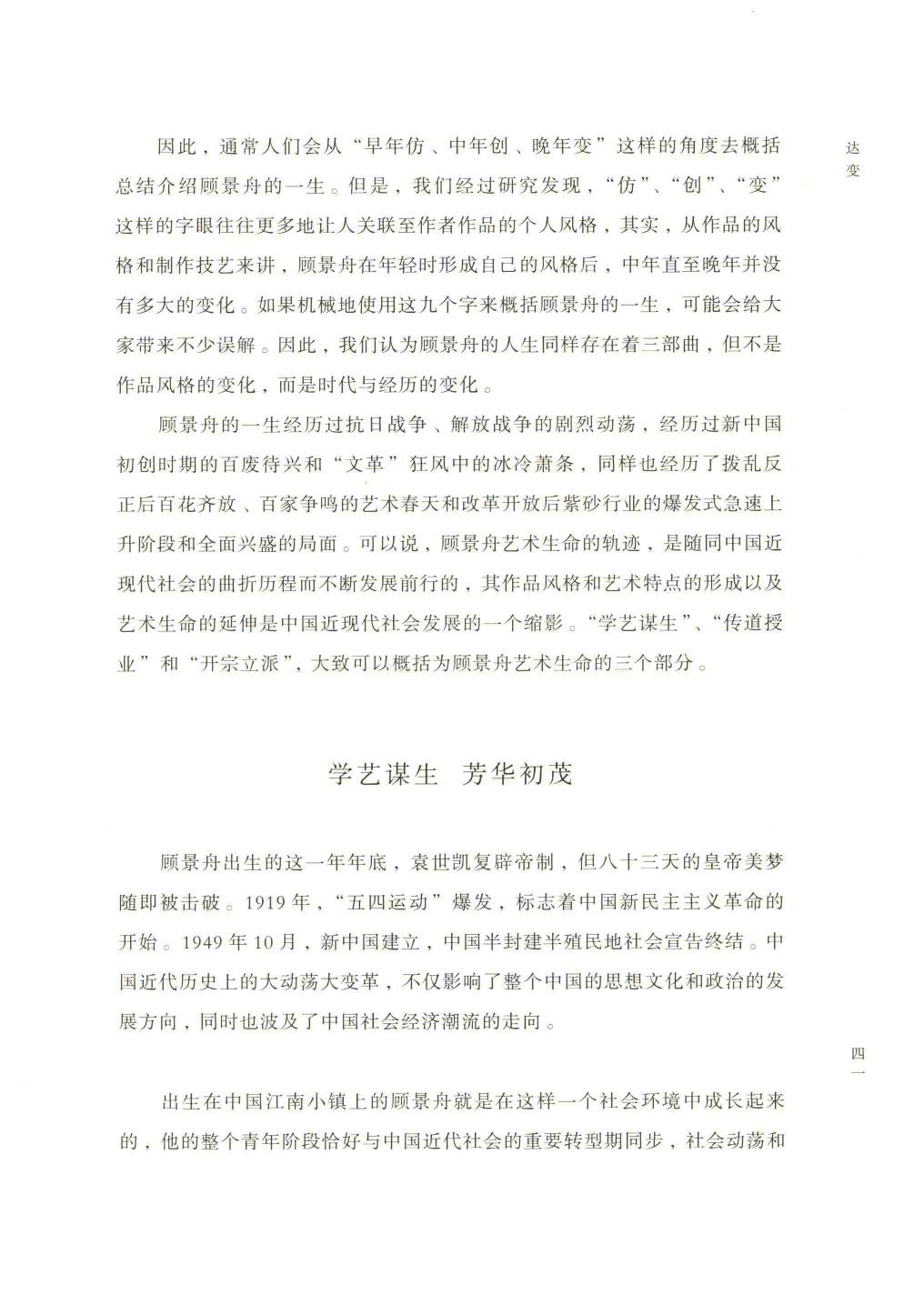
Therefore, people usually summarize Gu Jingzhou's life with the phrase "imitation in early years, creation in middle years, transformation in late years." However, through our research, we have found that such wording often leads to considerable misunderstanding among researchers. In fact, from the perspective of his works' style and craftsmanship, after Gu Jingzhou formed his own style in his youth, there were no significant changes from middle age through his later years. If we mechanically use these nine characters to summarize Gu Jingzhou's life, it may bring many misconceptions to everyone. Therefore, we believe that Gu Jingzhou's life also has a trilogy, but it is not about changes in personal style related to the author's works, but rather changes in era and experience. From this perspective, Gu Jingzhou experienced the violent turbulence of the Anti-Japanese War and the War of Liberation, the desolation and depression of the early days of New China's founding and the icy cold winds of the "Cultural Revolution," as well as the artistic spring of "letting a hundred flowers bloom and a hundred schools of thought contend" after order was restored, and the explosive rapid rise of the purple clay industry after reform and opening up. It can be said that the trajectory of Gu Jingzhou's artistic life developed and progressed alongside the tortuous course of modern and contemporary Chinese society. The formation of his work style and artistic characteristics, as well as the extension of his artistic life, are a microcosm of the development of modern and contemporary Chinese society. "Learning the craft to make a living," "passing on knowledge and teaching," and "founding a school of thought" can roughly be summarized as the three parts of Gu Jingzhou's artistic life.
## Learning the Craft to Make a Living: The Budding of Youth
At the end of the year Gu Jingzhou was born, Yuan Shikai attempted to restore the imperial system, but his eighty-three-day emperor's dream was immediately shattered. In 1919, the "May Fourth Movement" broke out, marking the beginning of China's New Democratic Revolution. In October 1949, New China was established, declaring the end of China's semi-feudal and semi-colonial society. The great upheavals and transformations in modern Chinese history not only influenced the entire country's ideological, cultural, and political development direction, but also affected the trends of China's socioeconomic currents. Gu Jingzhou, born in a small town in Jiangnan, grew up in such a social environment. His entire youth coincided with an important transitional period in modern Chinese society, and the social turmoil and
Chapter 3
达变
Adaptation
Pages 32-133
View Chapter →
English Translation
Therefore, people usually summarize Gu Jingzhou's life with the phrase "imitation in early years, creation in middle years, transformation in late years." However, through our research, we have found that such wording often leads to considerable misunderstanding among researchers. In fact, from the perspective of his works' style and craftsmanship, after Gu Jingzhou formed his own style in his youth, there were no significant changes from middle age through his later years. If we mechanically use these nine characters to summarize Gu Jingzhou's life, it may bring many misconceptions to everyone. Therefore, we believe that Gu Jingzhou's life also has a trilogy, but it is not about changes in personal style related to the author's works, but rather changes in era and experience. From this perspective, Gu Jingzhou experienced the violent turbulence of the Anti-Japanese War and the War of Liberation, the desolation and depression of the early days of New China's founding and the icy cold winds of the "Cultural Revolution," as well as the artistic spring of "letting a hundred flowers bloom and a hundred schools of thought contend" after order was restored, and the explosive rapid rise of the purple clay industry after reform and opening up. It can be said that the trajectory of Gu Jingzhou's artistic life developed and progressed alongside the tortuous course of modern and contemporary Chinese society. The formation of his work style and artistic characteristics, as well as the extension of his artistic life, are a microcosm of the development of modern and contemporary Chinese society. "Learning the craft to make a living," "passing on knowledge and teaching," and "founding a school of thought" can roughly be summarized as the three parts of Gu Jingzhou's artistic life.
## Learning the Craft to Make a Living: The Budding of Youth
At the end of the year Gu Jingzhou was born, Yuan Shikai attempted to restore the imperial system, but his eighty-three-day emperor's dream was immediately shattered. In 1919, the "May Fourth Movement" broke out, marking the beginning of China's New Democratic Revolution. In October 1949, New China was established, declaring the end of China's semi-feudal and semi-colonial society. The great upheavals and transformations in modern Chinese history not only influenced the entire country's ideological, cultural, and political development direction, but also affected the trends of China's socioeconomic currents. Gu Jingzhou, born in a small town in Jiangnan, grew up in such a social environment. His entire youth coincided with an important transitional period in modern Chinese society, and the social turmoil and
章节导航 Chapter Navigation
Chapter 1
序文
Pages 6-6
Chapter 2
引言
Pages 28-31
Chapter 3
达变
Pages 32-133
Chapter 3
开宗立派
Pages 46-66
Chapter 3
传道授业
Pages 67-98
Chapter 3
大师淳友
Pages 99-120
Chapter 3
学艺谋生
Pages 121-133
Chapter 4
化神
Pages 134-141
Chapter 5
独妙
Pages 142-405
Chapter 5
匠心独运 不苟丝毫
Pages 142-179
Chapter 5
器利善事 物尽其用
Pages 180-199
Chapter 5
紫泥春华 研精究微
Pages 200-405
Chapter 6
驾简
Pages 406-427
Chapter 6
精雕细刻 文质合一
Pages 406-410
Chapter 6
师法自然 妙趣横生
Pages 411-415
Chapter 6
丝来线去 曲尽其妙
Pages 416-427
Chapter 7
明志
Pages 463-485
Chapter 7
高山仰止 淡泊明志
Pages 463-472
Chapter 7
啜墨看茶 气定神闲
Pages 473-478
Chapter 7
齿少心锐 怡志抒情
Pages 479-485
Chapter 8
存真
Pages 428-462
Chapter 8
规圆矩方 弃伪存真
Pages 428-436
Chapter 8
有物有则 钻尖仰高
Pages 437-462
Chapter 9
心营
Pages 506-525
Chapter 9
坚守传统 艺立潮头
Pages 506-513
Chapter 9
新型师承 桃李满园
Pages 514-525
Chapter 10
附录
Pages 526-651
Chapter 10
顾景舟紫艺论文
Pages 526-535
Chapter 10
技术课备课笔记
Pages 536-543
Chapter 10
顾景舟艺术年表
Pages 544-651
Chapter 11
参考文献
Pages 652-657
Chapter 12
鸣谢
Pages 658-659