Chapter 3
达变
Adaptation
128
of 659
English Translation
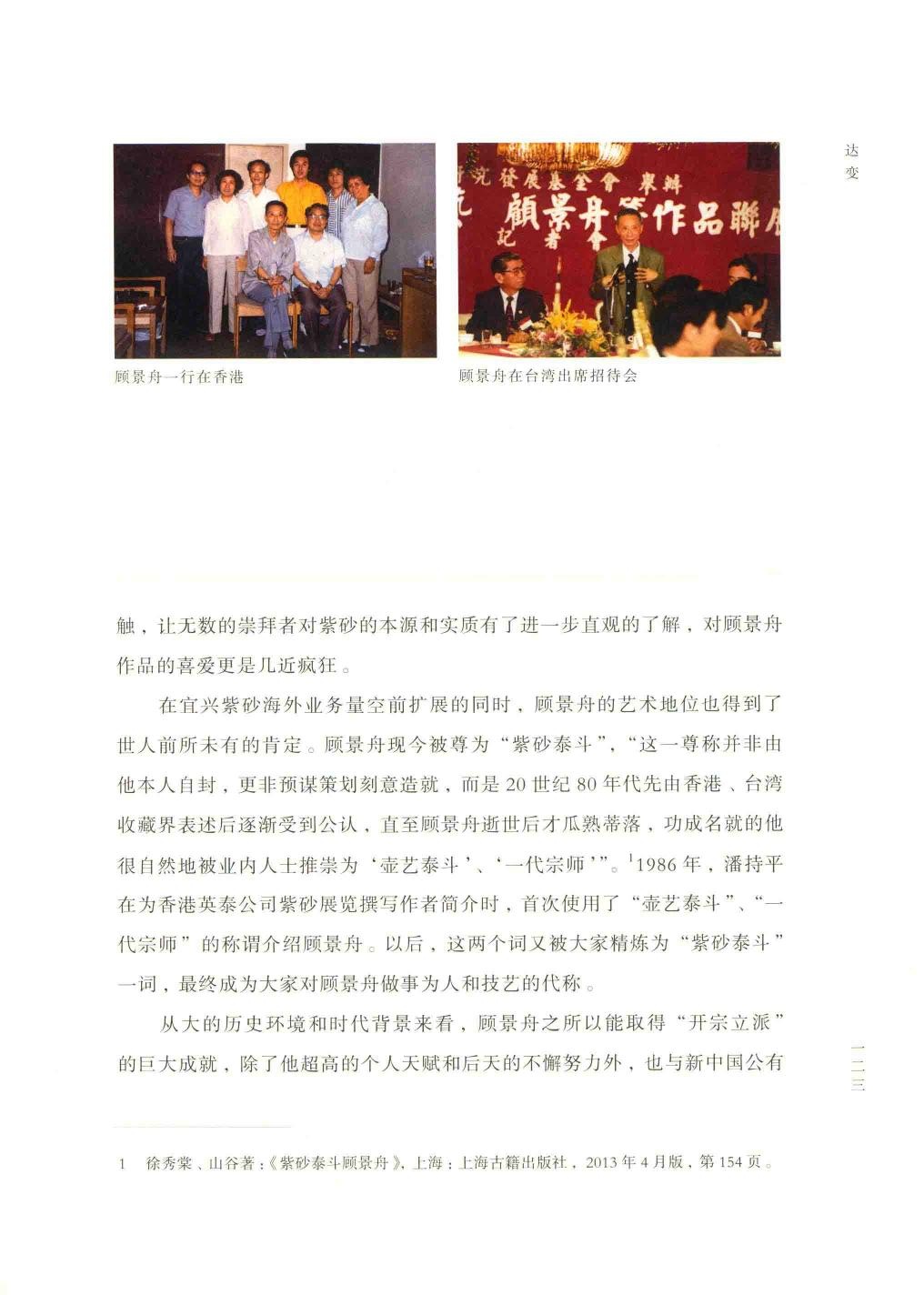
[Image captions: Jingzhou's group in Hong Kong | Gu Jingzhou attending a reception in Taiwan]
This contact allowed countless admirers to gain a more direct understanding of the origins and essence of Yixing pottery, and their appreciation for Gu Jingzhou's works became almost fanatical.
As Yixing pottery's overseas business expanded to unprecedented levels, Gu Jingzhou's artistic status also received recognition from the world like never before. Gu Jingzhou is now revered as the "Grand Master of Yixing Pottery." This honorific title was not self-proclaimed by him, nor was it deliberately planned or manufactured. Rather, it was first expressed by collectors in Hong Kong and Taiwan in the 1980s and gradually gained widespread recognition. It was only after Gu Jingzhou's death that this naturally came to fruition, and he was quite naturally acclaimed by industry insiders as the "Grand Master of Teapot Art" and "Master of a Generation." In 1986, when Pan Chiping was writing artist biographies for the Yixing pottery exhibition at Hong Kong's Ying Tai Company, he first used the terms "Grand Master of Teapot Art" and "Master of a Generation" to introduce Gu Jingzhou. Later, these two phrases were refined by everyone into the single term "Grand Master of Yixing Pottery," which ultimately became the common designation for Gu Jingzhou's character, conduct, and craftsmanship.
From the perspective of the broader historical environment and era, the reason Gu Jingzhou was able to achieve the tremendous accomplishment of "founding a school and establishing a tradition" was not only due to his exceptional personal talent and tireless efforts, but also related to the public ownership system of New China...
---
[1] Xu Xiudang and Shangu, *Grand Master of Yixing Pottery: Gu Jingzhou* (Shanghai: Shanghai Classics Publishing House, April 2013 edition), p. 154.
Chapter 3
达变
Adaptation
Pages 32-133
View Chapter →
English Translation
[Image captions: Jingzhou's group in Hong Kong | Gu Jingzhou attending a reception in Taiwan]
This contact allowed countless admirers to gain a more direct understanding of the origins and essence of Yixing pottery, and their appreciation for Gu Jingzhou's works became almost fanatical.
As Yixing pottery's overseas business expanded to unprecedented levels, Gu Jingzhou's artistic status also received recognition from the world like never before. Gu Jingzhou is now revered as the "Grand Master of Yixing Pottery." This honorific title was not self-proclaimed by him, nor was it deliberately planned or manufactured. Rather, it was first expressed by collectors in Hong Kong and Taiwan in the 1980s and gradually gained widespread recognition. It was only after Gu Jingzhou's death that this naturally came to fruition, and he was quite naturally acclaimed by industry insiders as the "Grand Master of Teapot Art" and "Master of a Generation." In 1986, when Pan Chiping was writing artist biographies for the Yixing pottery exhibition at Hong Kong's Ying Tai Company, he first used the terms "Grand Master of Teapot Art" and "Master of a Generation" to introduce Gu Jingzhou. Later, these two phrases were refined by everyone into the single term "Grand Master of Yixing Pottery," which ultimately became the common designation for Gu Jingzhou's character, conduct, and craftsmanship.
From the perspective of the broader historical environment and era, the reason Gu Jingzhou was able to achieve the tremendous accomplishment of "founding a school and establishing a tradition" was not only due to his exceptional personal talent and tireless efforts, but also related to the public ownership system of New China...
---
[1] Xu Xiudang and Shangu, *Grand Master of Yixing Pottery: Gu Jingzhou* (Shanghai: Shanghai Classics Publishing House, April 2013 edition), p. 154.
章节导航 Chapter Navigation
Chapter 1
序文
Pages 6-6
Chapter 2
引言
Pages 28-31
Chapter 3
达变
Pages 32-133
Chapter 3
开宗立派
Pages 46-66
Chapter 3
传道授业
Pages 67-98
Chapter 3
大师淳友
Pages 99-120
Chapter 3
学艺谋生
Pages 121-133
Chapter 4
化神
Pages 134-141
Chapter 5
独妙
Pages 142-405
Chapter 5
匠心独运 不苟丝毫
Pages 142-179
Chapter 5
器利善事 物尽其用
Pages 180-199
Chapter 5
紫泥春华 研精究微
Pages 200-405
Chapter 6
驾简
Pages 406-427
Chapter 6
精雕细刻 文质合一
Pages 406-410
Chapter 6
师法自然 妙趣横生
Pages 411-415
Chapter 6
丝来线去 曲尽其妙
Pages 416-427
Chapter 7
明志
Pages 463-485
Chapter 7
高山仰止 淡泊明志
Pages 463-472
Chapter 7
啜墨看茶 气定神闲
Pages 473-478
Chapter 7
齿少心锐 怡志抒情
Pages 479-485
Chapter 8
存真
Pages 428-462
Chapter 8
规圆矩方 弃伪存真
Pages 428-436
Chapter 8
有物有则 钻尖仰高
Pages 437-462
Chapter 9
心营
Pages 506-525
Chapter 9
坚守传统 艺立潮头
Pages 506-513
Chapter 9
新型师承 桃李满园
Pages 514-525
Chapter 10
附录
Pages 526-651
Chapter 10
顾景舟紫艺论文
Pages 526-535
Chapter 10
技术课备课笔记
Pages 536-543
Chapter 10
顾景舟艺术年表
Pages 544-651
Chapter 11
参考文献
Pages 652-657
Chapter 12
鸣谢
Pages 658-659