Chapter 5
独妙
Unique Excellence
164
of 659
English Translation
The "shuiping" teapot has a long history and is popular in Guangdong, Fujian, and Southeast Asian regions of China. It is the primary vessel used for "gongfu tea." The so-called "gongfu tea" does not merely refer to attention to the details of tea preparation; more importantly, it represents a standardized and ritualized way of drinking tea. During the Qianlong period of the Qing Dynasty, Xi Guangdou wrote in *Min Suo Ji* (Records of Fujian):
> "Passing through Longxi, I encountered a rustic pavilion by chance on the road. The host invited me into a simple room where a ground stove kept a lively fire, and a teapot awaited. The pot was extremely small, holding only enough for one sip, yet as soon as it went down the throat, it permeated the heart and spleen."
Drinking gongfu tea places extremely high demands on tea utensils. Zhou Kai wrote in *Xiamen Zhi* (Gazetteer of Xiamen) during the Daoguang period of the Qing Dynasty: "The local custom favors Chinese tea, with utensils refined and small. Teapots must be from Huimengchen, and cups must be Ruoshen cups."
The shuiping teapot gradually became an important category of Yixing purple clay teapots. Zhang Tingji, a famous scholar and connoisseur from northern Zhejiang during the Qing Dynasty, carved on the wooden base of a small Huimengchen purple clay teapot in his collection: "A single drop from this pot is worth a thousand gold." The popularity of small purple clay teapots is evident from this.
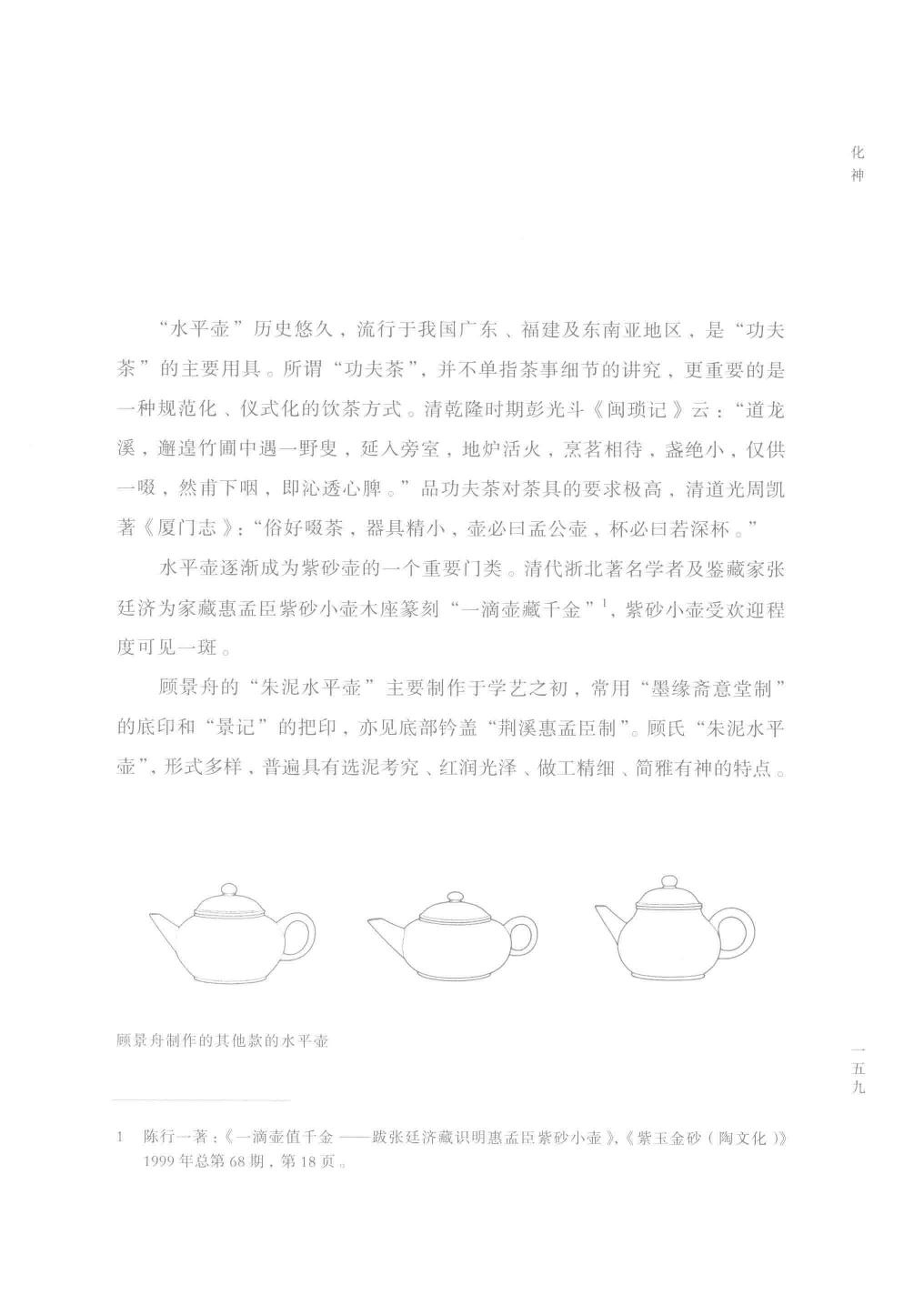
Gu Jingzhou's "zhu ni shuiping teapots" were mainly made during his early apprenticeship years. He commonly used the base seal "Moyuanzhai Yitang Zhi" and the handle seal "Jing Ji," and occasionally the base was stamped with "Yanxi Huimengchen Zhi." Gu's "zhu ni shuiping teapots" came in various forms and generally possessed the characteristics of carefully selected clay, lustrous red color, exquisite craftsmanship, and elegant simplicity with spirit.
Shuiping teapots of other styles made by Gu Jingzhou
---
[1] Chen Xingyi, "A Single Drop from This Pot is Worth a Thousand Gold—On Zhang Tingji's Collection and Authentication of Ming Dynasty Huimengchen Small Purple Clay Teapots," *Ziyu Jinsha (Ceramic Culture)*, Issue 68 (1999), p. 18.
Chapter 5
独妙
Unique Excellence
Pages 142-405
View Chapter →
English Translation
The "shuiping" teapot has a long history and is popular in Guangdong, Fujian, and Southeast Asian regions of China. It is the primary vessel used for "gongfu tea." The so-called "gongfu tea" does not merely refer to attention to the details of tea preparation; more importantly, it represents a standardized and ritualized way of drinking tea. During the Qianlong period of the Qing Dynasty, Xi Guangdou wrote in *Min Suo Ji* (Records of Fujian):
> "Passing through Longxi, I encountered a rustic pavilion by chance on the road. The host invited me into a simple room where a ground stove kept a lively fire, and a teapot awaited. The pot was extremely small, holding only enough for one sip, yet as soon as it went down the throat, it permeated the heart and spleen."
Drinking gongfu tea places extremely high demands on tea utensils. Zhou Kai wrote in *Xiamen Zhi* (Gazetteer of Xiamen) during the Daoguang period of the Qing Dynasty: "The local custom favors Chinese tea, with utensils refined and small. Teapots must be from Huimengchen, and cups must be Ruoshen cups."
The shuiping teapot gradually became an important category of Yixing purple clay teapots. Zhang Tingji, a famous scholar and connoisseur from northern Zhejiang during the Qing Dynasty, carved on the wooden base of a small Huimengchen purple clay teapot in his collection: "A single drop from this pot is worth a thousand gold." The popularity of small purple clay teapots is evident from this.
Gu Jingzhou's "zhu ni shuiping teapots" were mainly made during his early apprenticeship years. He commonly used the base seal "Moyuanzhai Yitang Zhi" and the handle seal "Jing Ji," and occasionally the base was stamped with "Yanxi Huimengchen Zhi." Gu's "zhu ni shuiping teapots" came in various forms and generally possessed the characteristics of carefully selected clay, lustrous red color, exquisite craftsmanship, and elegant simplicity with spirit.
Shuiping teapots of other styles made by Gu Jingzhou
---
[1] Chen Xingyi, "A Single Drop from This Pot is Worth a Thousand Gold—On Zhang Tingji's Collection and Authentication of Ming Dynasty Huimengchen Small Purple Clay Teapots," *Ziyu Jinsha (Ceramic Culture)*, Issue 68 (1999), p. 18.
章节导航 Chapter Navigation
Chapter 1
序文
Pages 6-6
Chapter 2
引言
Pages 28-31
Chapter 3
达变
Pages 32-133
Chapter 3
开宗立派
Pages 46-66
Chapter 3
传道授业
Pages 67-98
Chapter 3
大师淳友
Pages 99-120
Chapter 3
学艺谋生
Pages 121-133
Chapter 4
化神
Pages 134-141
Chapter 5
独妙
Pages 142-405
Chapter 5
匠心独运 不苟丝毫
Pages 142-179
Chapter 5
器利善事 物尽其用
Pages 180-199
Chapter 5
紫泥春华 研精究微
Pages 200-405
Chapter 6
驾简
Pages 406-427
Chapter 6
精雕细刻 文质合一
Pages 406-410
Chapter 6
师法自然 妙趣横生
Pages 411-415
Chapter 6
丝来线去 曲尽其妙
Pages 416-427
Chapter 7
明志
Pages 463-485
Chapter 7
高山仰止 淡泊明志
Pages 463-472
Chapter 7
啜墨看茶 气定神闲
Pages 473-478
Chapter 7
齿少心锐 怡志抒情
Pages 479-485
Chapter 8
存真
Pages 428-462
Chapter 8
规圆矩方 弃伪存真
Pages 428-436
Chapter 8
有物有则 钻尖仰高
Pages 437-462
Chapter 9
心营
Pages 506-525
Chapter 9
坚守传统 艺立潮头
Pages 506-513
Chapter 9
新型师承 桃李满园
Pages 514-525
Chapter 10
附录
Pages 526-651
Chapter 10
顾景舟紫艺论文
Pages 526-535
Chapter 10
技术课备课笔记
Pages 536-543
Chapter 10
顾景舟艺术年表
Pages 544-651
Chapter 11
参考文献
Pages 652-657
Chapter 12
鸣谢
Pages 658-659