Chapter 5
独妙
Unique Excellence
208
of 659
English Translation
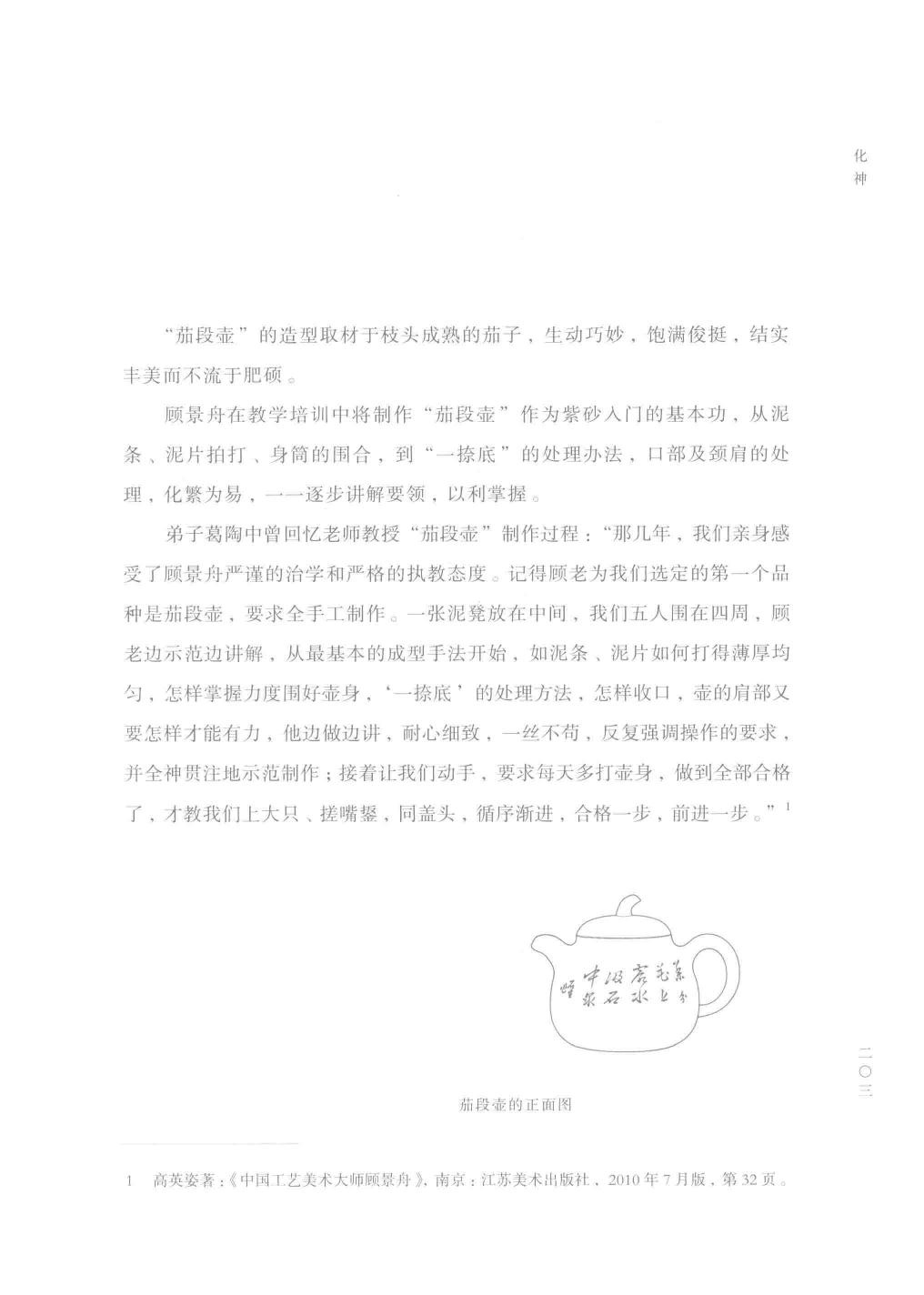
The form of the "Eggplant Segment Teapot" draws inspiration from ripe eggplants on the branch—vivid and ingenious, full and upright, solid and abundant without becoming overly plump.
In his teaching and training, Gu Jingzhou made the creation of the "Eggplant Segment Teapot" a fundamental exercise for beginners in Yixing pottery. He simplified complexity into manageable steps, explaining each key point systematically to facilitate mastery—from kneading the clay and beating clay slabs, to forming the body cylinder, handling the "single-palm base," and treating the mouth, neck, and shoulder.
His disciple Ge Taozhong once recalled the teacher's instruction on making the "Eggplant Segment Teapot": "During those years, we personally experienced Gu Jingzhou's rigorous scholarship and strict teaching approach. I remember the first piece Master Gu selected for us was the Eggplant Segment Teapot, requiring entirely handmade construction. A clay table was placed in the center, with the five of us gathered around. Master Gu demonstrated while explaining, starting from the most basic forming techniques—how to beat clay coils and slabs to uniform thickness, how to control one's strength to properly form the teapot body, the method for handling the 'single-palm base,' how to close the mouth, and how to give the shoulder strength. He worked while teaching, patient and meticulous, utterly conscientious, repeatedly emphasizing operational requirements and demonstrating with complete concentration. Then he had us practice, requiring us to form multiple teapot bodies daily until all were qualified. Only then would he teach us to attach the handle, shape the spout, and fit the lid—progressing step by step, advancing only when each stage met standards."[1]
> Front view of the Eggplant Segment Teapot
---
[1] Gao Yingzi, *Gu Jingzhou: Master of Chinese Arts and Crafts* (Nanjing: Jiangsu Fine Arts Publishing House, July 2010), p. 32.
Chapter 5
独妙
Unique Excellence
Pages 142-405
View Chapter →
English Translation
The form of the "Eggplant Segment Teapot" draws inspiration from ripe eggplants on the branch—vivid and ingenious, full and upright, solid and abundant without becoming overly plump.
In his teaching and training, Gu Jingzhou made the creation of the "Eggplant Segment Teapot" a fundamental exercise for beginners in Yixing pottery. He simplified complexity into manageable steps, explaining each key point systematically to facilitate mastery—from kneading the clay and beating clay slabs, to forming the body cylinder, handling the "single-palm base," and treating the mouth, neck, and shoulder.
His disciple Ge Taozhong once recalled the teacher's instruction on making the "Eggplant Segment Teapot": "During those years, we personally experienced Gu Jingzhou's rigorous scholarship and strict teaching approach. I remember the first piece Master Gu selected for us was the Eggplant Segment Teapot, requiring entirely handmade construction. A clay table was placed in the center, with the five of us gathered around. Master Gu demonstrated while explaining, starting from the most basic forming techniques—how to beat clay coils and slabs to uniform thickness, how to control one's strength to properly form the teapot body, the method for handling the 'single-palm base,' how to close the mouth, and how to give the shoulder strength. He worked while teaching, patient and meticulous, utterly conscientious, repeatedly emphasizing operational requirements and demonstrating with complete concentration. Then he had us practice, requiring us to form multiple teapot bodies daily until all were qualified. Only then would he teach us to attach the handle, shape the spout, and fit the lid—progressing step by step, advancing only when each stage met standards."[1]
> Front view of the Eggplant Segment Teapot
---
[1] Gao Yingzi, *Gu Jingzhou: Master of Chinese Arts and Crafts* (Nanjing: Jiangsu Fine Arts Publishing House, July 2010), p. 32.
章节导航 Chapter Navigation
Chapter 1
序文
Pages 6-6
Chapter 2
引言
Pages 28-31
Chapter 3
达变
Pages 32-133
Chapter 3
开宗立派
Pages 46-66
Chapter 3
传道授业
Pages 67-98
Chapter 3
大师淳友
Pages 99-120
Chapter 3
学艺谋生
Pages 121-133
Chapter 4
化神
Pages 134-141
Chapter 5
独妙
Pages 142-405
Chapter 5
匠心独运 不苟丝毫
Pages 142-179
Chapter 5
器利善事 物尽其用
Pages 180-199
Chapter 5
紫泥春华 研精究微
Pages 200-405
Chapter 6
驾简
Pages 406-427
Chapter 6
精雕细刻 文质合一
Pages 406-410
Chapter 6
师法自然 妙趣横生
Pages 411-415
Chapter 6
丝来线去 曲尽其妙
Pages 416-427
Chapter 7
明志
Pages 463-485
Chapter 7
高山仰止 淡泊明志
Pages 463-472
Chapter 7
啜墨看茶 气定神闲
Pages 473-478
Chapter 7
齿少心锐 怡志抒情
Pages 479-485
Chapter 8
存真
Pages 428-462
Chapter 8
规圆矩方 弃伪存真
Pages 428-436
Chapter 8
有物有则 钻尖仰高
Pages 437-462
Chapter 9
心营
Pages 506-525
Chapter 9
坚守传统 艺立潮头
Pages 506-513
Chapter 9
新型师承 桃李满园
Pages 514-525
Chapter 10
附录
Pages 526-651
Chapter 10
顾景舟紫艺论文
Pages 526-535
Chapter 10
技术课备课笔记
Pages 536-543
Chapter 10
顾景舟艺术年表
Pages 544-651
Chapter 11
参考文献
Pages 652-657
Chapter 12
鸣谢
Pages 658-659