Chapter 5
独妙
Unique Excellence
224
of 659
English Translation
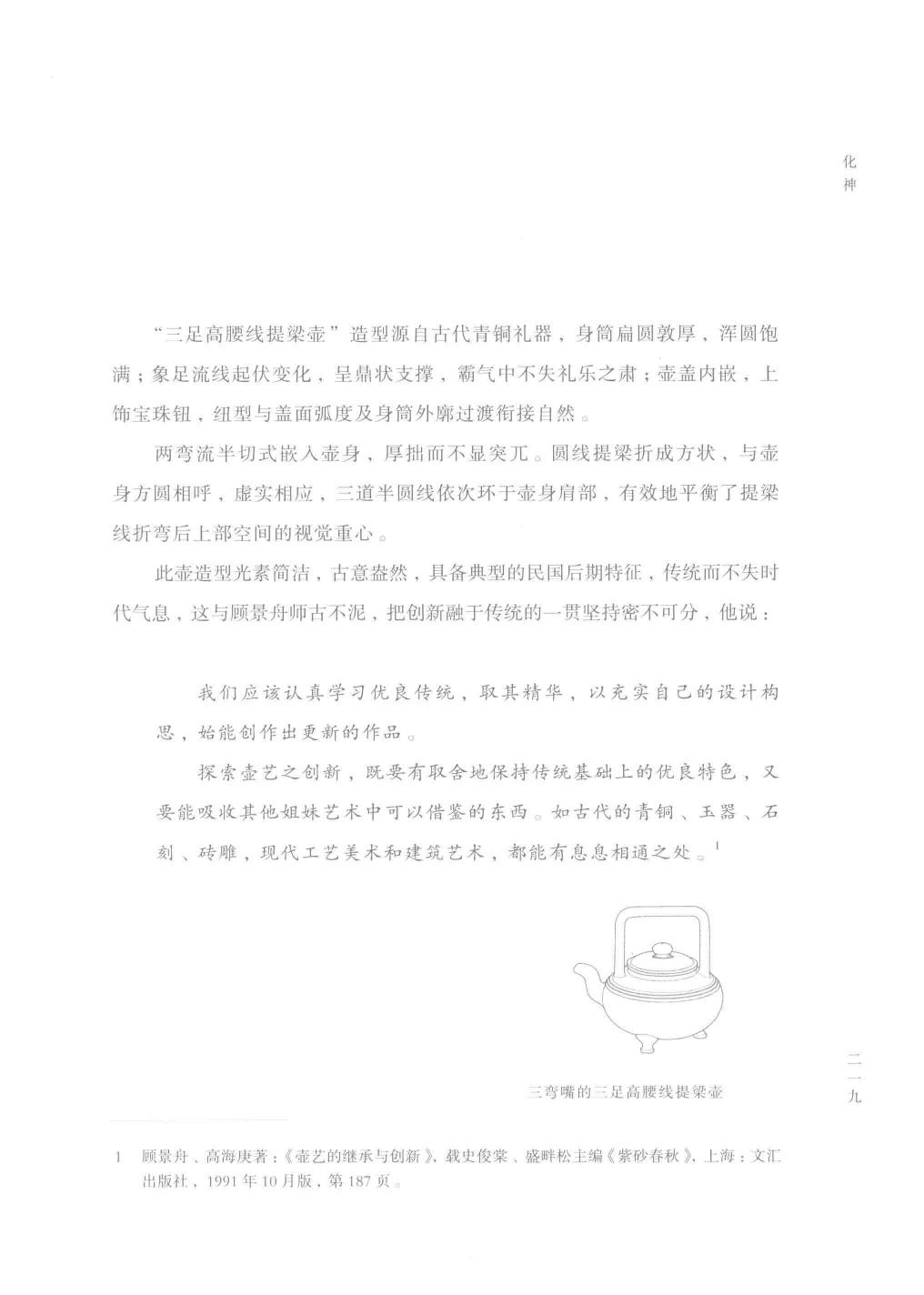
The form of the "Three-Legged High-Waisted Overhead Handle Teapot" originates from ancient bronze ritual vessels. Its body is simple, rounded, and substantial, with a full and complete belly. The elephant-foot spout features flowing, undulating lines that form a tripod-like support, maintaining the dignity of ritual and music within its imposing presence. The flat lid is inset, adorned with a jewel-shaped knob on top. The knob's form transitions naturally with the arc of the lid surface and the outer contour of the body.
The curved spout is half-cut and integrated into the body of the pot, appearing thick and solid without seeming abrupt or clumsy. The round overhead handle is bent into a square shape, echoing the square and round forms of the body, creating a harmonious interplay of solid and void. Three semi-circular lines encircle the shoulder of the body in succession, effectively balancing the visual center of gravity in the upper space after the handle's angular bend.
This teapot's form is plain and simple, with an inherent ancient elegance. It possesses the typical characteristics of the late Republican period—traditional yet not lacking in contemporary spirit. This is inseparable from Gu Jingzhou's consistent principle of learning from the ancients without being bound by them, integrating innovation into tradition. He said:
> We should earnestly study excellent traditions, extract their essence, and enrich our own design concepts, so that we can create even newer works.
> In exploring innovation in teapot art, we must selectively preserve the excellent characteristics based on traditional foundations, while also being able to absorb what can be learned from other sister arts. Ancient bronzes, jade, stone carvings, brick sculptures, modern arts and crafts, and architectural art—all can have interconnected elements.[1]
---
[1] Gu Jingzhou and Gao Haigeng, "The Inheritance and Innovation of Teapot Art," in *Annals of Purple Clay*, ed. Shi Jundang and Sheng Pansong (Shanghai: Wenhui Publishing House, October 1991), 187.
Chapter 5
独妙
Unique Excellence
Pages 142-405
View Chapter →
English Translation
The form of the "Three-Legged High-Waisted Overhead Handle Teapot" originates from ancient bronze ritual vessels. Its body is simple, rounded, and substantial, with a full and complete belly. The elephant-foot spout features flowing, undulating lines that form a tripod-like support, maintaining the dignity of ritual and music within its imposing presence. The flat lid is inset, adorned with a jewel-shaped knob on top. The knob's form transitions naturally with the arc of the lid surface and the outer contour of the body.
The curved spout is half-cut and integrated into the body of the pot, appearing thick and solid without seeming abrupt or clumsy. The round overhead handle is bent into a square shape, echoing the square and round forms of the body, creating a harmonious interplay of solid and void. Three semi-circular lines encircle the shoulder of the body in succession, effectively balancing the visual center of gravity in the upper space after the handle's angular bend.
This teapot's form is plain and simple, with an inherent ancient elegance. It possesses the typical characteristics of the late Republican period—traditional yet not lacking in contemporary spirit. This is inseparable from Gu Jingzhou's consistent principle of learning from the ancients without being bound by them, integrating innovation into tradition. He said:
> We should earnestly study excellent traditions, extract their essence, and enrich our own design concepts, so that we can create even newer works.
> In exploring innovation in teapot art, we must selectively preserve the excellent characteristics based on traditional foundations, while also being able to absorb what can be learned from other sister arts. Ancient bronzes, jade, stone carvings, brick sculptures, modern arts and crafts, and architectural art—all can have interconnected elements.[1]
---
[1] Gu Jingzhou and Gao Haigeng, "The Inheritance and Innovation of Teapot Art," in *Annals of Purple Clay*, ed. Shi Jundang and Sheng Pansong (Shanghai: Wenhui Publishing House, October 1991), 187.
章节导航 Chapter Navigation
Chapter 1
序文
Pages 6-6
Chapter 2
引言
Pages 28-31
Chapter 3
达变
Pages 32-133
Chapter 3
开宗立派
Pages 46-66
Chapter 3
传道授业
Pages 67-98
Chapter 3
大师淳友
Pages 99-120
Chapter 3
学艺谋生
Pages 121-133
Chapter 4
化神
Pages 134-141
Chapter 5
独妙
Pages 142-405
Chapter 5
匠心独运 不苟丝毫
Pages 142-179
Chapter 5
器利善事 物尽其用
Pages 180-199
Chapter 5
紫泥春华 研精究微
Pages 200-405
Chapter 6
驾简
Pages 406-427
Chapter 6
精雕细刻 文质合一
Pages 406-410
Chapter 6
师法自然 妙趣横生
Pages 411-415
Chapter 6
丝来线去 曲尽其妙
Pages 416-427
Chapter 7
明志
Pages 463-485
Chapter 7
高山仰止 淡泊明志
Pages 463-472
Chapter 7
啜墨看茶 气定神闲
Pages 473-478
Chapter 7
齿少心锐 怡志抒情
Pages 479-485
Chapter 8
存真
Pages 428-462
Chapter 8
规圆矩方 弃伪存真
Pages 428-436
Chapter 8
有物有则 钻尖仰高
Pages 437-462
Chapter 9
心营
Pages 506-525
Chapter 9
坚守传统 艺立潮头
Pages 506-513
Chapter 9
新型师承 桃李满园
Pages 514-525
Chapter 10
附录
Pages 526-651
Chapter 10
顾景舟紫艺论文
Pages 526-535
Chapter 10
技术课备课笔记
Pages 536-543
Chapter 10
顾景舟艺术年表
Pages 544-651
Chapter 11
参考文献
Pages 652-657
Chapter 12
鸣谢
Pages 658-659