Chapter 5
独妙
Unique Excellence
230
of 659
English Translation
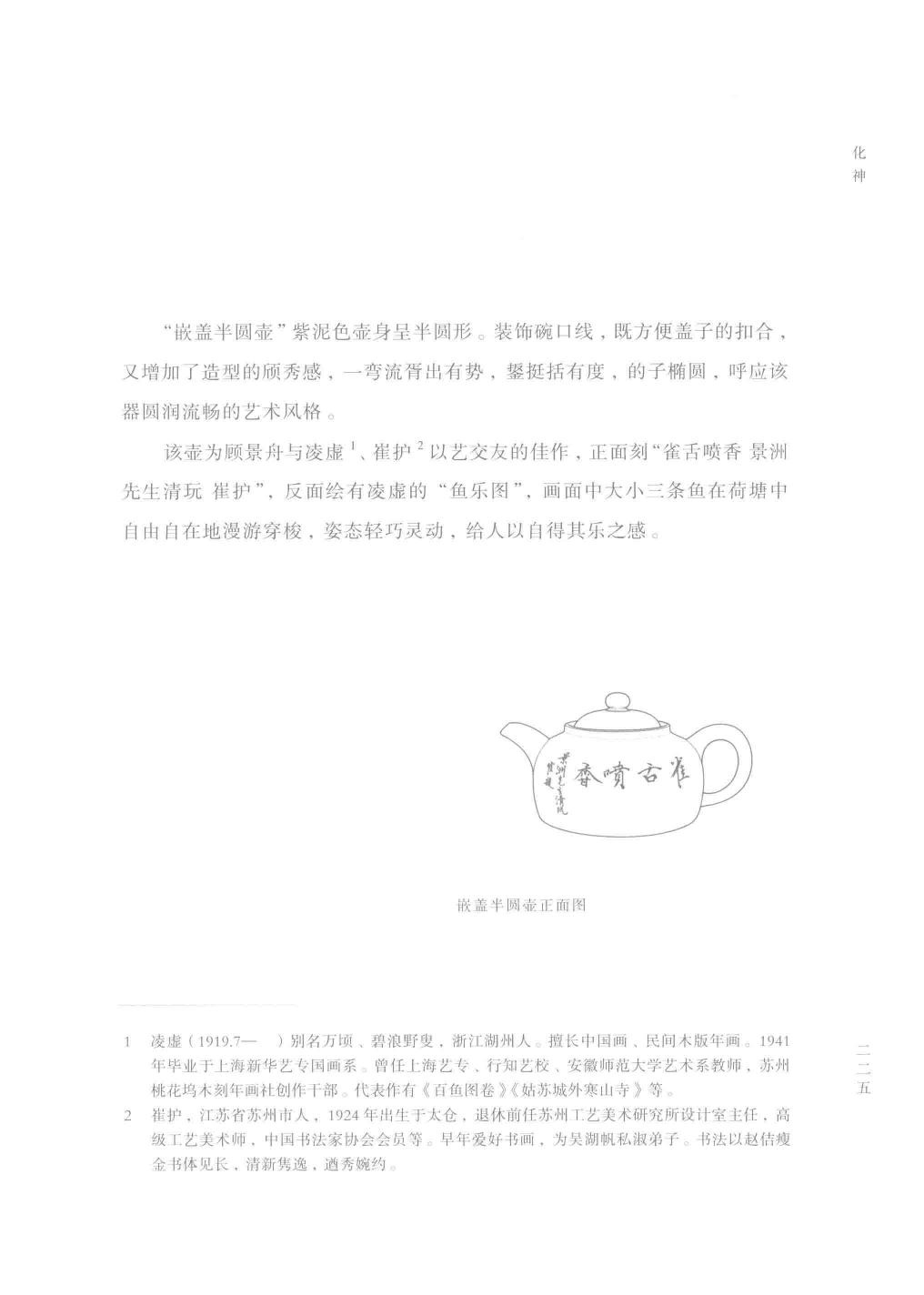
The body of the purple clay teapot is semi-circular in form. It features decorative ribbed lines around the rim, which not only facilitate the fitting of the lid but also enhance the refined elegance of the overall form. The curved spout extends with momentum, its reverse curve measured and controlled. The handle is elliptical, echoing the rounded and flowing artistic style of the vessel.
This teapot represents an excellent work created through the artistic friendship between Gu Jingzhou and Ling Xu[1] and Cui Hu[2]. The front is inscribed with "Harmonious tea fragrance overflows, for Mr. Jingzhou's refined enjoyment, Cui Hu." The reverse features Ling Xu's "Fish at Play," depicting three fish of varying sizes swimming freely through a lotus pond, their postures light and nimble, conveying a sense of carefree contentment.
## Artist Biographies
**Ling Xu** (July 1919–)[1]: Also known as Wan Xiang and Ruilang Yezhang, native of Huzhou, Zhejiang. Specialized in Chinese painting and folk woodblock New Year prints. Graduated from the Chinese Painting Department of Shanghai Xinhua Art Academy in 1941. Served as instructor at Shanghai Art Academy, Xingzhi Art School, and the Art Department of Anhui Normal University, as well as creative staff member at the Suzhou Taohuawu Woodblock New Year Print Society. Representative works include *One Hundred Fish Scroll* and *Cold Mountain Temple Outside Gusu City*.
**Cui Hu**[2]: Native of Suzhou, Jiangsu Province, born in Taicang in 1924. Prior to retirement, served as Director of the Design Office at the Suzhou Arts and Crafts Research Institute, Senior Arts and Crafts Master, and member of the Chinese Calligraphers Association. Developed an early love for calligraphy and painting, becoming a private student of Wu Hufan. His calligraphy excels in the Zhao Mengfu style of running script, characterized by fresh elegance and graceful refinement.
---
[1] Ling Xu (1919.7–)
[2] Cui Hu (1924–)
Chapter 5
独妙
Unique Excellence
Pages 142-405
View Chapter →
English Translation
The body of the purple clay teapot is semi-circular in form. It features decorative ribbed lines around the rim, which not only facilitate the fitting of the lid but also enhance the refined elegance of the overall form. The curved spout extends with momentum, its reverse curve measured and controlled. The handle is elliptical, echoing the rounded and flowing artistic style of the vessel.
This teapot represents an excellent work created through the artistic friendship between Gu Jingzhou and Ling Xu[1] and Cui Hu[2]. The front is inscribed with "Harmonious tea fragrance overflows, for Mr. Jingzhou's refined enjoyment, Cui Hu." The reverse features Ling Xu's "Fish at Play," depicting three fish of varying sizes swimming freely through a lotus pond, their postures light and nimble, conveying a sense of carefree contentment.
## Artist Biographies
**Ling Xu** (July 1919–)[1]: Also known as Wan Xiang and Ruilang Yezhang, native of Huzhou, Zhejiang. Specialized in Chinese painting and folk woodblock New Year prints. Graduated from the Chinese Painting Department of Shanghai Xinhua Art Academy in 1941. Served as instructor at Shanghai Art Academy, Xingzhi Art School, and the Art Department of Anhui Normal University, as well as creative staff member at the Suzhou Taohuawu Woodblock New Year Print Society. Representative works include *One Hundred Fish Scroll* and *Cold Mountain Temple Outside Gusu City*.
**Cui Hu**[2]: Native of Suzhou, Jiangsu Province, born in Taicang in 1924. Prior to retirement, served as Director of the Design Office at the Suzhou Arts and Crafts Research Institute, Senior Arts and Crafts Master, and member of the Chinese Calligraphers Association. Developed an early love for calligraphy and painting, becoming a private student of Wu Hufan. His calligraphy excels in the Zhao Mengfu style of running script, characterized by fresh elegance and graceful refinement.
---
[1] Ling Xu (1919.7–)
[2] Cui Hu (1924–)
章节导航 Chapter Navigation
Chapter 1
序文
Pages 6-6
Chapter 2
引言
Pages 28-31
Chapter 3
达变
Pages 32-133
Chapter 3
开宗立派
Pages 46-66
Chapter 3
传道授业
Pages 67-98
Chapter 3
大师淳友
Pages 99-120
Chapter 3
学艺谋生
Pages 121-133
Chapter 4
化神
Pages 134-141
Chapter 5
独妙
Pages 142-405
Chapter 5
匠心独运 不苟丝毫
Pages 142-179
Chapter 5
器利善事 物尽其用
Pages 180-199
Chapter 5
紫泥春华 研精究微
Pages 200-405
Chapter 6
驾简
Pages 406-427
Chapter 6
精雕细刻 文质合一
Pages 406-410
Chapter 6
师法自然 妙趣横生
Pages 411-415
Chapter 6
丝来线去 曲尽其妙
Pages 416-427
Chapter 7
明志
Pages 463-485
Chapter 7
高山仰止 淡泊明志
Pages 463-472
Chapter 7
啜墨看茶 气定神闲
Pages 473-478
Chapter 7
齿少心锐 怡志抒情
Pages 479-485
Chapter 8
存真
Pages 428-462
Chapter 8
规圆矩方 弃伪存真
Pages 428-436
Chapter 8
有物有则 钻尖仰高
Pages 437-462
Chapter 9
心营
Pages 506-525
Chapter 9
坚守传统 艺立潮头
Pages 506-513
Chapter 9
新型师承 桃李满园
Pages 514-525
Chapter 10
附录
Pages 526-651
Chapter 10
顾景舟紫艺论文
Pages 526-535
Chapter 10
技术课备课笔记
Pages 536-543
Chapter 10
顾景舟艺术年表
Pages 544-651
Chapter 11
参考文献
Pages 652-657
Chapter 12
鸣谢
Pages 658-659