Chapter 2
引言
Foreword
29
of 659
English Translation
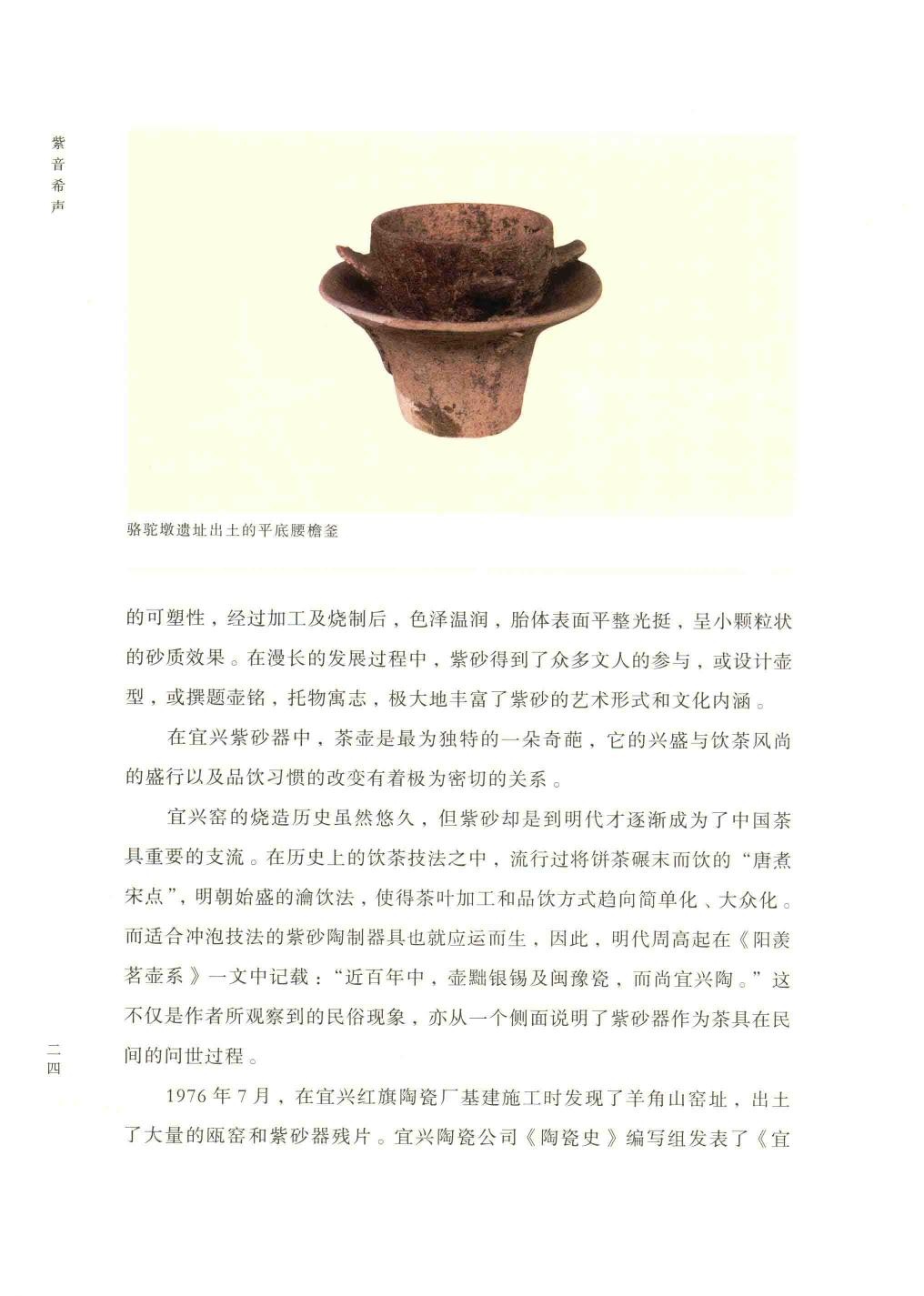
The flat-bottomed waisted pomegranate vessel unearthed from the Luotuodun site
possesses excellent plasticity. After processing and firing, it displays a warm and lustrous color, with a smooth and even surface on the body, presenting a sandy texture of fine granular effect. Throughout its long development, zisha (purple clay) has attracted the participation of numerous literati, who either designed vessel forms or composed inscriptions and engravings, expressing aspirations through objects, greatly enriching the artistic forms and cultural connotations of zisha.
Among Yixing zisha wares, the teapot is the most distinctive and extraordinary category. Its flourishing is intimately connected with the prevalence of tea-drinking customs and changes in brewing habits.
Although Yixing has a long history of ceramic production, it was not until the Ming dynasty that zisha gradually became an important branch of Chinese tea utensils. Among the historical tea-drinking techniques, the "Tang method of whisking" was popular, which involved grinding cake tea into powder for consumption. The steeping method that began to flourish in the Ming dynasty made tea processing and drinking methods simpler and more accessible to the masses. Zisha ceramic vessels suitable for steeping techniques thus emerged in response to this need. Therefore, Zhou Gaoqi of the Ming dynasty recorded in his essay *Yangxian Ming Hu Xi* (Catalogue of Famous Teapots from Yangxian): "In the past hundred years, teapots made of silver, tin, and those from Fujian and Henan have become secondary, while Yixing pottery is esteemed." This not only reflects the folk customs observed by the author, but also illustrates from one perspective the process by which zisha wares emerged as tea utensils among the common people.
In July 1976, during infrastructure construction at the Hongqi Ceramics Factory No. 3 in Yixing, the Yangjiao Mountain kiln site was discovered, yielding large quantities of kiln furniture and zisha ware fragments. The Editorial Group for *History of Ceramics* at the Yixing Ceramics Company published "Yi[xing]
Chapter 2
引言
Foreword
Pages 28-31
View Chapter →
English Translation
The flat-bottomed waisted pomegranate vessel unearthed from the Luotuodun site
possesses excellent plasticity. After processing and firing, it displays a warm and lustrous color, with a smooth and even surface on the body, presenting a sandy texture of fine granular effect. Throughout its long development, zisha (purple clay) has attracted the participation of numerous literati, who either designed vessel forms or composed inscriptions and engravings, expressing aspirations through objects, greatly enriching the artistic forms and cultural connotations of zisha.
Among Yixing zisha wares, the teapot is the most distinctive and extraordinary category. Its flourishing is intimately connected with the prevalence of tea-drinking customs and changes in brewing habits.
Although Yixing has a long history of ceramic production, it was not until the Ming dynasty that zisha gradually became an important branch of Chinese tea utensils. Among the historical tea-drinking techniques, the "Tang method of whisking" was popular, which involved grinding cake tea into powder for consumption. The steeping method that began to flourish in the Ming dynasty made tea processing and drinking methods simpler and more accessible to the masses. Zisha ceramic vessels suitable for steeping techniques thus emerged in response to this need. Therefore, Zhou Gaoqi of the Ming dynasty recorded in his essay *Yangxian Ming Hu Xi* (Catalogue of Famous Teapots from Yangxian): "In the past hundred years, teapots made of silver, tin, and those from Fujian and Henan have become secondary, while Yixing pottery is esteemed." This not only reflects the folk customs observed by the author, but also illustrates from one perspective the process by which zisha wares emerged as tea utensils among the common people.
In July 1976, during infrastructure construction at the Hongqi Ceramics Factory No. 3 in Yixing, the Yangjiao Mountain kiln site was discovered, yielding large quantities of kiln furniture and zisha ware fragments. The Editorial Group for *History of Ceramics* at the Yixing Ceramics Company published "Yi[xing]
章节导航 Chapter Navigation
Chapter 1
序文
Pages 6-6
Chapter 2
引言
Pages 28-31
Chapter 3
达变
Pages 32-133
Chapter 3
开宗立派
Pages 46-66
Chapter 3
传道授业
Pages 67-98
Chapter 3
大师淳友
Pages 99-120
Chapter 3
学艺谋生
Pages 121-133
Chapter 4
化神
Pages 134-141
Chapter 5
独妙
Pages 142-405
Chapter 5
匠心独运 不苟丝毫
Pages 142-179
Chapter 5
器利善事 物尽其用
Pages 180-199
Chapter 5
紫泥春华 研精究微
Pages 200-405
Chapter 6
驾简
Pages 406-427
Chapter 6
精雕细刻 文质合一
Pages 406-410
Chapter 6
师法自然 妙趣横生
Pages 411-415
Chapter 6
丝来线去 曲尽其妙
Pages 416-427
Chapter 7
明志
Pages 463-485
Chapter 7
高山仰止 淡泊明志
Pages 463-472
Chapter 7
啜墨看茶 气定神闲
Pages 473-478
Chapter 7
齿少心锐 怡志抒情
Pages 479-485
Chapter 8
存真
Pages 428-462
Chapter 8
规圆矩方 弃伪存真
Pages 428-436
Chapter 8
有物有则 钻尖仰高
Pages 437-462
Chapter 9
心营
Pages 506-525
Chapter 9
坚守传统 艺立潮头
Pages 506-513
Chapter 9
新型师承 桃李满园
Pages 514-525
Chapter 10
附录
Pages 526-651
Chapter 10
顾景舟紫艺论文
Pages 526-535
Chapter 10
技术课备课笔记
Pages 536-543
Chapter 10
顾景舟艺术年表
Pages 544-651
Chapter 11
参考文献
Pages 652-657
Chapter 12
鸣谢
Pages 658-659