Chapter 2
引言
Foreword
31
of 659
English Translation
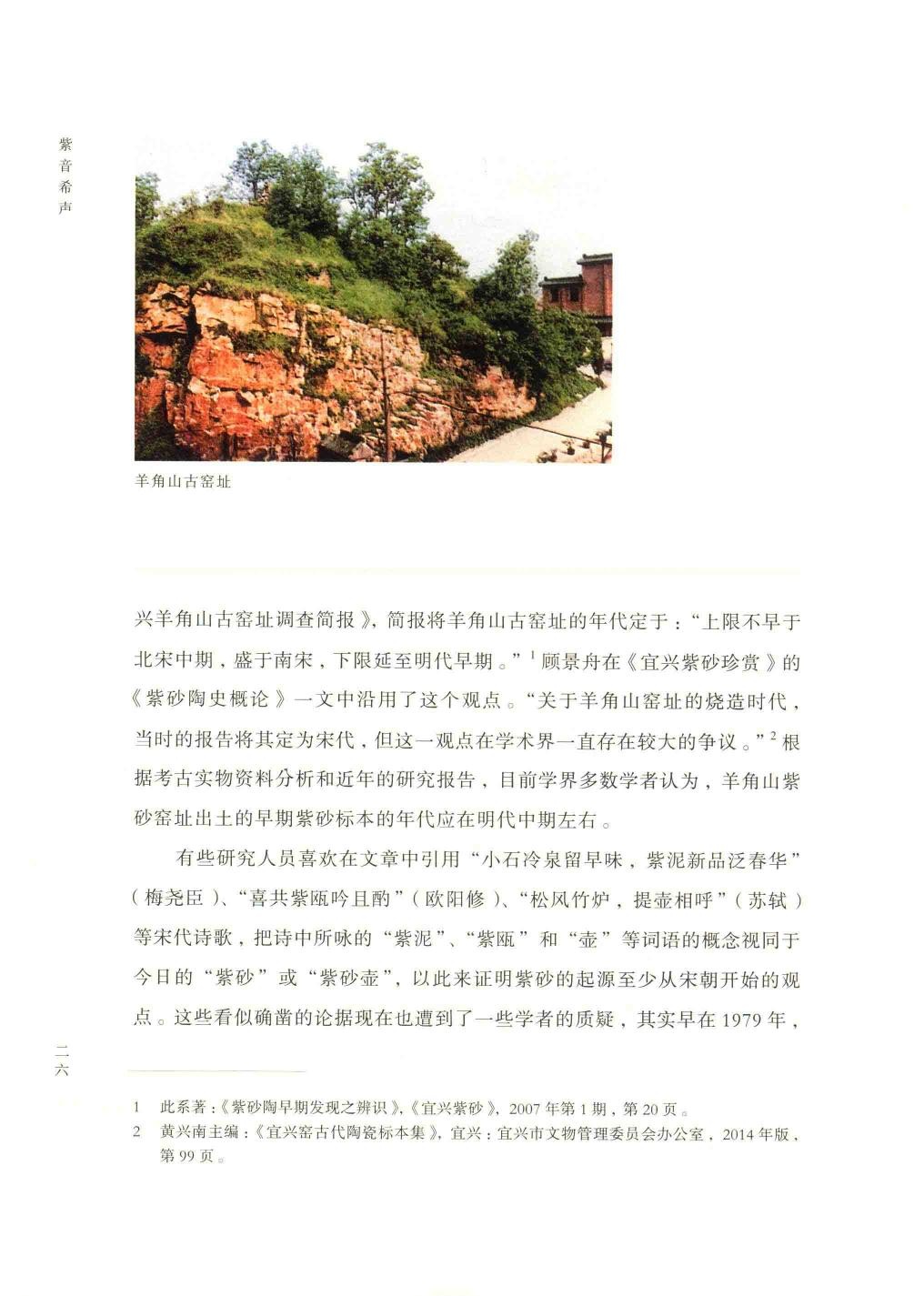
The *Brief Report on the Investigation of the Yangjiaoshan Ancient Kiln Site in Yixing* dates the Yangjiaoshan ancient kiln site as: "The upper limit is no earlier than the mid-Northern Song Dynasty, flourishing in the Southern Song Dynasty, with the lower limit extending to the early Ming Dynasty."[1] Gu Jingzhou, in his essay "An Overview of Zisha Pottery History" from *Appreciation of Yixing Zisha Treasures*, adopted this viewpoint. "Regarding the firing period of the Yangjiaoshan kiln site, the report at that time dated it to the Song Dynasty, but this view has been subject to considerable controversy in academic circles."[2] Based on analysis of archaeological material evidence and research reports in recent years, most scholars currently believe that the early zisha specimens excavated from the Yangjiaoshan zisha kiln site should date to around the mid-Ming Dynasty.
Some researchers like to cite Song Dynasty poems in their articles, such as "Small stones and cold springs preserve the early flavor, purple clay new wares brim with spring's splendor" (Mei Yaochen), "Delighted to chant and drink together with purple cups" (Ouyang Xiu), and "Pine wind and bamboo stove, lifting the pot to call to one another" (Su Shi). They equate the concepts of "purple clay," "purple cups," and "pot" in these poems with today's "zisha" or "zisha teapot," using this to prove the viewpoint that the origins of zisha began at least from the Song Dynasty. These seemingly solid arguments have now also been questioned by some scholars. In fact, as early as 1979,
---
[1] Ci Xizhu: "Distinguishing Early Discoveries of Zisha Pottery," *Yixing Zisha*, Issue 1, 2007, p. 20
[2] Huang Xingnan, ed.: *Collection of Ancient Ceramic Specimens from Yixing Kilns*, Yixing: Office of the Yixing Cultural Relics Management Committee, 2014 edition, p. 99
Chapter 2
引言
Foreword
Pages 28-31
View Chapter →
English Translation
The *Brief Report on the Investigation of the Yangjiaoshan Ancient Kiln Site in Yixing* dates the Yangjiaoshan ancient kiln site as: "The upper limit is no earlier than the mid-Northern Song Dynasty, flourishing in the Southern Song Dynasty, with the lower limit extending to the early Ming Dynasty."[1] Gu Jingzhou, in his essay "An Overview of Zisha Pottery History" from *Appreciation of Yixing Zisha Treasures*, adopted this viewpoint. "Regarding the firing period of the Yangjiaoshan kiln site, the report at that time dated it to the Song Dynasty, but this view has been subject to considerable controversy in academic circles."[2] Based on analysis of archaeological material evidence and research reports in recent years, most scholars currently believe that the early zisha specimens excavated from the Yangjiaoshan zisha kiln site should date to around the mid-Ming Dynasty.
Some researchers like to cite Song Dynasty poems in their articles, such as "Small stones and cold springs preserve the early flavor, purple clay new wares brim with spring's splendor" (Mei Yaochen), "Delighted to chant and drink together with purple cups" (Ouyang Xiu), and "Pine wind and bamboo stove, lifting the pot to call to one another" (Su Shi). They equate the concepts of "purple clay," "purple cups," and "pot" in these poems with today's "zisha" or "zisha teapot," using this to prove the viewpoint that the origins of zisha began at least from the Song Dynasty. These seemingly solid arguments have now also been questioned by some scholars. In fact, as early as 1979,
---
[1] Ci Xizhu: "Distinguishing Early Discoveries of Zisha Pottery," *Yixing Zisha*, Issue 1, 2007, p. 20
[2] Huang Xingnan, ed.: *Collection of Ancient Ceramic Specimens from Yixing Kilns*, Yixing: Office of the Yixing Cultural Relics Management Committee, 2014 edition, p. 99
章节导航 Chapter Navigation
Chapter 1
序文
Pages 6-6
Chapter 2
引言
Pages 28-31
Chapter 3
达变
Pages 32-133
Chapter 3
开宗立派
Pages 46-66
Chapter 3
传道授业
Pages 67-98
Chapter 3
大师淳友
Pages 99-120
Chapter 3
学艺谋生
Pages 121-133
Chapter 4
化神
Pages 134-141
Chapter 5
独妙
Pages 142-405
Chapter 5
匠心独运 不苟丝毫
Pages 142-179
Chapter 5
器利善事 物尽其用
Pages 180-199
Chapter 5
紫泥春华 研精究微
Pages 200-405
Chapter 6
驾简
Pages 406-427
Chapter 6
精雕细刻 文质合一
Pages 406-410
Chapter 6
师法自然 妙趣横生
Pages 411-415
Chapter 6
丝来线去 曲尽其妙
Pages 416-427
Chapter 7
明志
Pages 463-485
Chapter 7
高山仰止 淡泊明志
Pages 463-472
Chapter 7
啜墨看茶 气定神闲
Pages 473-478
Chapter 7
齿少心锐 怡志抒情
Pages 479-485
Chapter 8
存真
Pages 428-462
Chapter 8
规圆矩方 弃伪存真
Pages 428-436
Chapter 8
有物有则 钻尖仰高
Pages 437-462
Chapter 9
心营
Pages 506-525
Chapter 9
坚守传统 艺立潮头
Pages 506-513
Chapter 9
新型师承 桃李满园
Pages 514-525
Chapter 10
附录
Pages 526-651
Chapter 10
顾景舟紫艺论文
Pages 526-535
Chapter 10
技术课备课笔记
Pages 536-543
Chapter 10
顾景舟艺术年表
Pages 544-651
Chapter 11
参考文献
Pages 652-657
Chapter 12
鸣谢
Pages 658-659