Chapter 3
达变
Adaptation
36
of 659
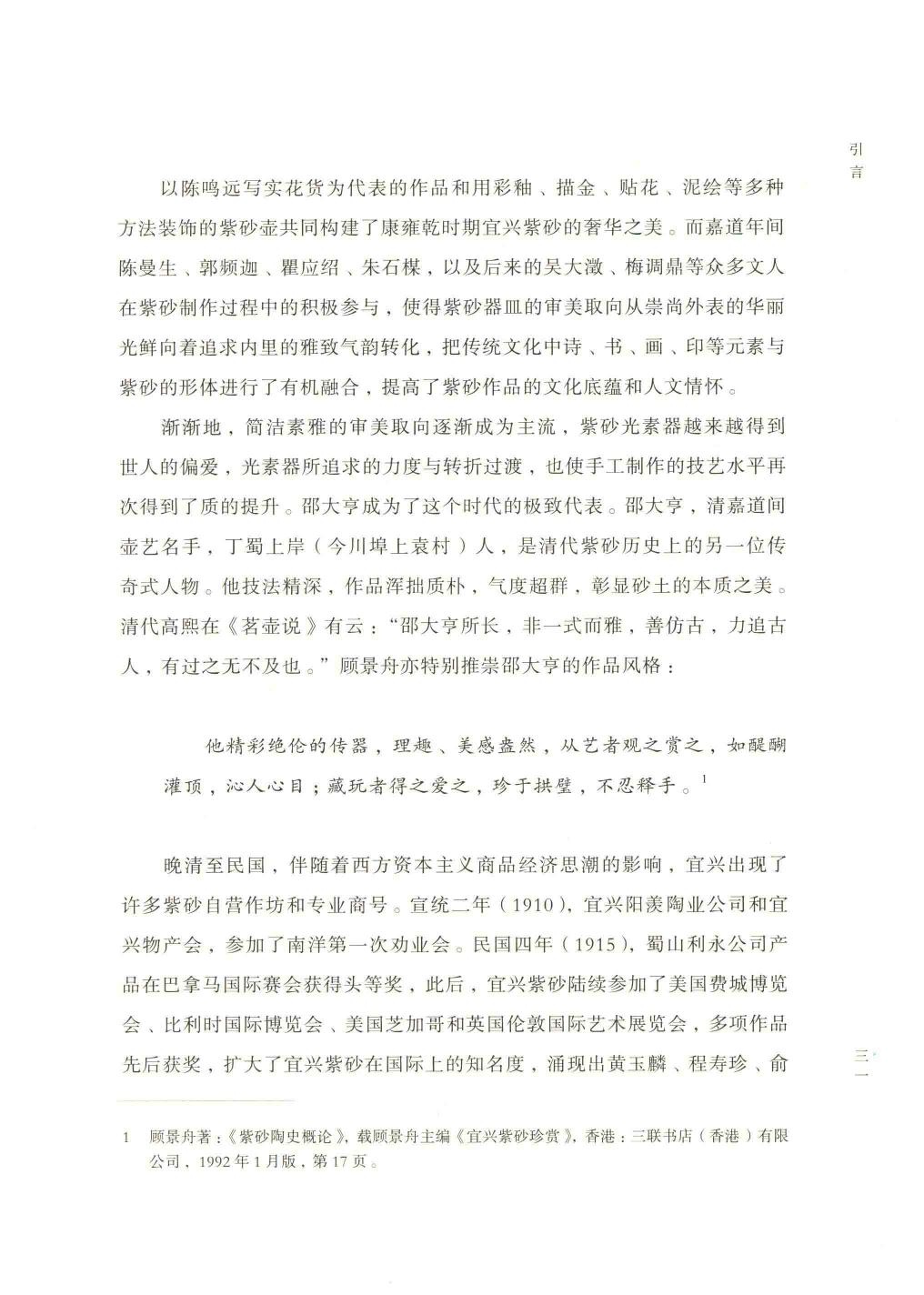
English Translation
Works represented by Chen Mayuan's realistic flower-form pieces, together with zisha teapots decorated through various methods such as colored glazes, gold painting, appliqué, and clay painting, jointly constructed the luxurious beauty of Yixing zisha during the Kangxi, Yongzheng, and Qianlong periods. During the Jiaqing and Daoguang years, the active participation of numerous literati in the zisha production process—including Chen Mansheng, Guo Pinjia, Qu Yingshao, Zhu Shigan, and later Wu Dacheng and Mei Tiaoyi—transformed the aesthetic orientation of zisha wares from admiring external splendor and brilliance toward pursuing inner elegance and refined spirit. They organically integrated elements of poetry, calligraphy, painting, and seal carving from traditional culture with the physical forms of zisha, elevating the cultural depth and humanistic sentiment of zisha works.
Gradually, a simple and elegant aesthetic orientation became mainstream. Plain zisha wares increasingly won the favor of the world, and the pursuit of strength and refined transitions in plain wares also brought the level of handcrafted technique to a qualitative elevation. Shao Daheng became the ultimate representative of this era. Shao Daheng, a renowned potter of the Qing Jiaqing and Daoguang periods, was from Dingshu Shangyuan (present-day Chuanbu Shangyuan Village) and was another legendary figure in the history of Qing dynasty zisha. His techniques were profound, his works simple and unadorned yet substantial, with extraordinary bearing that manifested the essential beauty of the clay itself. The Qing scholar Gao Zhong wrote in *Yanghu Shuo* (On Teapots):
> "Shao Daheng's strength lies not in a single style but in elegance. He excels at imitating antiquity, striving to match the ancients—surpassing them rather than falling short."
Gu Jingzhou also particularly admired Shao Daheng's artistic style:
> His brilliant masterpieces possess both philosophical depth and aesthetic beauty. When artists observe and appreciate them, it is like receiving enlightenment poured from above, penetrating heart and mind; when collectors obtain and cherish them, they treasure them more than jade discs, unable to let them go.[1]
From the late Qing through the Republican period, accompanied by the influence of Western capitalist commodity economy trends, many privately-owned zisha workshops and professional trading houses emerged in Yixing. In the second year of the Xuantong reign (1910), the Yixing Yangxian Pottery Company and the Yixing Products Association participated in the First Nanyang Industrial Exposition. In the fourth year of the Republic (1915), products from the Lishan Liyong Company won first prize at the Panama International Exhibition. Subsequently, Yixing zisha participated in the Philadelphia Exposition in the United States, the International Exposition in Belgium, and the International Art Exhibitions in Chicago and London, with multiple works winning awards. This expanded Yixing zisha's international reputation and brought forth masters such as Huang Yulin, Cheng Shouzhen, and Yu Guoliang.
---
[1] Gu Jingzhou, "An Overview of Zisha Pottery History," in *Appreciation of Yixing Zisha*, ed. Gu Jingzhou (Hong Kong: Joint Publishing (H.K.) Co., Ltd., January 1992), 17.
Chapter 3
达变
Adaptation
Pages 32-133
View Chapter →
English Translation
Works represented by Chen Mayuan's realistic flower-form pieces, together with zisha teapots decorated through various methods such as colored glazes, gold painting, appliqué, and clay painting, jointly constructed the luxurious beauty of Yixing zisha during the Kangxi, Yongzheng, and Qianlong periods. During the Jiaqing and Daoguang years, the active participation of numerous literati in the zisha production process—including Chen Mansheng, Guo Pinjia, Qu Yingshao, Zhu Shigan, and later Wu Dacheng and Mei Tiaoyi—transformed the aesthetic orientation of zisha wares from admiring external splendor and brilliance toward pursuing inner elegance and refined spirit. They organically integrated elements of poetry, calligraphy, painting, and seal carving from traditional culture with the physical forms of zisha, elevating the cultural depth and humanistic sentiment of zisha works.
Gradually, a simple and elegant aesthetic orientation became mainstream. Plain zisha wares increasingly won the favor of the world, and the pursuit of strength and refined transitions in plain wares also brought the level of handcrafted technique to a qualitative elevation. Shao Daheng became the ultimate representative of this era. Shao Daheng, a renowned potter of the Qing Jiaqing and Daoguang periods, was from Dingshu Shangyuan (present-day Chuanbu Shangyuan Village) and was another legendary figure in the history of Qing dynasty zisha. His techniques were profound, his works simple and unadorned yet substantial, with extraordinary bearing that manifested the essential beauty of the clay itself. The Qing scholar Gao Zhong wrote in *Yanghu Shuo* (On Teapots):
> "Shao Daheng's strength lies not in a single style but in elegance. He excels at imitating antiquity, striving to match the ancients—surpassing them rather than falling short."
Gu Jingzhou also particularly admired Shao Daheng's artistic style:
> His brilliant masterpieces possess both philosophical depth and aesthetic beauty. When artists observe and appreciate them, it is like receiving enlightenment poured from above, penetrating heart and mind; when collectors obtain and cherish them, they treasure them more than jade discs, unable to let them go.[1]
From the late Qing through the Republican period, accompanied by the influence of Western capitalist commodity economy trends, many privately-owned zisha workshops and professional trading houses emerged in Yixing. In the second year of the Xuantong reign (1910), the Yixing Yangxian Pottery Company and the Yixing Products Association participated in the First Nanyang Industrial Exposition. In the fourth year of the Republic (1915), products from the Lishan Liyong Company won first prize at the Panama International Exhibition. Subsequently, Yixing zisha participated in the Philadelphia Exposition in the United States, the International Exposition in Belgium, and the International Art Exhibitions in Chicago and London, with multiple works winning awards. This expanded Yixing zisha's international reputation and brought forth masters such as Huang Yulin, Cheng Shouzhen, and Yu Guoliang.
---
[1] Gu Jingzhou, "An Overview of Zisha Pottery History," in *Appreciation of Yixing Zisha*, ed. Gu Jingzhou (Hong Kong: Joint Publishing (H.K.) Co., Ltd., January 1992), 17.
章节导航 Chapter Navigation
Chapter 1
序文
Pages 6-6
Chapter 2
引言
Pages 28-31
Chapter 3
达变
Pages 32-133
Chapter 3
开宗立派
Pages 46-66
Chapter 3
传道授业
Pages 67-98
Chapter 3
大师淳友
Pages 99-120
Chapter 3
学艺谋生
Pages 121-133
Chapter 4
化神
Pages 134-141
Chapter 5
独妙
Pages 142-405
Chapter 5
匠心独运 不苟丝毫
Pages 142-179
Chapter 5
器利善事 物尽其用
Pages 180-199
Chapter 5
紫泥春华 研精究微
Pages 200-405
Chapter 6
驾简
Pages 406-427
Chapter 6
精雕细刻 文质合一
Pages 406-410
Chapter 6
师法自然 妙趣横生
Pages 411-415
Chapter 6
丝来线去 曲尽其妙
Pages 416-427
Chapter 7
明志
Pages 463-485
Chapter 7
高山仰止 淡泊明志
Pages 463-472
Chapter 7
啜墨看茶 气定神闲
Pages 473-478
Chapter 7
齿少心锐 怡志抒情
Pages 479-485
Chapter 8
存真
Pages 428-462
Chapter 8
规圆矩方 弃伪存真
Pages 428-436
Chapter 8
有物有则 钻尖仰高
Pages 437-462
Chapter 9
心营
Pages 506-525
Chapter 9
坚守传统 艺立潮头
Pages 506-513
Chapter 9
新型师承 桃李满园
Pages 514-525
Chapter 10
附录
Pages 526-651
Chapter 10
顾景舟紫艺论文
Pages 526-535
Chapter 10
技术课备课笔记
Pages 536-543
Chapter 10
顾景舟艺术年表
Pages 544-651
Chapter 11
参考文献
Pages 652-657
Chapter 12
鸣谢
Pages 658-659