Chapter 5
独妙
Unique Excellence
374
of 659
English Translation
> "Before the age of 20, due to the pressures of making a living, I was particularly meticulous in beating clay coils and slabs. I worked with both quality and speed, so my foundation was quite solid. I could effortlessly make thirty teapot bodies in a single morning."
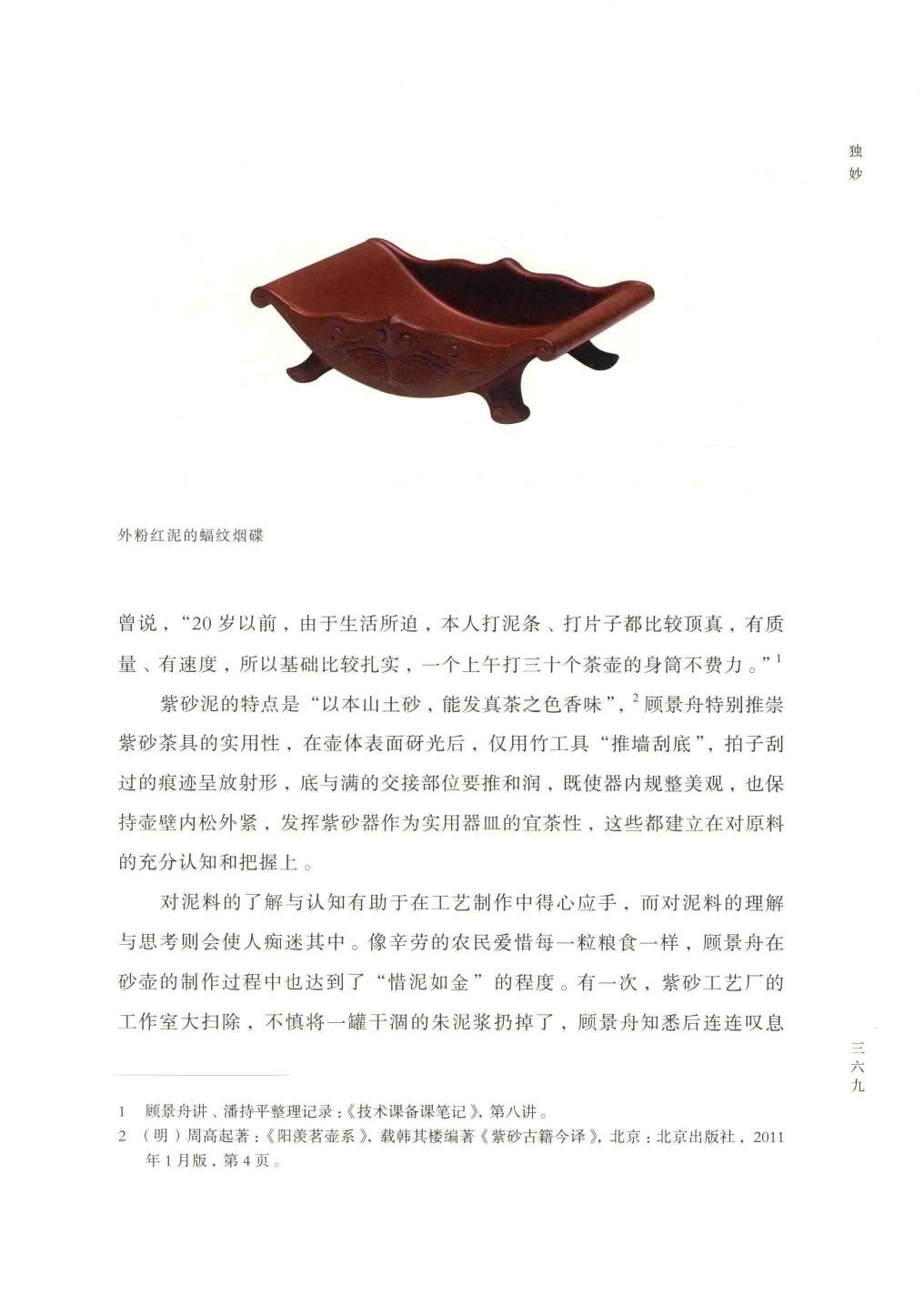
The characteristic of zisha clay is that "using the native mountain earth and sand, it can bring out the true color, aroma, and flavor of tea."[1] Gu Jingzhou particularly advocated for the practical utility of zisha tea ware. After burnishing the surface of the pot body, he would only use bamboo tools to "push the walls and scrape the bottom." The marks left by the scraping tool radiate outward, and the junction between the bottom and the walls must be pushed smooth and润, making the interior regular and beautiful while maintaining the pot walls loose on the inside and tight on the outside, thus bringing out the tea-enhancing properties of zisha ware as practical vessels. All of this is built upon a full understanding and mastery of the raw materials.
Understanding and knowledge of clay materials helps one work with ease and confidence in the craft-making process, while comprehension and contemplation of clay materials will cause one to become deeply absorbed in them. Gu Jingzhou also reached an "extraordinary degree" in the making of zisha pots. Once, during a major cleaning of the studio, someone carelessly threw away some vermilion clay slip负干泗. When Gu Jingzhou learned of this, he sighed repeatedly. Like a hardworking farmer cherishing every grain, Gu Jingzhou achieved the境界 of "clay is as precious as gold" and "filtering."
---
[1] Gu Jingzhou (lecturer), Pan Chiping (compiler and recorder): *Technical Course Lecture Notes*, Lecture Eight.
[2] (Ming Dynasty) Compiled and annotated by Zhou Gaoqi: *Ancient Zisha Texts in Modern Translation*, Beijing: Beijing Publishing House, 2011, January edition, p. 9.
Chapter 5
独妙
Unique Excellence
Pages 142-405
View Chapter →
English Translation
> "Before the age of 20, due to the pressures of making a living, I was particularly meticulous in beating clay coils and slabs. I worked with both quality and speed, so my foundation was quite solid. I could effortlessly make thirty teapot bodies in a single morning."
The characteristic of zisha clay is that "using the native mountain earth and sand, it can bring out the true color, aroma, and flavor of tea."[1] Gu Jingzhou particularly advocated for the practical utility of zisha tea ware. After burnishing the surface of the pot body, he would only use bamboo tools to "push the walls and scrape the bottom." The marks left by the scraping tool radiate outward, and the junction between the bottom and the walls must be pushed smooth and润, making the interior regular and beautiful while maintaining the pot walls loose on the inside and tight on the outside, thus bringing out the tea-enhancing properties of zisha ware as practical vessels. All of this is built upon a full understanding and mastery of the raw materials.
Understanding and knowledge of clay materials helps one work with ease and confidence in the craft-making process, while comprehension and contemplation of clay materials will cause one to become deeply absorbed in them. Gu Jingzhou also reached an "extraordinary degree" in the making of zisha pots. Once, during a major cleaning of the studio, someone carelessly threw away some vermilion clay slip负干泗. When Gu Jingzhou learned of this, he sighed repeatedly. Like a hardworking farmer cherishing every grain, Gu Jingzhou achieved the境界 of "clay is as precious as gold" and "filtering."
---
[1] Gu Jingzhou (lecturer), Pan Chiping (compiler and recorder): *Technical Course Lecture Notes*, Lecture Eight.
[2] (Ming Dynasty) Compiled and annotated by Zhou Gaoqi: *Ancient Zisha Texts in Modern Translation*, Beijing: Beijing Publishing House, 2011, January edition, p. 9.
章节导航 Chapter Navigation
Chapter 1
序文
Pages 6-6
Chapter 2
引言
Pages 28-31
Chapter 3
达变
Pages 32-133
Chapter 3
开宗立派
Pages 46-66
Chapter 3
传道授业
Pages 67-98
Chapter 3
大师淳友
Pages 99-120
Chapter 3
学艺谋生
Pages 121-133
Chapter 4
化神
Pages 134-141
Chapter 5
独妙
Pages 142-405
Chapter 5
匠心独运 不苟丝毫
Pages 142-179
Chapter 5
器利善事 物尽其用
Pages 180-199
Chapter 5
紫泥春华 研精究微
Pages 200-405
Chapter 6
驾简
Pages 406-427
Chapter 6
精雕细刻 文质合一
Pages 406-410
Chapter 6
师法自然 妙趣横生
Pages 411-415
Chapter 6
丝来线去 曲尽其妙
Pages 416-427
Chapter 7
明志
Pages 463-485
Chapter 7
高山仰止 淡泊明志
Pages 463-472
Chapter 7
啜墨看茶 气定神闲
Pages 473-478
Chapter 7
齿少心锐 怡志抒情
Pages 479-485
Chapter 8
存真
Pages 428-462
Chapter 8
规圆矩方 弃伪存真
Pages 428-436
Chapter 8
有物有则 钻尖仰高
Pages 437-462
Chapter 9
心营
Pages 506-525
Chapter 9
坚守传统 艺立潮头
Pages 506-513
Chapter 9
新型师承 桃李满园
Pages 514-525
Chapter 10
附录
Pages 526-651
Chapter 10
顾景舟紫艺论文
Pages 526-535
Chapter 10
技术课备课笔记
Pages 536-543
Chapter 10
顾景舟艺术年表
Pages 544-651
Chapter 11
参考文献
Pages 652-657
Chapter 12
鸣谢
Pages 658-659