Chapter 3
达变
Adaptation
38
of 659
English Translation
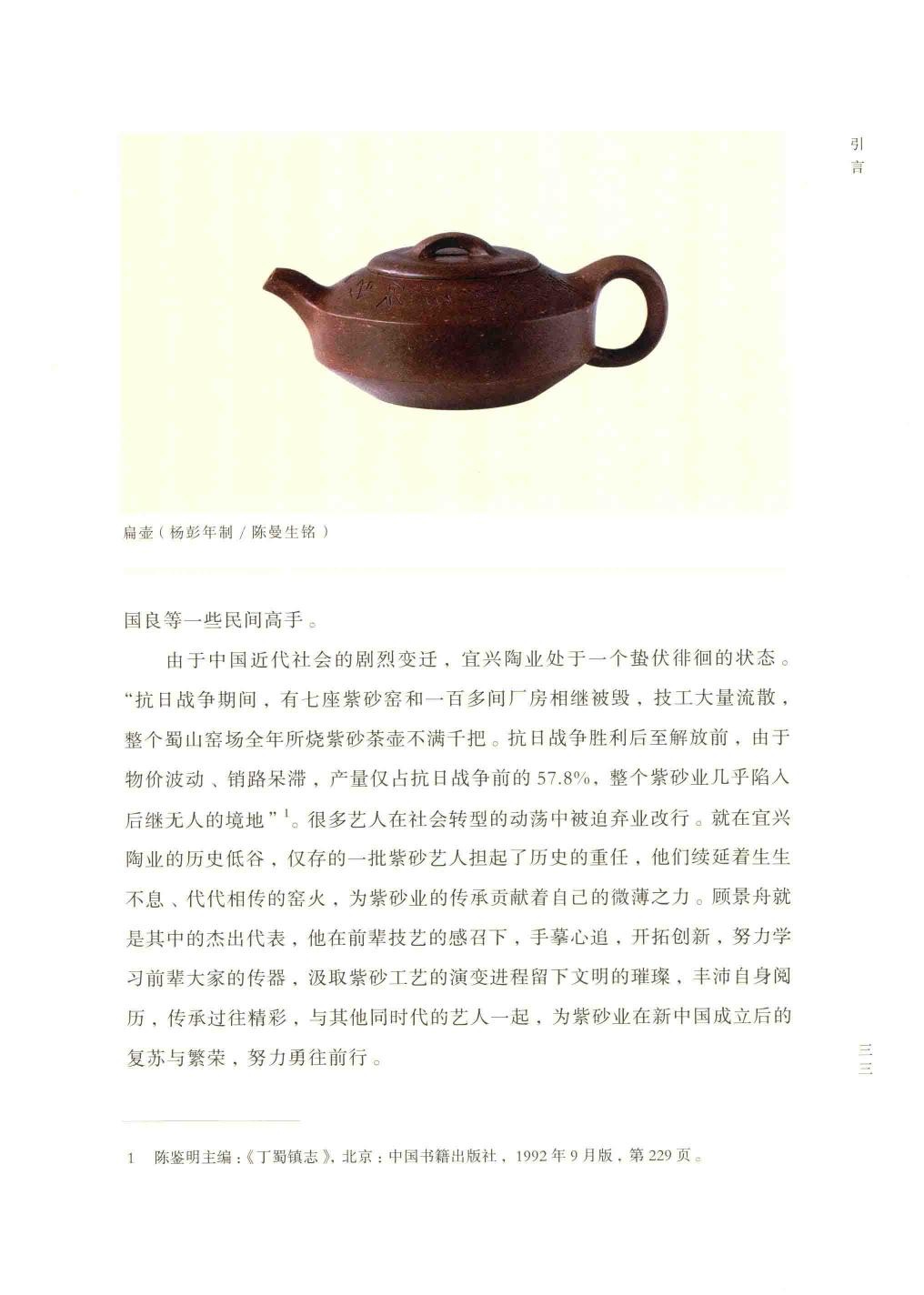
## Flat Pot (Made by Yang Pengnian / Inscribed by Chen Mansheng)
...and some folk masters like Guo Liang.
Due to the drastic changes in modern Chinese society, the Yixing pottery industry was in a state of stagnation and uncertainty. "During the War of Resistance Against Japan, seven Zisha kilns and more than one hundred workshops were successively destroyed, a large number of craftsmen were scattered, and the entire Shushan kiln site produced less than a thousand Zisha teapots throughout the year. After the victory in the War of Resistance Against Japan and before Liberation, due to price fluctuations and sluggish sales, output was only 57.8% of pre-war levels, and the entire Zisha industry was almost left with no successors."[1] Many artisans were forced to abandon their craft and change professions amid the turmoil of social transformation. At this historical low point for the Yixing pottery industry, the remaining group of Zisha artisans shouldered the historical responsibility. They continued the endlessly vital, generation-to-generation transmission of the kiln fire, contributing their modest efforts to the inheritance of the Zisha craft. Gu Jingzhou was an outstanding representative among them. Inspired by the skills of his predecessors, he studied and imitated with his hands and contemplated with his heart, pioneering and innovating. He diligently studied the handed-down works of the great masters before him, absorbing the brilliant civilization left behind by the evolutionary process of Zisha craftsmanship, enriching his own experience, inheriting past excellence, and together with other artisans of his generation, striving courageously forward for the revival and prosperity of the Zisha industry after the founding of New China.
---
[1] Chen Jianming, ed., *Dingshu Town Gazetteer* (Beijing: China Books Publishing House, September 1992), p. 229.
Chapter 3
达变
Adaptation
Pages 32-133
View Chapter →
English Translation
## Flat Pot (Made by Yang Pengnian / Inscribed by Chen Mansheng)
...and some folk masters like Guo Liang.
Due to the drastic changes in modern Chinese society, the Yixing pottery industry was in a state of stagnation and uncertainty. "During the War of Resistance Against Japan, seven Zisha kilns and more than one hundred workshops were successively destroyed, a large number of craftsmen were scattered, and the entire Shushan kiln site produced less than a thousand Zisha teapots throughout the year. After the victory in the War of Resistance Against Japan and before Liberation, due to price fluctuations and sluggish sales, output was only 57.8% of pre-war levels, and the entire Zisha industry was almost left with no successors."[1] Many artisans were forced to abandon their craft and change professions amid the turmoil of social transformation. At this historical low point for the Yixing pottery industry, the remaining group of Zisha artisans shouldered the historical responsibility. They continued the endlessly vital, generation-to-generation transmission of the kiln fire, contributing their modest efforts to the inheritance of the Zisha craft. Gu Jingzhou was an outstanding representative among them. Inspired by the skills of his predecessors, he studied and imitated with his hands and contemplated with his heart, pioneering and innovating. He diligently studied the handed-down works of the great masters before him, absorbing the brilliant civilization left behind by the evolutionary process of Zisha craftsmanship, enriching his own experience, inheriting past excellence, and together with other artisans of his generation, striving courageously forward for the revival and prosperity of the Zisha industry after the founding of New China.
---
[1] Chen Jianming, ed., *Dingshu Town Gazetteer* (Beijing: China Books Publishing House, September 1992), p. 229.
章节导航 Chapter Navigation
Chapter 1
序文
Pages 6-6
Chapter 2
引言
Pages 28-31
Chapter 3
达变
Pages 32-133
Chapter 3
开宗立派
Pages 46-66
Chapter 3
传道授业
Pages 67-98
Chapter 3
大师淳友
Pages 99-120
Chapter 3
学艺谋生
Pages 121-133
Chapter 4
化神
Pages 134-141
Chapter 5
独妙
Pages 142-405
Chapter 5
匠心独运 不苟丝毫
Pages 142-179
Chapter 5
器利善事 物尽其用
Pages 180-199
Chapter 5
紫泥春华 研精究微
Pages 200-405
Chapter 6
驾简
Pages 406-427
Chapter 6
精雕细刻 文质合一
Pages 406-410
Chapter 6
师法自然 妙趣横生
Pages 411-415
Chapter 6
丝来线去 曲尽其妙
Pages 416-427
Chapter 7
明志
Pages 463-485
Chapter 7
高山仰止 淡泊明志
Pages 463-472
Chapter 7
啜墨看茶 气定神闲
Pages 473-478
Chapter 7
齿少心锐 怡志抒情
Pages 479-485
Chapter 8
存真
Pages 428-462
Chapter 8
规圆矩方 弃伪存真
Pages 428-436
Chapter 8
有物有则 钻尖仰高
Pages 437-462
Chapter 9
心营
Pages 506-525
Chapter 9
坚守传统 艺立潮头
Pages 506-513
Chapter 9
新型师承 桃李满园
Pages 514-525
Chapter 10
附录
Pages 526-651
Chapter 10
顾景舟紫艺论文
Pages 526-535
Chapter 10
技术课备课笔记
Pages 536-543
Chapter 10
顾景舟艺术年表
Pages 544-651
Chapter 11
参考文献
Pages 652-657
Chapter 12
鸣谢
Pages 658-659