Chapter 3
达变
Adaptation
42
of 659
English Translation
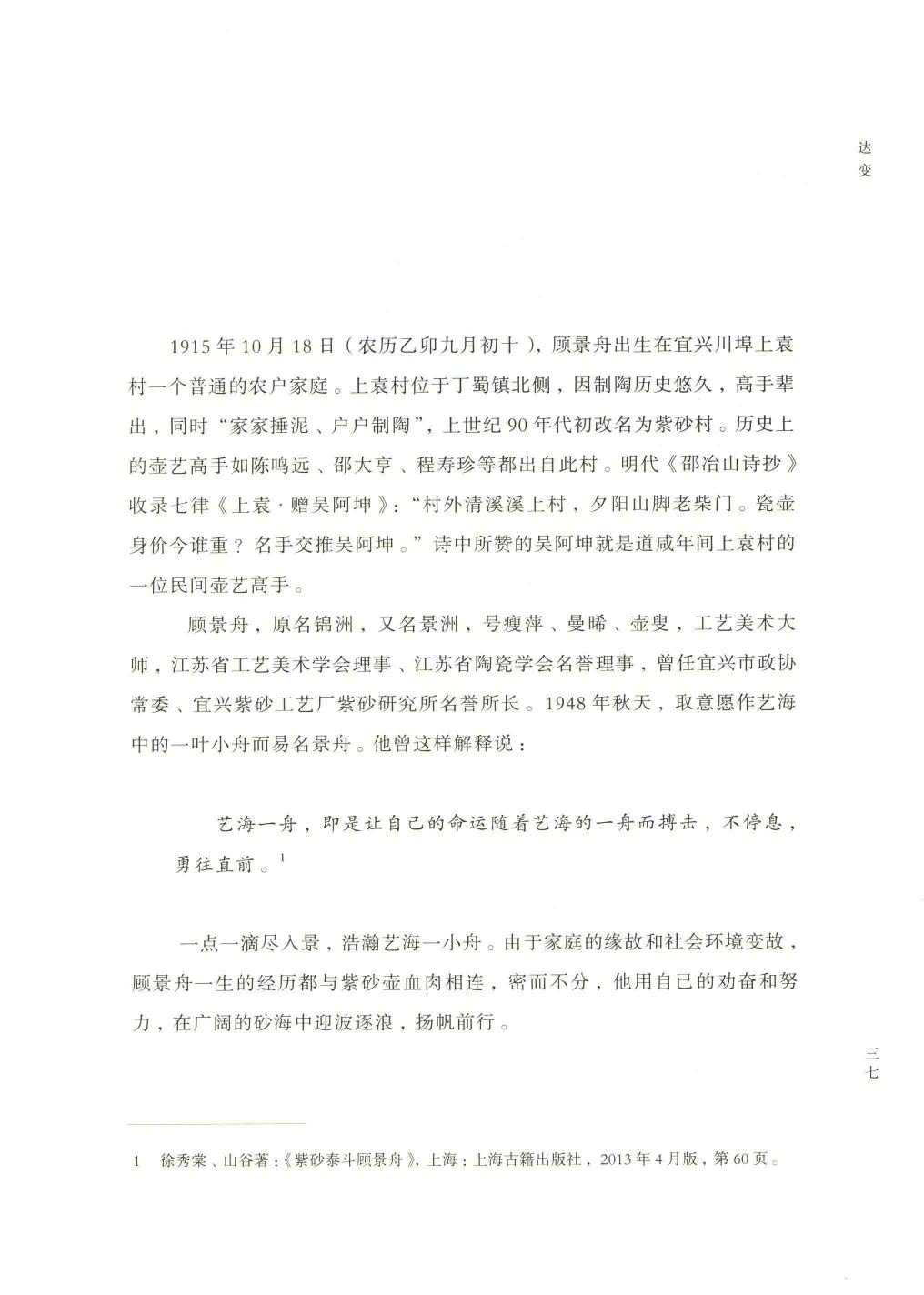
On October 18, 1915 (the tenth day of the ninth lunar month in the year Yimao), Gu Jingzhou was born into an ordinary farming family in Shangzhen Village, Chuanfu, Yixing. Shangzhen Village is located on the north side of Dingshu Town. Due to its long history of pottery making and the emergence of many masters, and because "every family kneaded clay and every household made pottery," it was renamed Zisha Village in the early 1990s. Historical pottery masters such as Chen Mingyuan, Shao Daxiang, and Cheng Shouzhen all came from this village. The Ming Dynasty work *Shao Yeshan Shichao* includes the seven-character regulated verse "Shangzhen: Presented to Wu Akun": "Beyond the village a clear stream, above the stream a village, at the foot of Eryang Mountain an old wooden gate. Whose porcelain commands high prices today? The renowned master everyone praises is Wu Akun." The Wu Akun mentioned in the poem was a folk pottery master from Shangzhen Village during the Daoguang and Xianfeng reigns.
Gu Jingzhou, originally named Jinzhou, also known as Jingzhou, with the courtesy names Shouping, Manxiao, and Huxiao, was a Master of Arts and Crafts, a council member of the Jiangsu Province Arts and Crafts Society, and an honorary council member of the Jiangsu Province Ceramics Society. He served as a standing committee member of the Yixing Municipal Political Consultative Conference and honorary director of the Zisha Research Institute at the Yixing Zisha Craft Factory. In the autumn of 1948, he changed his name to Jingzhou, expressing his wish to be a small boat in the sea of art. He once explained it this way:
> A boat in the sea of art means letting one's fate struggle along with that boat in the sea of art, never ceasing, forging ahead courageously.
Every drop and bit enters the scene, a small boat in the vast sea of art. Due to family circumstances and changes in the social environment, Gu Jingzhou's life experiences were inseparably connected with Zisha teapots, bound together as one. Through his diligence and effort, he rode the waves in the vast sea of sand, sailing forward with unfurled sails.
---
[1] Xu Xiudang and Shan Gu, *Zisha Master Gu Jingzhou* (Shanghai: Shanghai Guji Publishing House, April 2013 edition), p. 60.
Chapter 3
达变
Adaptation
Pages 32-133
View Chapter →
English Translation
On October 18, 1915 (the tenth day of the ninth lunar month in the year Yimao), Gu Jingzhou was born into an ordinary farming family in Shangzhen Village, Chuanfu, Yixing. Shangzhen Village is located on the north side of Dingshu Town. Due to its long history of pottery making and the emergence of many masters, and because "every family kneaded clay and every household made pottery," it was renamed Zisha Village in the early 1990s. Historical pottery masters such as Chen Mingyuan, Shao Daxiang, and Cheng Shouzhen all came from this village. The Ming Dynasty work *Shao Yeshan Shichao* includes the seven-character regulated verse "Shangzhen: Presented to Wu Akun": "Beyond the village a clear stream, above the stream a village, at the foot of Eryang Mountain an old wooden gate. Whose porcelain commands high prices today? The renowned master everyone praises is Wu Akun." The Wu Akun mentioned in the poem was a folk pottery master from Shangzhen Village during the Daoguang and Xianfeng reigns.
Gu Jingzhou, originally named Jinzhou, also known as Jingzhou, with the courtesy names Shouping, Manxiao, and Huxiao, was a Master of Arts and Crafts, a council member of the Jiangsu Province Arts and Crafts Society, and an honorary council member of the Jiangsu Province Ceramics Society. He served as a standing committee member of the Yixing Municipal Political Consultative Conference and honorary director of the Zisha Research Institute at the Yixing Zisha Craft Factory. In the autumn of 1948, he changed his name to Jingzhou, expressing his wish to be a small boat in the sea of art. He once explained it this way:
> A boat in the sea of art means letting one's fate struggle along with that boat in the sea of art, never ceasing, forging ahead courageously.
Every drop and bit enters the scene, a small boat in the vast sea of art. Due to family circumstances and changes in the social environment, Gu Jingzhou's life experiences were inseparably connected with Zisha teapots, bound together as one. Through his diligence and effort, he rode the waves in the vast sea of sand, sailing forward with unfurled sails.
---
[1] Xu Xiudang and Shan Gu, *Zisha Master Gu Jingzhou* (Shanghai: Shanghai Guji Publishing House, April 2013 edition), p. 60.
章节导航 Chapter Navigation
Chapter 1
序文
Pages 6-6
Chapter 2
引言
Pages 28-31
Chapter 3
达变
Pages 32-133
Chapter 3
开宗立派
Pages 46-66
Chapter 3
传道授业
Pages 67-98
Chapter 3
大师淳友
Pages 99-120
Chapter 3
学艺谋生
Pages 121-133
Chapter 4
化神
Pages 134-141
Chapter 5
独妙
Pages 142-405
Chapter 5
匠心独运 不苟丝毫
Pages 142-179
Chapter 5
器利善事 物尽其用
Pages 180-199
Chapter 5
紫泥春华 研精究微
Pages 200-405
Chapter 6
驾简
Pages 406-427
Chapter 6
精雕细刻 文质合一
Pages 406-410
Chapter 6
师法自然 妙趣横生
Pages 411-415
Chapter 6
丝来线去 曲尽其妙
Pages 416-427
Chapter 7
明志
Pages 463-485
Chapter 7
高山仰止 淡泊明志
Pages 463-472
Chapter 7
啜墨看茶 气定神闲
Pages 473-478
Chapter 7
齿少心锐 怡志抒情
Pages 479-485
Chapter 8
存真
Pages 428-462
Chapter 8
规圆矩方 弃伪存真
Pages 428-436
Chapter 8
有物有则 钻尖仰高
Pages 437-462
Chapter 9
心营
Pages 506-525
Chapter 9
坚守传统 艺立潮头
Pages 506-513
Chapter 9
新型师承 桃李满园
Pages 514-525
Chapter 10
附录
Pages 526-651
Chapter 10
顾景舟紫艺论文
Pages 526-535
Chapter 10
技术课备课笔记
Pages 536-543
Chapter 10
顾景舟艺术年表
Pages 544-651
Chapter 11
参考文献
Pages 652-657
Chapter 12
鸣谢
Pages 658-659