Chapter 7
明志
Clarifying Aspiration
464
of 659
English Translation
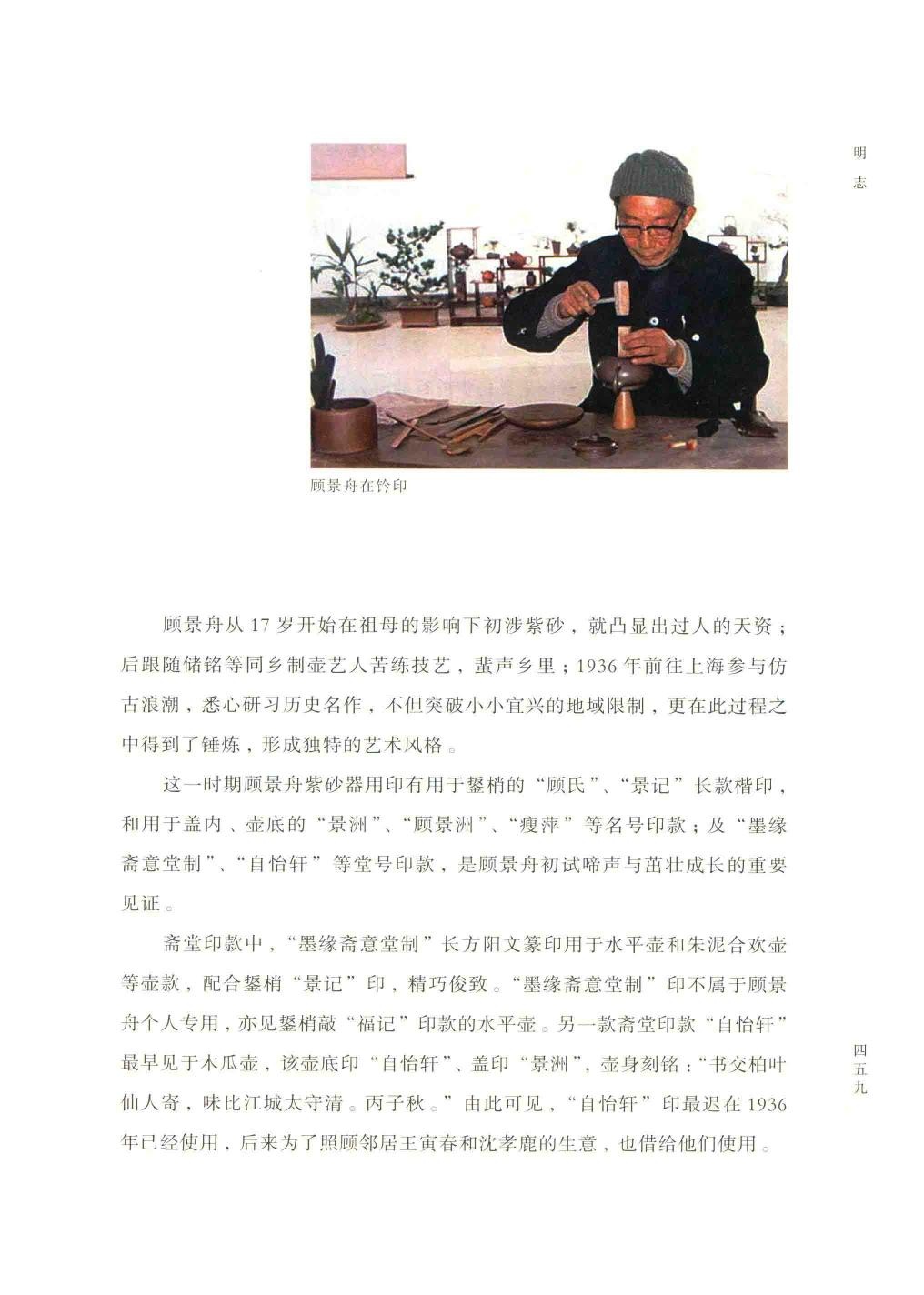
Gu Jingzhou began his journey into Yixing pottery at the age of 17 under his grandmother's influence, immediately displaying exceptional natural talent. He later honed his skills by studying with fellow townsmen and accomplished artisans such as Chu Ming, earning recognition throughout the region. In 1936, he traveled to Shanghai to participate in the wave of antique reproductions, meticulously studying historical masterpieces. This experience not only broke through the geographical limitations of small Yixing, but also refined his craft through the process, forming a distinctive artistic style.
During this period, Gu Jingzhou's seal marks on his Yixing teapots included rectangular seal impressions in regular script reading "Gu Shi" and "Jing Ji" used on handles, as well as personal name seals such as "Jingzhou," "Gu Jingzhou," and "Shou Ping" used inside lids and on pot bottoms. He also employed studio hall marks including "Mo Yuan Zhai Yi Tang Zhi" and "Zi Yi Xuan," which serve as important testimony to Gu Jingzhou's early artistic debut and vigorous development.
Among the studio hall marks, the rectangular relief seal in seal script reading "Mo Yuan Zhai Yi Tang Zhi" was used on horizontal teapots and vermillion clay *Hehuan* teapots, paired with the handle seal "Jing Ji," creating an elegant and refined effect. The "Mo Yuan Zhai Yi Tang Zhi" seal was not exclusively Gu Jingzhou's personal mark; it also appears on horizontal teapots with the handle seal "Fu Ji." Another studio hall mark, "Zi Yi Xuan," first appeared on a melon-shaped teapot, with "Zi Yi Xuan" impressed on the bottom, "Jingzhou" on the lid, and an inscription carved on the body reading: "Correspondence with cypress leaves sent by immortals, flavor as pure as the Prefect of Jiangcheng. Autumn of Bingzi year." This indicates that the "Zi Yi Xuan" seal was in use by 1936 at the latest. Later, to help support the livelihoods of his neighbors Wang Yinchun and Shen Xiaolu, he also lent them this seal for their use.
Chapter 7
明志
Clarifying Aspiration
Pages 463-485
View Chapter →
English Translation
Gu Jingzhou began his journey into Yixing pottery at the age of 17 under his grandmother's influence, immediately displaying exceptional natural talent. He later honed his skills by studying with fellow townsmen and accomplished artisans such as Chu Ming, earning recognition throughout the region. In 1936, he traveled to Shanghai to participate in the wave of antique reproductions, meticulously studying historical masterpieces. This experience not only broke through the geographical limitations of small Yixing, but also refined his craft through the process, forming a distinctive artistic style.
During this period, Gu Jingzhou's seal marks on his Yixing teapots included rectangular seal impressions in regular script reading "Gu Shi" and "Jing Ji" used on handles, as well as personal name seals such as "Jingzhou," "Gu Jingzhou," and "Shou Ping" used inside lids and on pot bottoms. He also employed studio hall marks including "Mo Yuan Zhai Yi Tang Zhi" and "Zi Yi Xuan," which serve as important testimony to Gu Jingzhou's early artistic debut and vigorous development.
Among the studio hall marks, the rectangular relief seal in seal script reading "Mo Yuan Zhai Yi Tang Zhi" was used on horizontal teapots and vermillion clay *Hehuan* teapots, paired with the handle seal "Jing Ji," creating an elegant and refined effect. The "Mo Yuan Zhai Yi Tang Zhi" seal was not exclusively Gu Jingzhou's personal mark; it also appears on horizontal teapots with the handle seal "Fu Ji." Another studio hall mark, "Zi Yi Xuan," first appeared on a melon-shaped teapot, with "Zi Yi Xuan" impressed on the bottom, "Jingzhou" on the lid, and an inscription carved on the body reading: "Correspondence with cypress leaves sent by immortals, flavor as pure as the Prefect of Jiangcheng. Autumn of Bingzi year." This indicates that the "Zi Yi Xuan" seal was in use by 1936 at the latest. Later, to help support the livelihoods of his neighbors Wang Yinchun and Shen Xiaolu, he also lent them this seal for their use.
章节导航 Chapter Navigation
Chapter 1
序文
Pages 6-6
Chapter 2
引言
Pages 28-31
Chapter 3
达变
Pages 32-133
Chapter 3
开宗立派
Pages 46-66
Chapter 3
传道授业
Pages 67-98
Chapter 3
大师淳友
Pages 99-120
Chapter 3
学艺谋生
Pages 121-133
Chapter 4
化神
Pages 134-141
Chapter 5
独妙
Pages 142-405
Chapter 5
匠心独运 不苟丝毫
Pages 142-179
Chapter 5
器利善事 物尽其用
Pages 180-199
Chapter 5
紫泥春华 研精究微
Pages 200-405
Chapter 6
驾简
Pages 406-427
Chapter 6
精雕细刻 文质合一
Pages 406-410
Chapter 6
师法自然 妙趣横生
Pages 411-415
Chapter 6
丝来线去 曲尽其妙
Pages 416-427
Chapter 7
明志
Pages 463-485
Chapter 7
高山仰止 淡泊明志
Pages 463-472
Chapter 7
啜墨看茶 气定神闲
Pages 473-478
Chapter 7
齿少心锐 怡志抒情
Pages 479-485
Chapter 8
存真
Pages 428-462
Chapter 8
规圆矩方 弃伪存真
Pages 428-436
Chapter 8
有物有则 钻尖仰高
Pages 437-462
Chapter 9
心营
Pages 506-525
Chapter 9
坚守传统 艺立潮头
Pages 506-513
Chapter 9
新型师承 桃李满园
Pages 514-525
Chapter 10
附录
Pages 526-651
Chapter 10
顾景舟紫艺论文
Pages 526-535
Chapter 10
技术课备课笔记
Pages 536-543
Chapter 10
顾景舟艺术年表
Pages 544-651
Chapter 11
参考文献
Pages 652-657
Chapter 12
鸣谢
Pages 658-659