499
of 659
English Translation
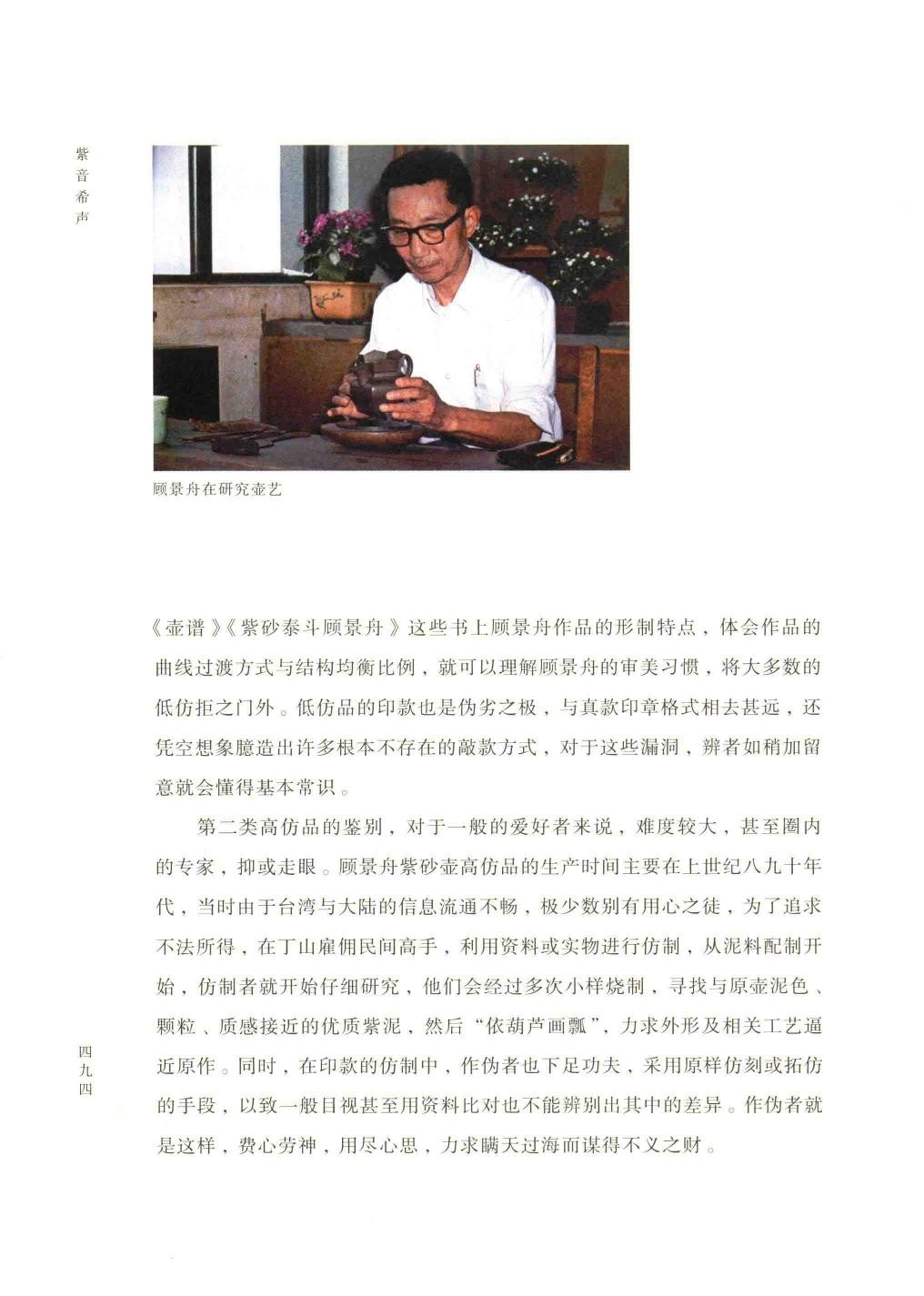
By studying the formal characteristics of Gu Jingzhou's works in books such as *Suo Pu* and *Purple Clay Master Gu Jingzhou*, and experiencing the curved transitions and structural balance proportions of his pieces, one can understand Gu Jingzhou's aesthetic habits and reject most low-quality forgeries at the door. The seal marks on low-quality fakes are also extremely crude, far removed from the format of genuine seal impressions. Forgers fabricate many seal application methods that simply do not exist. Regarding these flaws, discerning observers who pay slight attention will understand the basic common knowledge.
The second category—identifying high-quality forgeries—presents greater difficulty for general enthusiasts, and even experts within the field may occasionally be deceived. The production of high-quality Gu Jingzhou purple clay teapot forgeries mainly occurred in the 1980s and 1990s. At that time, due to poor information flow between Taiwan and mainland China, a very small number of individuals with ulterior motives, in pursuit of illegal gains, hired skilled folk artisans in Dingshan to create reproductions using reference materials or actual objects. Starting from the clay preparation stage, forgers began meticulous research. They would conduct multiple test firings of small samples, seeking high-quality purple clay that closely matched the original teapot's clay color, granularity, and texture. Then, "drawing the gourd to paint the ladle," they strove to make the external form and related craftsmanship approach the original work. Simultaneously, in forging the seal marks, counterfeiters also invested considerable effort, employing methods of direct imitation carving or rubbing reproduction, such that ordinary visual inspection or even comparison with reference materials could not discern the differences. This is how forgers operate—painstakingly and exhaustively scheming, striving to deceive and obtain ill-gotten gains.
English Translation
By studying the formal characteristics of Gu Jingzhou's works in books such as *Suo Pu* and *Purple Clay Master Gu Jingzhou*, and experiencing the curved transitions and structural balance proportions of his pieces, one can understand Gu Jingzhou's aesthetic habits and reject most low-quality forgeries at the door. The seal marks on low-quality fakes are also extremely crude, far removed from the format of genuine seal impressions. Forgers fabricate many seal application methods that simply do not exist. Regarding these flaws, discerning observers who pay slight attention will understand the basic common knowledge.
The second category—identifying high-quality forgeries—presents greater difficulty for general enthusiasts, and even experts within the field may occasionally be deceived. The production of high-quality Gu Jingzhou purple clay teapot forgeries mainly occurred in the 1980s and 1990s. At that time, due to poor information flow between Taiwan and mainland China, a very small number of individuals with ulterior motives, in pursuit of illegal gains, hired skilled folk artisans in Dingshan to create reproductions using reference materials or actual objects. Starting from the clay preparation stage, forgers began meticulous research. They would conduct multiple test firings of small samples, seeking high-quality purple clay that closely matched the original teapot's clay color, granularity, and texture. Then, "drawing the gourd to paint the ladle," they strove to make the external form and related craftsmanship approach the original work. Simultaneously, in forging the seal marks, counterfeiters also invested considerable effort, employing methods of direct imitation carving or rubbing reproduction, such that ordinary visual inspection or even comparison with reference materials could not discern the differences. This is how forgers operate—painstakingly and exhaustively scheming, striving to deceive and obtain ill-gotten gains.
章节导航 Chapter Navigation
Chapter 1
序文
Pages 6-6
Chapter 2
引言
Pages 28-31
Chapter 3
达变
Pages 32-133
Chapter 3
开宗立派
Pages 46-66
Chapter 3
传道授业
Pages 67-98
Chapter 3
大师淳友
Pages 99-120
Chapter 3
学艺谋生
Pages 121-133
Chapter 4
化神
Pages 134-141
Chapter 5
独妙
Pages 142-405
Chapter 5
匠心独运 不苟丝毫
Pages 142-179
Chapter 5
器利善事 物尽其用
Pages 180-199
Chapter 5
紫泥春华 研精究微
Pages 200-405
Chapter 6
驾简
Pages 406-427
Chapter 6
精雕细刻 文质合一
Pages 406-410
Chapter 6
师法自然 妙趣横生
Pages 411-415
Chapter 6
丝来线去 曲尽其妙
Pages 416-427
Chapter 7
明志
Pages 463-485
Chapter 7
高山仰止 淡泊明志
Pages 463-472
Chapter 7
啜墨看茶 气定神闲
Pages 473-478
Chapter 7
齿少心锐 怡志抒情
Pages 479-485
Chapter 8
存真
Pages 428-462
Chapter 8
规圆矩方 弃伪存真
Pages 428-436
Chapter 8
有物有则 钻尖仰高
Pages 437-462
Chapter 9
心营
Pages 506-525
Chapter 9
坚守传统 艺立潮头
Pages 506-513
Chapter 9
新型师承 桃李满园
Pages 514-525
Chapter 10
附录
Pages 526-651
Chapter 10
顾景舟紫艺论文
Pages 526-535
Chapter 10
技术课备课笔记
Pages 536-543
Chapter 10
顾景舟艺术年表
Pages 544-651
Chapter 11
参考文献
Pages 652-657
Chapter 12
鸣谢
Pages 658-659