501
of 659
English Translation
## Nine
## Six
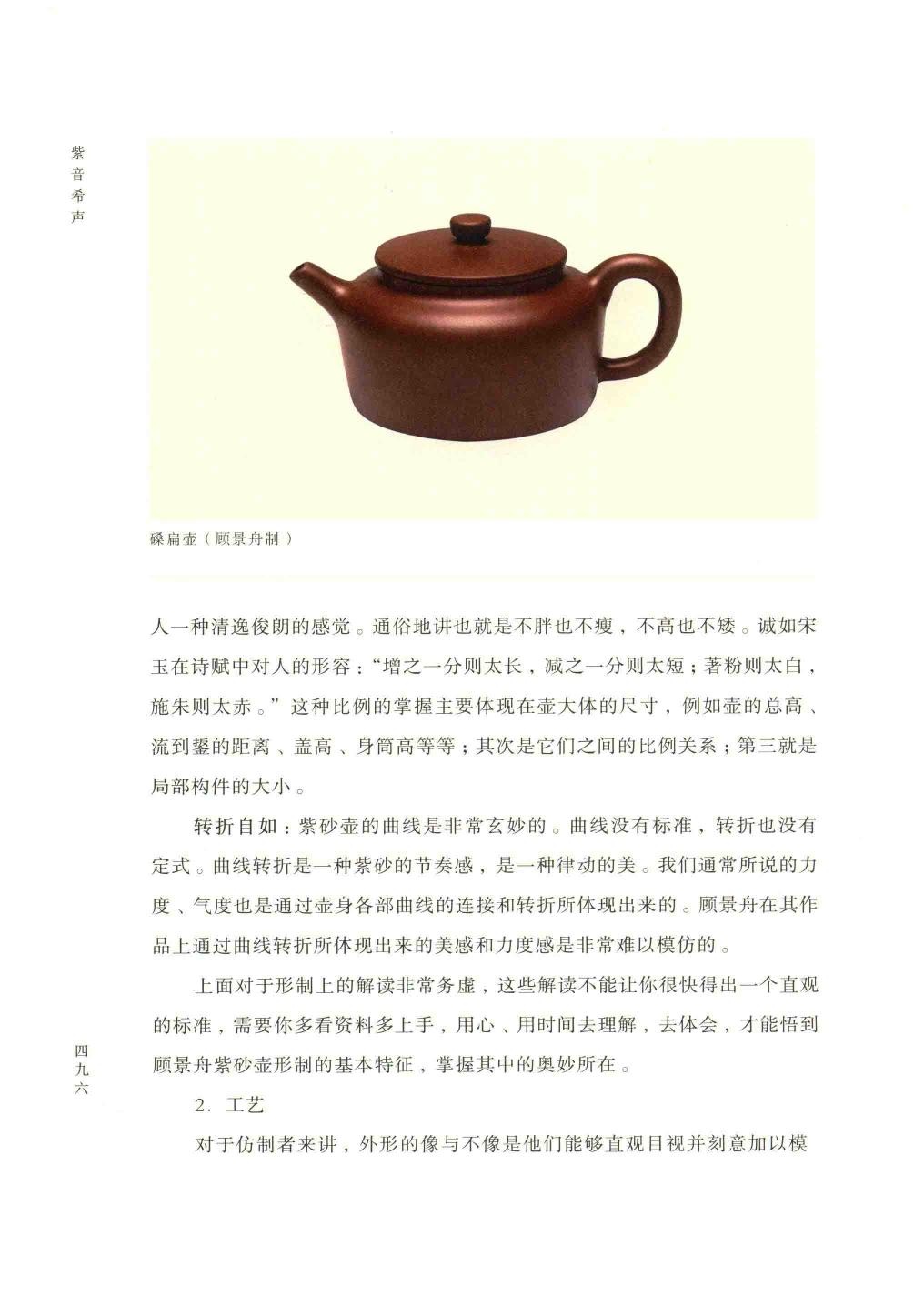
Friendship Flat Pot (Made by Gu Jingzhou)
gives one a feeling of elegant refinement and grace. As commonly described by Liu Yu in poetry and prose when depicting a person: "Add one measure and it becomes too long, subtract one measure and it becomes too short; apply powder and it becomes too white, apply rouge and it becomes too red." This mastery of proportion
means neither fat nor thin, neither tall nor short. The control of these proportions is primarily manifested in the overall dimensions of the pot, such as the total height of the pot,
the distance from spout to handle, the height of the lid, the height of the body, and so forth; secondly, in the proportional relationships between these elements; and thirdly, in
the size of individual components.
Fluid transitions: The curves of Yixing teapots are extraordinarily subtle. Curves have no standard, and transitions have no
fixed formula. The curving transitions represent a sense of rhythm in Yixing pottery, a
beauty of movement. What we commonly refer to as strength
and bearing are also expressed through the connection and transition of curves across various parts of the pot body. The aesthetic beauty and sense of strength that Gu Jingzhou expressed through curving transitions in his
works are extremely difficult to imitate.
The above interpretation of form is quite abstract; these
interpretations cannot quickly provide you with an intuitive and direct
standard. You need to examine more materials, handle more pieces, use your
mind and time to understand and experience them before you can grasp
the fundamental characteristics of Gu Jingzhou's Yixing teapot forms and comprehend
the mysteries within.
## 2. Craftsmanship
For
imitators, whether the external form resembles the original or not is something they can visually assess and deliberately attempt to replicate.
English Translation
## Nine
## Six
Friendship Flat Pot (Made by Gu Jingzhou)
gives one a feeling of elegant refinement and grace. As commonly described by Liu Yu in poetry and prose when depicting a person: "Add one measure and it becomes too long, subtract one measure and it becomes too short; apply powder and it becomes too white, apply rouge and it becomes too red." This mastery of proportion
means neither fat nor thin, neither tall nor short. The control of these proportions is primarily manifested in the overall dimensions of the pot, such as the total height of the pot,
the distance from spout to handle, the height of the lid, the height of the body, and so forth; secondly, in the proportional relationships between these elements; and thirdly, in
the size of individual components.
Fluid transitions: The curves of Yixing teapots are extraordinarily subtle. Curves have no standard, and transitions have no
fixed formula. The curving transitions represent a sense of rhythm in Yixing pottery, a
beauty of movement. What we commonly refer to as strength
and bearing are also expressed through the connection and transition of curves across various parts of the pot body. The aesthetic beauty and sense of strength that Gu Jingzhou expressed through curving transitions in his
works are extremely difficult to imitate.
The above interpretation of form is quite abstract; these
interpretations cannot quickly provide you with an intuitive and direct
standard. You need to examine more materials, handle more pieces, use your
mind and time to understand and experience them before you can grasp
the fundamental characteristics of Gu Jingzhou's Yixing teapot forms and comprehend
the mysteries within.
## 2. Craftsmanship
For
imitators, whether the external form resembles the original or not is something they can visually assess and deliberately attempt to replicate.
章节导航 Chapter Navigation
Chapter 1
序文
Pages 6-6
Chapter 2
引言
Pages 28-31
Chapter 3
达变
Pages 32-133
Chapter 3
开宗立派
Pages 46-66
Chapter 3
传道授业
Pages 67-98
Chapter 3
大师淳友
Pages 99-120
Chapter 3
学艺谋生
Pages 121-133
Chapter 4
化神
Pages 134-141
Chapter 5
独妙
Pages 142-405
Chapter 5
匠心独运 不苟丝毫
Pages 142-179
Chapter 5
器利善事 物尽其用
Pages 180-199
Chapter 5
紫泥春华 研精究微
Pages 200-405
Chapter 6
驾简
Pages 406-427
Chapter 6
精雕细刻 文质合一
Pages 406-410
Chapter 6
师法自然 妙趣横生
Pages 411-415
Chapter 6
丝来线去 曲尽其妙
Pages 416-427
Chapter 7
明志
Pages 463-485
Chapter 7
高山仰止 淡泊明志
Pages 463-472
Chapter 7
啜墨看茶 气定神闲
Pages 473-478
Chapter 7
齿少心锐 怡志抒情
Pages 479-485
Chapter 8
存真
Pages 428-462
Chapter 8
规圆矩方 弃伪存真
Pages 428-436
Chapter 8
有物有则 钻尖仰高
Pages 437-462
Chapter 9
心营
Pages 506-525
Chapter 9
坚守传统 艺立潮头
Pages 506-513
Chapter 9
新型师承 桃李满园
Pages 514-525
Chapter 10
附录
Pages 526-651
Chapter 10
顾景舟紫艺论文
Pages 526-535
Chapter 10
技术课备课笔记
Pages 536-543
Chapter 10
顾景舟艺术年表
Pages 544-651
Chapter 11
参考文献
Pages 652-657
Chapter 12
鸣谢
Pages 658-659