Chapter 9
心营
Heart's Cultivation
521
of 659
English Translation
## Sheng Ji
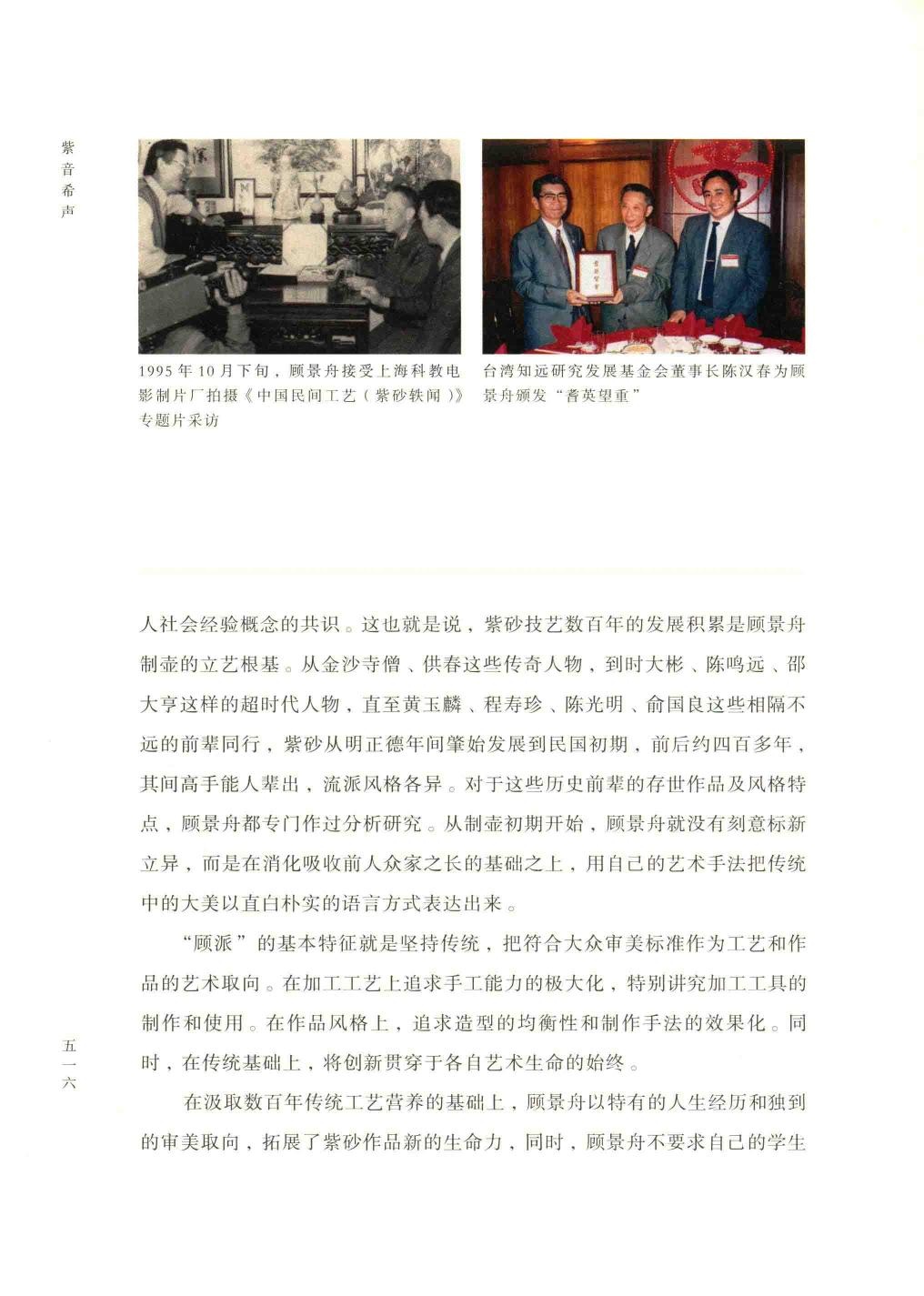
In late October 1995, Gu Jingzhou accepted an interview for the documentary *Chinese Folk Crafts (Anecdotes of Yixing Pottery)* produced by Shanghai Science and Education Film Studio.
The development and accumulation of Yixing pottery over several centuries formed the foundation of Gu Jingzhou's artistic practice. From legendary figures like the monk of Jinsha Temple and Gong Chun, to transcendent masters like Shi Dabin and Chen Mingyuan, and on to predecessors closer in time like Huang Yulin, Yu Guoliang, Wang Yinchun, and Chen Guangming—throughout this history, skilled artisans emerged in great numbers, each with distinct schools and styles. Gu Jingzhou conducted specialized analytical studies of these historical predecessors and their stylistic characteristics. From the beginning of his pottery-making career, Gu Jingzhou never deliberately sought novelty or difference. Rather, on the foundation of digesting and absorbing the strengths of his many predecessors, he used his unique life experiences and distinctive aesthetic sensibility to express the great beauty within tradition through direct and unpretentious language.
The basic characteristics of the "Gu School" are: adherence to tradition, expressing artistic orientations in works that align with popular aesthetic consensus—which is to say, the shared conceptual understanding of human social experience accumulated over hundreds of years of Yixing pottery craftsmanship. In craftsmanship, he pursued the maximization of manual skill, with particular emphasis on the processing and use of hand tools. In stylistic terms, he pursued balance in form and effectiveness in technique. At the same time, on a traditional foundation, he integrated innovation throughout his artistic life. On the basis of absorbing hundreds of years of traditional craft nourishment, Gu Jingzhou expanded new vitality in Yixing pottery works with his distinctive artistic methods. Meanwhile, Gu Jingzhou did not require his students to...
---
Chen Hanchun, Chairman of Taiwan's Zhiyuan Research and Development Foundation, presenting Gu Jingzhou with the "Virtue and Prestige" award.
Chapter 9
心营
Heart's Cultivation
Pages 506-525
View Chapter →
English Translation
## Sheng Ji
In late October 1995, Gu Jingzhou accepted an interview for the documentary *Chinese Folk Crafts (Anecdotes of Yixing Pottery)* produced by Shanghai Science and Education Film Studio.
The development and accumulation of Yixing pottery over several centuries formed the foundation of Gu Jingzhou's artistic practice. From legendary figures like the monk of Jinsha Temple and Gong Chun, to transcendent masters like Shi Dabin and Chen Mingyuan, and on to predecessors closer in time like Huang Yulin, Yu Guoliang, Wang Yinchun, and Chen Guangming—throughout this history, skilled artisans emerged in great numbers, each with distinct schools and styles. Gu Jingzhou conducted specialized analytical studies of these historical predecessors and their stylistic characteristics. From the beginning of his pottery-making career, Gu Jingzhou never deliberately sought novelty or difference. Rather, on the foundation of digesting and absorbing the strengths of his many predecessors, he used his unique life experiences and distinctive aesthetic sensibility to express the great beauty within tradition through direct and unpretentious language.
The basic characteristics of the "Gu School" are: adherence to tradition, expressing artistic orientations in works that align with popular aesthetic consensus—which is to say, the shared conceptual understanding of human social experience accumulated over hundreds of years of Yixing pottery craftsmanship. In craftsmanship, he pursued the maximization of manual skill, with particular emphasis on the processing and use of hand tools. In stylistic terms, he pursued balance in form and effectiveness in technique. At the same time, on a traditional foundation, he integrated innovation throughout his artistic life. On the basis of absorbing hundreds of years of traditional craft nourishment, Gu Jingzhou expanded new vitality in Yixing pottery works with his distinctive artistic methods. Meanwhile, Gu Jingzhou did not require his students to...
---
Chen Hanchun, Chairman of Taiwan's Zhiyuan Research and Development Foundation, presenting Gu Jingzhou with the "Virtue and Prestige" award.
章节导航 Chapter Navigation
Chapter 1
序文
Pages 6-6
Chapter 2
引言
Pages 28-31
Chapter 3
达变
Pages 32-133
Chapter 3
开宗立派
Pages 46-66
Chapter 3
传道授业
Pages 67-98
Chapter 3
大师淳友
Pages 99-120
Chapter 3
学艺谋生
Pages 121-133
Chapter 4
化神
Pages 134-141
Chapter 5
独妙
Pages 142-405
Chapter 5
匠心独运 不苟丝毫
Pages 142-179
Chapter 5
器利善事 物尽其用
Pages 180-199
Chapter 5
紫泥春华 研精究微
Pages 200-405
Chapter 6
驾简
Pages 406-427
Chapter 6
精雕细刻 文质合一
Pages 406-410
Chapter 6
师法自然 妙趣横生
Pages 411-415
Chapter 6
丝来线去 曲尽其妙
Pages 416-427
Chapter 7
明志
Pages 463-485
Chapter 7
高山仰止 淡泊明志
Pages 463-472
Chapter 7
啜墨看茶 气定神闲
Pages 473-478
Chapter 7
齿少心锐 怡志抒情
Pages 479-485
Chapter 8
存真
Pages 428-462
Chapter 8
规圆矩方 弃伪存真
Pages 428-436
Chapter 8
有物有则 钻尖仰高
Pages 437-462
Chapter 9
心营
Pages 506-525
Chapter 9
坚守传统 艺立潮头
Pages 506-513
Chapter 9
新型师承 桃李满园
Pages 514-525
Chapter 10
附录
Pages 526-651
Chapter 10
顾景舟紫艺论文
Pages 526-535
Chapter 10
技术课备课笔记
Pages 536-543
Chapter 10
顾景舟艺术年表
Pages 544-651
Chapter 11
参考文献
Pages 652-657
Chapter 12
鸣谢
Pages 658-659