Chapter 10
附录
Appendix
573
of 659
English Translation
## Part Two, Complete
### Lesson 10, January 9, 1982
## Lines, Line Tools, Compound Tops, and Small Paddles:
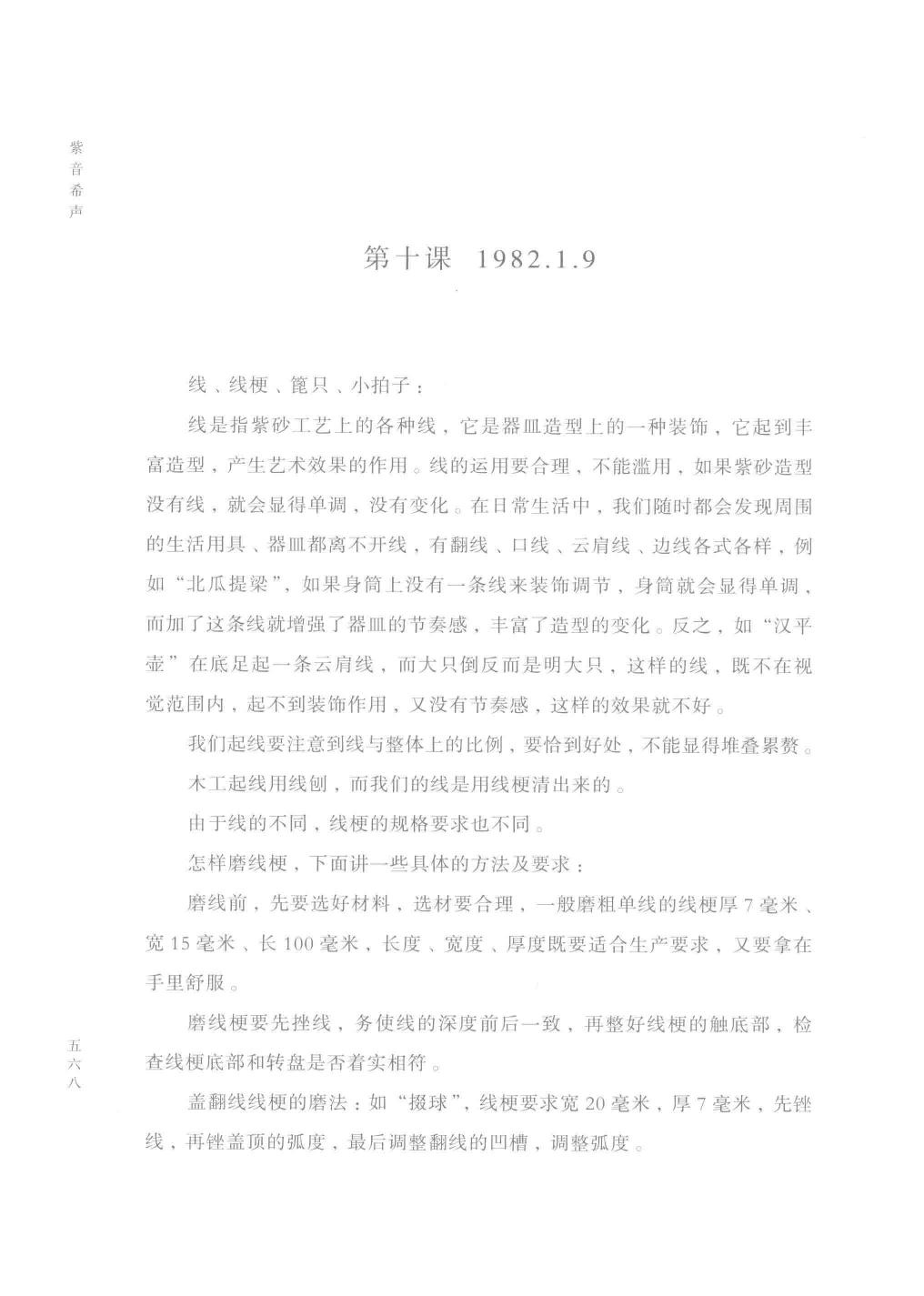
Lines refer to the various lines in Yixing pottery craftsmanship. They are a form of decoration on the vessel's form, serving to enrich the shape and produce artistic effects. The application of lines must be reasonable and not excessive. If a Yixing form has no lines, it will appear monotonous and lacking in variation. In daily life, we constantly discover that the household utensils and vessels around us cannot do without lines—there are flange lines, rim lines, cloud-shoulder lines, edge lines of all varieties. For example, in the "Beigua Tiliang" (Northern Melon Lifting Beam teapot), if the body cylinder had no line to decorate and regulate it, the body would appear monotonous, but adding this line enhances the vessel's sense of rhythm and enriches the variation in form. Conversely, as in the "Hanping Hu" (Han Flat teapot), if a cloud-shoulder line is raised at the foot, while the lid is instead a bright lid, such a line neither falls within the visual range to serve a decorative function, nor does it have rhythmic sense—such an effect is not good.
When creating lines, we must pay attention to the proportion of the line in relation to the whole; it must be just right and not appear piled up or cumbersome.
Carpenters create lines using a molding plane, while our lines are scraped out using line tools.
Because lines differ, the specifications and requirements for line tools also differ.
Below I will discuss some specific methods and requirements for grinding line tools.
Before grinding a line tool, one must first select good materials. Material selection must be reasonable. Generally, a line tool for grinding a thick single line is 7 millimeters thick, 15 millimeters wide, and 100 millimeters long. The length, width, and thickness must both suit production requirements and feel comfortable in the hand.
When grinding a line tool, one must first file the line, ensuring that the depth of the line is consistent from front to back, then finish the bottom contact surface of the line tool, checking whether the bottom of the line tool and the turntable correspond properly and make solid contact.
The grinding method for flange line tools: As in the "Shegiu" (Capturing the Ball teapot), the line tool requires a width of 20 millimeters and thickness of 7 millimeters. First file the line, then file the arc of the lid top, and finally adjust the concave groove of the flange line and adjust the arc.
Chapter 10
附录
Appendix
Pages 526-651
View Chapter →
English Translation
## Part Two, Complete
### Lesson 10, January 9, 1982
## Lines, Line Tools, Compound Tops, and Small Paddles:
Lines refer to the various lines in Yixing pottery craftsmanship. They are a form of decoration on the vessel's form, serving to enrich the shape and produce artistic effects. The application of lines must be reasonable and not excessive. If a Yixing form has no lines, it will appear monotonous and lacking in variation. In daily life, we constantly discover that the household utensils and vessels around us cannot do without lines—there are flange lines, rim lines, cloud-shoulder lines, edge lines of all varieties. For example, in the "Beigua Tiliang" (Northern Melon Lifting Beam teapot), if the body cylinder had no line to decorate and regulate it, the body would appear monotonous, but adding this line enhances the vessel's sense of rhythm and enriches the variation in form. Conversely, as in the "Hanping Hu" (Han Flat teapot), if a cloud-shoulder line is raised at the foot, while the lid is instead a bright lid, such a line neither falls within the visual range to serve a decorative function, nor does it have rhythmic sense—such an effect is not good.
When creating lines, we must pay attention to the proportion of the line in relation to the whole; it must be just right and not appear piled up or cumbersome.
Carpenters create lines using a molding plane, while our lines are scraped out using line tools.
Because lines differ, the specifications and requirements for line tools also differ.
Below I will discuss some specific methods and requirements for grinding line tools.
Before grinding a line tool, one must first select good materials. Material selection must be reasonable. Generally, a line tool for grinding a thick single line is 7 millimeters thick, 15 millimeters wide, and 100 millimeters long. The length, width, and thickness must both suit production requirements and feel comfortable in the hand.
When grinding a line tool, one must first file the line, ensuring that the depth of the line is consistent from front to back, then finish the bottom contact surface of the line tool, checking whether the bottom of the line tool and the turntable correspond properly and make solid contact.
The grinding method for flange line tools: As in the "Shegiu" (Capturing the Ball teapot), the line tool requires a width of 20 millimeters and thickness of 7 millimeters. First file the line, then file the arc of the lid top, and finally adjust the concave groove of the flange line and adjust the arc.
章节导航 Chapter Navigation
Chapter 1
序文
Pages 6-6
Chapter 2
引言
Pages 28-31
Chapter 3
达变
Pages 32-133
Chapter 3
开宗立派
Pages 46-66
Chapter 3
传道授业
Pages 67-98
Chapter 3
大师淳友
Pages 99-120
Chapter 3
学艺谋生
Pages 121-133
Chapter 4
化神
Pages 134-141
Chapter 5
独妙
Pages 142-405
Chapter 5
匠心独运 不苟丝毫
Pages 142-179
Chapter 5
器利善事 物尽其用
Pages 180-199
Chapter 5
紫泥春华 研精究微
Pages 200-405
Chapter 6
驾简
Pages 406-427
Chapter 6
精雕细刻 文质合一
Pages 406-410
Chapter 6
师法自然 妙趣横生
Pages 411-415
Chapter 6
丝来线去 曲尽其妙
Pages 416-427
Chapter 7
明志
Pages 463-485
Chapter 7
高山仰止 淡泊明志
Pages 463-472
Chapter 7
啜墨看茶 气定神闲
Pages 473-478
Chapter 7
齿少心锐 怡志抒情
Pages 479-485
Chapter 8
存真
Pages 428-462
Chapter 8
规圆矩方 弃伪存真
Pages 428-436
Chapter 8
有物有则 钻尖仰高
Pages 437-462
Chapter 9
心营
Pages 506-525
Chapter 9
坚守传统 艺立潮头
Pages 506-513
Chapter 9
新型师承 桃李满园
Pages 514-525
Chapter 10
附录
Pages 526-651
Chapter 10
顾景舟紫艺论文
Pages 526-535
Chapter 10
技术课备课笔记
Pages 536-543
Chapter 10
顾景舟艺术年表
Pages 544-651
Chapter 11
参考文献
Pages 652-657
Chapter 12
鸣谢
Pages 658-659