Chapter 10
附录
Appendix
622
of 659
English Translation
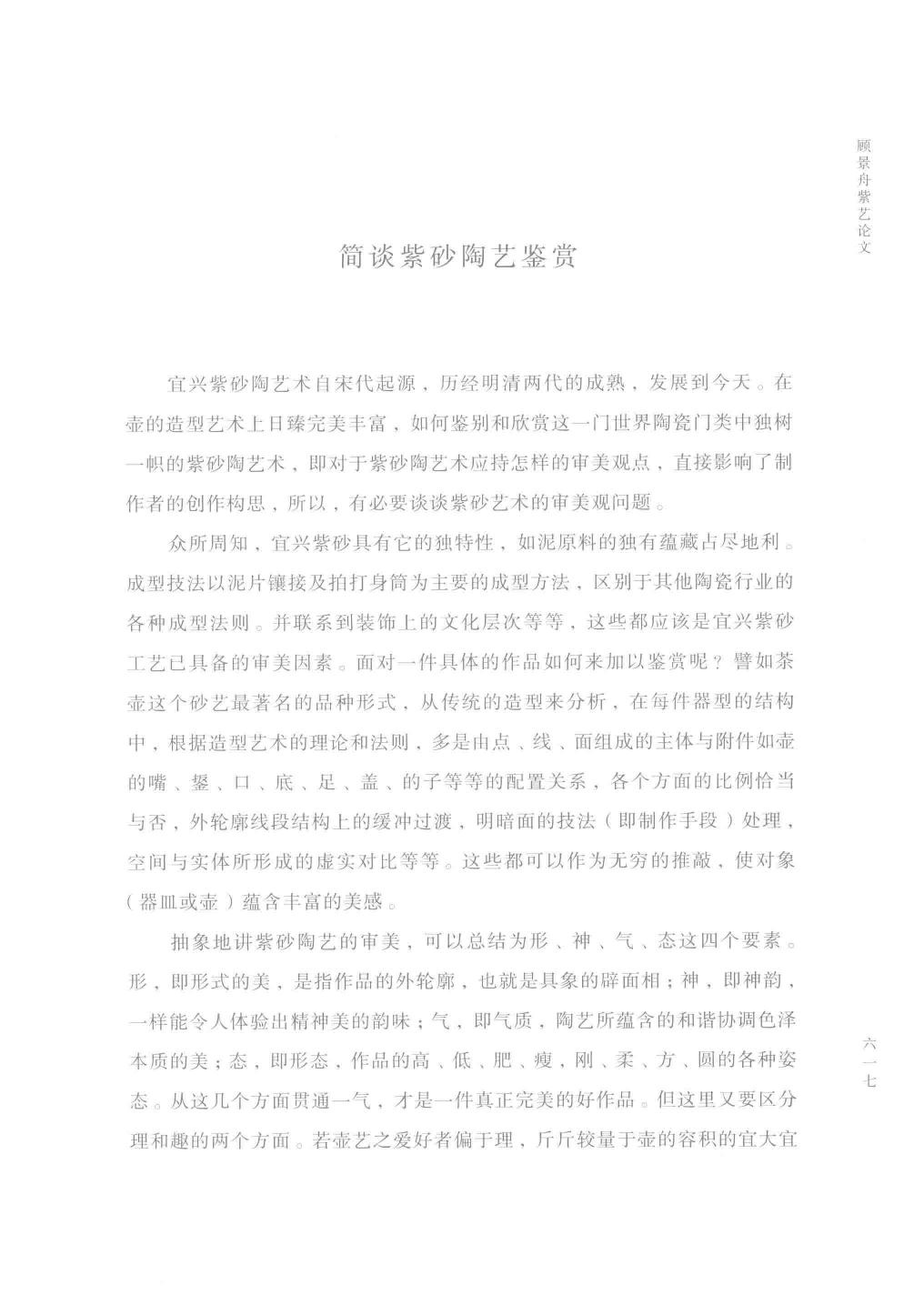
Yixing Zisha pottery art originated in the Song Dynasty, matured through the Ming and Qing dynasties, and has developed to the present day. The artistic forms of teapots have reached perfection and richness. How to identify and appreciate this unique branch of Zisha pottery art within the world of ceramics—that is, what aesthetic perspective should be held toward Zisha pottery art—directly influences the creative conception of makers. Therefore, it is necessary to discuss the aesthetic perspective of Zisha art.
As is well known, Yixing Zisha possesses its unique characteristics. For example, the exclusive deposits of clay raw materials occupy an advantageous geographical position. The forming techniques, primarily using clay slab joining and beating the body cylinder as the main forming methods, differ from the various forming principles of other ceramic industries. Connected to this are the cultural dimensions of decoration, and so on. These should all be considered aesthetic factors inherent to Yixing Zisha art. How should one appreciate a specific work? For instance, take the teapot, the most famous form in Zisha art. Analyzing traditional forms, in the structure of each vessel type, according to the theories and principles of sculptural art, most are composed of points, lines, and surfaces forming the main body, along with attachments such as the spout, handle, mouth, base, foot, lid, knob, and so on—the relationships of their configurations, the appropriateness of proportions in each aspect, the buffering transitions in the structure of outer contour lines, the technical treatment of light and dark surfaces (that is, the means of production), the contrast between void and solid formed by space and substance, and so on. All of these can serve as infinite considerations, enabling the object (vessel or teapot) to contain rich aesthetic appeal.
Speaking abstractly about the aesthetics of Zisha pottery art, it can be summarized into four elements: form, spirit, essence, and posture.
That is, the beauty of form refers to the outer contour of the work, which is the concrete visual appearance; spirit refers to spiritual resonance, which likewise enables people to experience the charm of spiritual beauty; essence refers to temperament, the harmonious and coordinated beauty of color and inherent quality contained in the pottery art; posture refers to form and bearing—the various attitudes of a work's height, lowness, plumpness, slenderness, firmness, softness, squareness, and roundness. Only when these aspects flow together as one is a work truly perfect and excellent. But here one must also distinguish between the two aspects of principle and interest. If teapot enthusiasts lean toward principle, they will calculate and measure whether the pot's capacity should be large or small...
Chapter 10
附录
Appendix
Pages 526-651
View Chapter →
English Translation
Yixing Zisha pottery art originated in the Song Dynasty, matured through the Ming and Qing dynasties, and has developed to the present day. The artistic forms of teapots have reached perfection and richness. How to identify and appreciate this unique branch of Zisha pottery art within the world of ceramics—that is, what aesthetic perspective should be held toward Zisha pottery art—directly influences the creative conception of makers. Therefore, it is necessary to discuss the aesthetic perspective of Zisha art.
As is well known, Yixing Zisha possesses its unique characteristics. For example, the exclusive deposits of clay raw materials occupy an advantageous geographical position. The forming techniques, primarily using clay slab joining and beating the body cylinder as the main forming methods, differ from the various forming principles of other ceramic industries. Connected to this are the cultural dimensions of decoration, and so on. These should all be considered aesthetic factors inherent to Yixing Zisha art. How should one appreciate a specific work? For instance, take the teapot, the most famous form in Zisha art. Analyzing traditional forms, in the structure of each vessel type, according to the theories and principles of sculptural art, most are composed of points, lines, and surfaces forming the main body, along with attachments such as the spout, handle, mouth, base, foot, lid, knob, and so on—the relationships of their configurations, the appropriateness of proportions in each aspect, the buffering transitions in the structure of outer contour lines, the technical treatment of light and dark surfaces (that is, the means of production), the contrast between void and solid formed by space and substance, and so on. All of these can serve as infinite considerations, enabling the object (vessel or teapot) to contain rich aesthetic appeal.
Speaking abstractly about the aesthetics of Zisha pottery art, it can be summarized into four elements: form, spirit, essence, and posture.
That is, the beauty of form refers to the outer contour of the work, which is the concrete visual appearance; spirit refers to spiritual resonance, which likewise enables people to experience the charm of spiritual beauty; essence refers to temperament, the harmonious and coordinated beauty of color and inherent quality contained in the pottery art; posture refers to form and bearing—the various attitudes of a work's height, lowness, plumpness, slenderness, firmness, softness, squareness, and roundness. Only when these aspects flow together as one is a work truly perfect and excellent. But here one must also distinguish between the two aspects of principle and interest. If teapot enthusiasts lean toward principle, they will calculate and measure whether the pot's capacity should be large or small...
章节导航 Chapter Navigation
Chapter 1
序文
Pages 6-6
Chapter 2
引言
Pages 28-31
Chapter 3
达变
Pages 32-133
Chapter 3
开宗立派
Pages 46-66
Chapter 3
传道授业
Pages 67-98
Chapter 3
大师淳友
Pages 99-120
Chapter 3
学艺谋生
Pages 121-133
Chapter 4
化神
Pages 134-141
Chapter 5
独妙
Pages 142-405
Chapter 5
匠心独运 不苟丝毫
Pages 142-179
Chapter 5
器利善事 物尽其用
Pages 180-199
Chapter 5
紫泥春华 研精究微
Pages 200-405
Chapter 6
驾简
Pages 406-427
Chapter 6
精雕细刻 文质合一
Pages 406-410
Chapter 6
师法自然 妙趣横生
Pages 411-415
Chapter 6
丝来线去 曲尽其妙
Pages 416-427
Chapter 7
明志
Pages 463-485
Chapter 7
高山仰止 淡泊明志
Pages 463-472
Chapter 7
啜墨看茶 气定神闲
Pages 473-478
Chapter 7
齿少心锐 怡志抒情
Pages 479-485
Chapter 8
存真
Pages 428-462
Chapter 8
规圆矩方 弃伪存真
Pages 428-436
Chapter 8
有物有则 钻尖仰高
Pages 437-462
Chapter 9
心营
Pages 506-525
Chapter 9
坚守传统 艺立潮头
Pages 506-513
Chapter 9
新型师承 桃李满园
Pages 514-525
Chapter 10
附录
Pages 526-651
Chapter 10
顾景舟紫艺论文
Pages 526-535
Chapter 10
技术课备课笔记
Pages 536-543
Chapter 10
顾景舟艺术年表
Pages 544-651
Chapter 11
参考文献
Pages 652-657
Chapter 12
鸣谢
Pages 658-659