Chapter 3
达变
Adaptation
77
of 659
English Translation
## Section 1
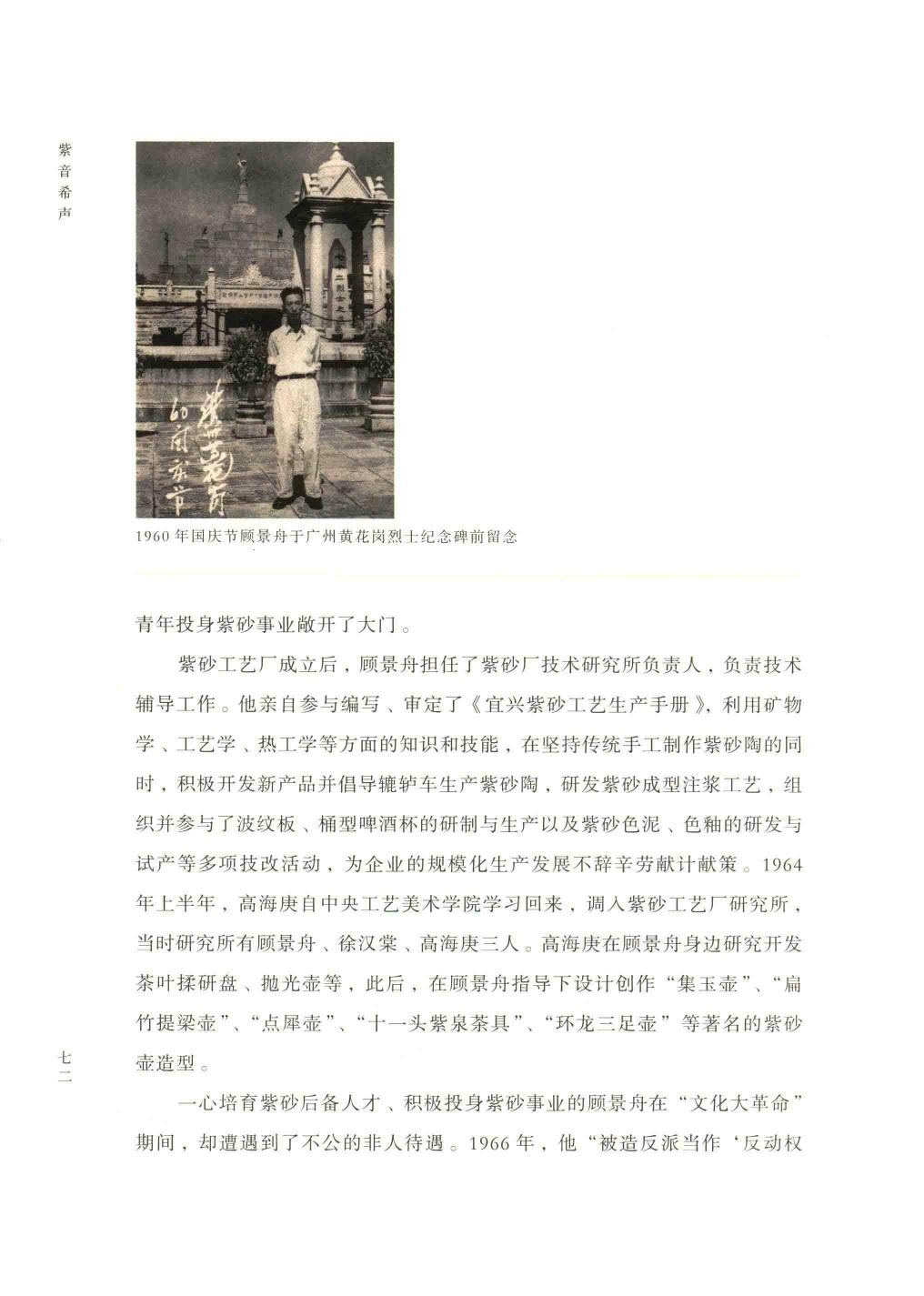
*[Image caption: Gu Jingzhou at the Huanghuagang Martyrs' Memorial in Guangzhou during National Day 1960]*
This opened the door for young people to devote themselves to the Yixing pottery enterprise.
After the establishment of the Yixing Pottery Factory, Gu Jingzhou took on the role of director of the factory's Technical Research Institute, responsible for technical guidance work. He personally participated in writing and reviewing the *Yixing Zisha Craft Production Manual*. Utilizing knowledge and skills in mineralogy, thermal engineering, and other fields, while maintaining traditional handcrafted Yixing pottery production methods, he actively developed new products and advocated for the use of wheel-throwing in Yixing pottery production. He researched and developed slip-casting molding techniques for Yixing ware, organized and participated in the research, development, and production of corrugated plates and cylindrical beer mugs, as well as the research, development, and trial production of colored Yixing clay and glazes, among many other technical innovation activities. He worked tirelessly to contribute ideas and strategies for the enterprise's large-scale production development. In the first half of 1964, Gao Haigeng returned from his studies at the Central Academy of Arts and Crafts and was transferred to the Research Institute of the Yixing Pottery Factory. At that time, the Research Institute had three members: Gu Jingzhou, Xu Hantang, and Gao Haigeng. Under Gu Jingzhou's guidance, Gao Haigeng researched and developed tea kneading plates and polished teapots. Subsequently, under Gu's direction, he designed and created famous Yixing pieces such as the "Jiyu Teapot," the "Ju [incomplete character] Teapot," and the "Huanlong Tripod Teapot."
Gu Jingzhou devoted himself wholeheartedly to cultivating the next generation of Yixing pottery talent and actively engaged in the Yixing pottery enterprise. However, during the "Cultural Revolution" period, he suffered unjust and inhumane treatment. In 1966, he was targeted by rebel factions as a "reactionary authority..."
Chapter 3
达变
Adaptation
Pages 32-133
View Chapter →
English Translation
## Section 1
*[Image caption: Gu Jingzhou at the Huanghuagang Martyrs' Memorial in Guangzhou during National Day 1960]*
This opened the door for young people to devote themselves to the Yixing pottery enterprise.
After the establishment of the Yixing Pottery Factory, Gu Jingzhou took on the role of director of the factory's Technical Research Institute, responsible for technical guidance work. He personally participated in writing and reviewing the *Yixing Zisha Craft Production Manual*. Utilizing knowledge and skills in mineralogy, thermal engineering, and other fields, while maintaining traditional handcrafted Yixing pottery production methods, he actively developed new products and advocated for the use of wheel-throwing in Yixing pottery production. He researched and developed slip-casting molding techniques for Yixing ware, organized and participated in the research, development, and production of corrugated plates and cylindrical beer mugs, as well as the research, development, and trial production of colored Yixing clay and glazes, among many other technical innovation activities. He worked tirelessly to contribute ideas and strategies for the enterprise's large-scale production development. In the first half of 1964, Gao Haigeng returned from his studies at the Central Academy of Arts and Crafts and was transferred to the Research Institute of the Yixing Pottery Factory. At that time, the Research Institute had three members: Gu Jingzhou, Xu Hantang, and Gao Haigeng. Under Gu Jingzhou's guidance, Gao Haigeng researched and developed tea kneading plates and polished teapots. Subsequently, under Gu's direction, he designed and created famous Yixing pieces such as the "Jiyu Teapot," the "Ju [incomplete character] Teapot," and the "Huanlong Tripod Teapot."
Gu Jingzhou devoted himself wholeheartedly to cultivating the next generation of Yixing pottery talent and actively engaged in the Yixing pottery enterprise. However, during the "Cultural Revolution" period, he suffered unjust and inhumane treatment. In 1966, he was targeted by rebel factions as a "reactionary authority..."
章节导航 Chapter Navigation
Chapter 1
序文
Pages 6-6
Chapter 2
引言
Pages 28-31
Chapter 3
达变
Pages 32-133
Chapter 3
开宗立派
Pages 46-66
Chapter 3
传道授业
Pages 67-98
Chapter 3
大师淳友
Pages 99-120
Chapter 3
学艺谋生
Pages 121-133
Chapter 4
化神
Pages 134-141
Chapter 5
独妙
Pages 142-405
Chapter 5
匠心独运 不苟丝毫
Pages 142-179
Chapter 5
器利善事 物尽其用
Pages 180-199
Chapter 5
紫泥春华 研精究微
Pages 200-405
Chapter 6
驾简
Pages 406-427
Chapter 6
精雕细刻 文质合一
Pages 406-410
Chapter 6
师法自然 妙趣横生
Pages 411-415
Chapter 6
丝来线去 曲尽其妙
Pages 416-427
Chapter 7
明志
Pages 463-485
Chapter 7
高山仰止 淡泊明志
Pages 463-472
Chapter 7
啜墨看茶 气定神闲
Pages 473-478
Chapter 7
齿少心锐 怡志抒情
Pages 479-485
Chapter 8
存真
Pages 428-462
Chapter 8
规圆矩方 弃伪存真
Pages 428-436
Chapter 8
有物有则 钻尖仰高
Pages 437-462
Chapter 9
心营
Pages 506-525
Chapter 9
坚守传统 艺立潮头
Pages 506-513
Chapter 9
新型师承 桃李满园
Pages 514-525
Chapter 10
附录
Pages 526-651
Chapter 10
顾景舟紫艺论文
Pages 526-535
Chapter 10
技术课备课笔记
Pages 536-543
Chapter 10
顾景舟艺术年表
Pages 544-651
Chapter 11
参考文献
Pages 652-657
Chapter 12
鸣谢
Pages 658-659