Chapter 3
达变
Adaptation
79
of 659
English Translation
## Four
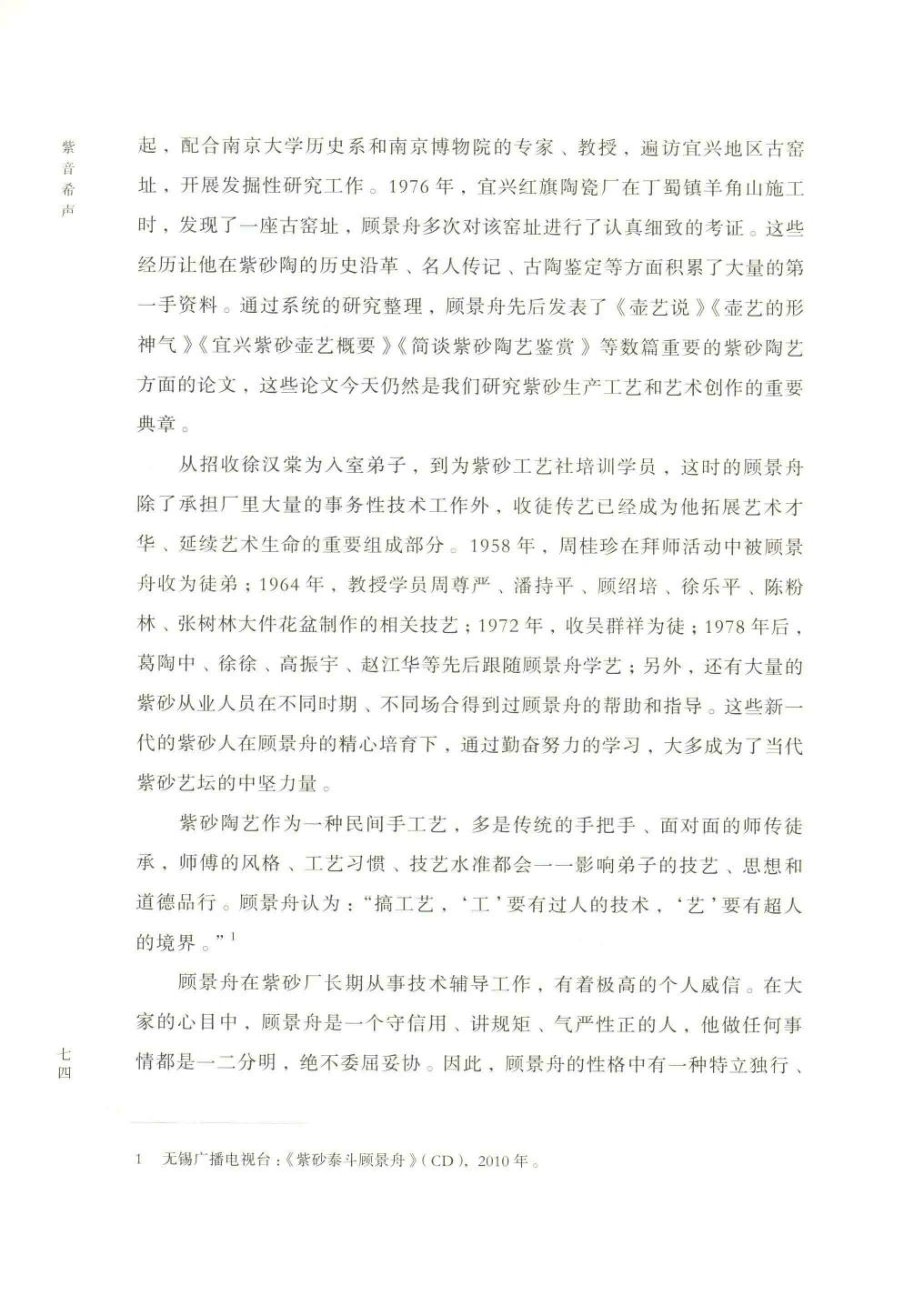
In collaboration with experts and professors from the History Department of Nanjing University and the Nanjing Museum, he visited ancient kiln sites in the Yixing region to conduct excavation research. In 1976, when the Yixing Hongqi Pottery Factory was conducting construction work at Yangjiao Mountain in Dingshu Town, an ancient kiln site was discovered. Gu Jingzhou conducted careful and meticulous investigations of this kiln site on multiple occasions. These experiences allowed him to accumulate a wealth of firsthand materials on the historical evolution of Zisha pottery, biographies of famous artisans, and authentication of ancient pottery. Through systematic research and compilation, Gu Jingzhou successively published several important papers on Zisha pottery art, including *Suo Yi Shuo* (On the Pursuit of Art), *Hu Yi de Xing Shen Qi* (The Form, Spirit, and Essence of Teapot Art), *Yixing Zisha Huyi Gaiyao* (An Overview of Yixing Zisha Teapot Art), and *Jian Tan Zisha Taoyi Jianshang* (A Brief Discussion on the Appreciation of Zisha Pottery Art). These papers remain important references for our study of Zisha production techniques and artistic creation today.
From accepting Xu Handang as his formal disciple to training students for the Zisha Craft Cooperative, Gu Jingzhou at this time, in addition to undertaking a large volume of technical and administrative work at the factory, found that taking on disciples and transmitting his art had become an important component of expanding his artistic talents and extending his artistic life. In 1958, Zhou Guizhen was accepted as his disciple during an apprenticeship ceremony; in 1964, he taught students Zhou Zunyan, Pan Chiping, Gu Shaopei, Xu Leping, Chen Fenlin, and Zhang Shulin the relevant techniques for making large flowerpots; in 1972, he accepted Wu Qunxiang as his disciple; after 1978, Ge Yinzhong, Xu Xu, Gao Zhenyu, Zhao Jianghua, and others successively studied under Gu Jingzhou; additionally, a large number of Zisha practitioners received help and guidance from Gu Jingzhou at different times and on different occasions. Under Gu Jingzhou's careful cultivation, through diligent and earnest study, most of these new generation Zisha artisans became the backbone forces of the contemporary Zisha art world.
As a folk handicraft, Zisha pottery art is mostly transmitted through the traditional hand-to-hand, face-to-face master-to-apprentice inheritance. The master's style, technical habits, and skill level all influence the disciple's techniques, thoughts, and moral character. Gu Jingzhou believed: "In pursuing craft, 'gong' (工, skill) requires exceptional technique, and 'yi' (艺, art) requires transcendent realm."
Gu Jingzhou engaged in technical guidance work at the Zisha Factory for a long period and enjoyed extremely high personal prestige. In everyone's minds, Gu Jingzhou was a person who kept his word, followed rules, and was upright and principled. In everything he did, he was clear-cut and would never compromise or yield. Therefore, Gu Jingzhou's character had a quality of independence and nonconformity.
---
[1] Wuxi Radio and Television Station: *Zisha Master Gu Jingzhou* (CD), 2010.
Chapter 3
达变
Adaptation
Pages 32-133
View Chapter →
English Translation
## Four
In collaboration with experts and professors from the History Department of Nanjing University and the Nanjing Museum, he visited ancient kiln sites in the Yixing region to conduct excavation research. In 1976, when the Yixing Hongqi Pottery Factory was conducting construction work at Yangjiao Mountain in Dingshu Town, an ancient kiln site was discovered. Gu Jingzhou conducted careful and meticulous investigations of this kiln site on multiple occasions. These experiences allowed him to accumulate a wealth of firsthand materials on the historical evolution of Zisha pottery, biographies of famous artisans, and authentication of ancient pottery. Through systematic research and compilation, Gu Jingzhou successively published several important papers on Zisha pottery art, including *Suo Yi Shuo* (On the Pursuit of Art), *Hu Yi de Xing Shen Qi* (The Form, Spirit, and Essence of Teapot Art), *Yixing Zisha Huyi Gaiyao* (An Overview of Yixing Zisha Teapot Art), and *Jian Tan Zisha Taoyi Jianshang* (A Brief Discussion on the Appreciation of Zisha Pottery Art). These papers remain important references for our study of Zisha production techniques and artistic creation today.
From accepting Xu Handang as his formal disciple to training students for the Zisha Craft Cooperative, Gu Jingzhou at this time, in addition to undertaking a large volume of technical and administrative work at the factory, found that taking on disciples and transmitting his art had become an important component of expanding his artistic talents and extending his artistic life. In 1958, Zhou Guizhen was accepted as his disciple during an apprenticeship ceremony; in 1964, he taught students Zhou Zunyan, Pan Chiping, Gu Shaopei, Xu Leping, Chen Fenlin, and Zhang Shulin the relevant techniques for making large flowerpots; in 1972, he accepted Wu Qunxiang as his disciple; after 1978, Ge Yinzhong, Xu Xu, Gao Zhenyu, Zhao Jianghua, and others successively studied under Gu Jingzhou; additionally, a large number of Zisha practitioners received help and guidance from Gu Jingzhou at different times and on different occasions. Under Gu Jingzhou's careful cultivation, through diligent and earnest study, most of these new generation Zisha artisans became the backbone forces of the contemporary Zisha art world.
As a folk handicraft, Zisha pottery art is mostly transmitted through the traditional hand-to-hand, face-to-face master-to-apprentice inheritance. The master's style, technical habits, and skill level all influence the disciple's techniques, thoughts, and moral character. Gu Jingzhou believed: "In pursuing craft, 'gong' (工, skill) requires exceptional technique, and 'yi' (艺, art) requires transcendent realm."
Gu Jingzhou engaged in technical guidance work at the Zisha Factory for a long period and enjoyed extremely high personal prestige. In everyone's minds, Gu Jingzhou was a person who kept his word, followed rules, and was upright and principled. In everything he did, he was clear-cut and would never compromise or yield. Therefore, Gu Jingzhou's character had a quality of independence and nonconformity.
---
[1] Wuxi Radio and Television Station: *Zisha Master Gu Jingzhou* (CD), 2010.
章节导航 Chapter Navigation
Chapter 1
序文
Pages 6-6
Chapter 2
引言
Pages 28-31
Chapter 3
达变
Pages 32-133
Chapter 3
开宗立派
Pages 46-66
Chapter 3
传道授业
Pages 67-98
Chapter 3
大师淳友
Pages 99-120
Chapter 3
学艺谋生
Pages 121-133
Chapter 4
化神
Pages 134-141
Chapter 5
独妙
Pages 142-405
Chapter 5
匠心独运 不苟丝毫
Pages 142-179
Chapter 5
器利善事 物尽其用
Pages 180-199
Chapter 5
紫泥春华 研精究微
Pages 200-405
Chapter 6
驾简
Pages 406-427
Chapter 6
精雕细刻 文质合一
Pages 406-410
Chapter 6
师法自然 妙趣横生
Pages 411-415
Chapter 6
丝来线去 曲尽其妙
Pages 416-427
Chapter 7
明志
Pages 463-485
Chapter 7
高山仰止 淡泊明志
Pages 463-472
Chapter 7
啜墨看茶 气定神闲
Pages 473-478
Chapter 7
齿少心锐 怡志抒情
Pages 479-485
Chapter 8
存真
Pages 428-462
Chapter 8
规圆矩方 弃伪存真
Pages 428-436
Chapter 8
有物有则 钻尖仰高
Pages 437-462
Chapter 9
心营
Pages 506-525
Chapter 9
坚守传统 艺立潮头
Pages 506-513
Chapter 9
新型师承 桃李满园
Pages 514-525
Chapter 10
附录
Pages 526-651
Chapter 10
顾景舟紫艺论文
Pages 526-535
Chapter 10
技术课备课笔记
Pages 536-543
Chapter 10
顾景舟艺术年表
Pages 544-651
Chapter 11
参考文献
Pages 652-657
Chapter 12
鸣谢
Pages 658-659