Chapter 3
达变
Adaptation
90
of 659
English Translation
In fact, what Gu Jingzhou demanded of others, he first demanded of himself. He always led by example in everything he did. Someone recalled that once they went to Gu Jingzhou's workshop at the factory very early in the morning, before work hours had even begun. They found Gu Jingzhou already there inspecting the work his students had completed the previous day. After carefully examining it, he was not entirely satisfied, so he began tapping and striking on the clay slab with a "bing bing bang bang" sound. After a moment of calm concentration, a full-bodied vessel form already stood upon the clay slab, covered in sweat. Gu Jingzhou then smiled and said to his guest: "You make the tea, I'll handle this!" The guest crouched to one side, not daring to breathe heavily, watching Gu Jingzhou's every move. Two hours later, in order not to disturb Gu Jingzhou's work, he laughed and said to the guest: "When they see this, they will naturally understand. Actions speak louder than words."
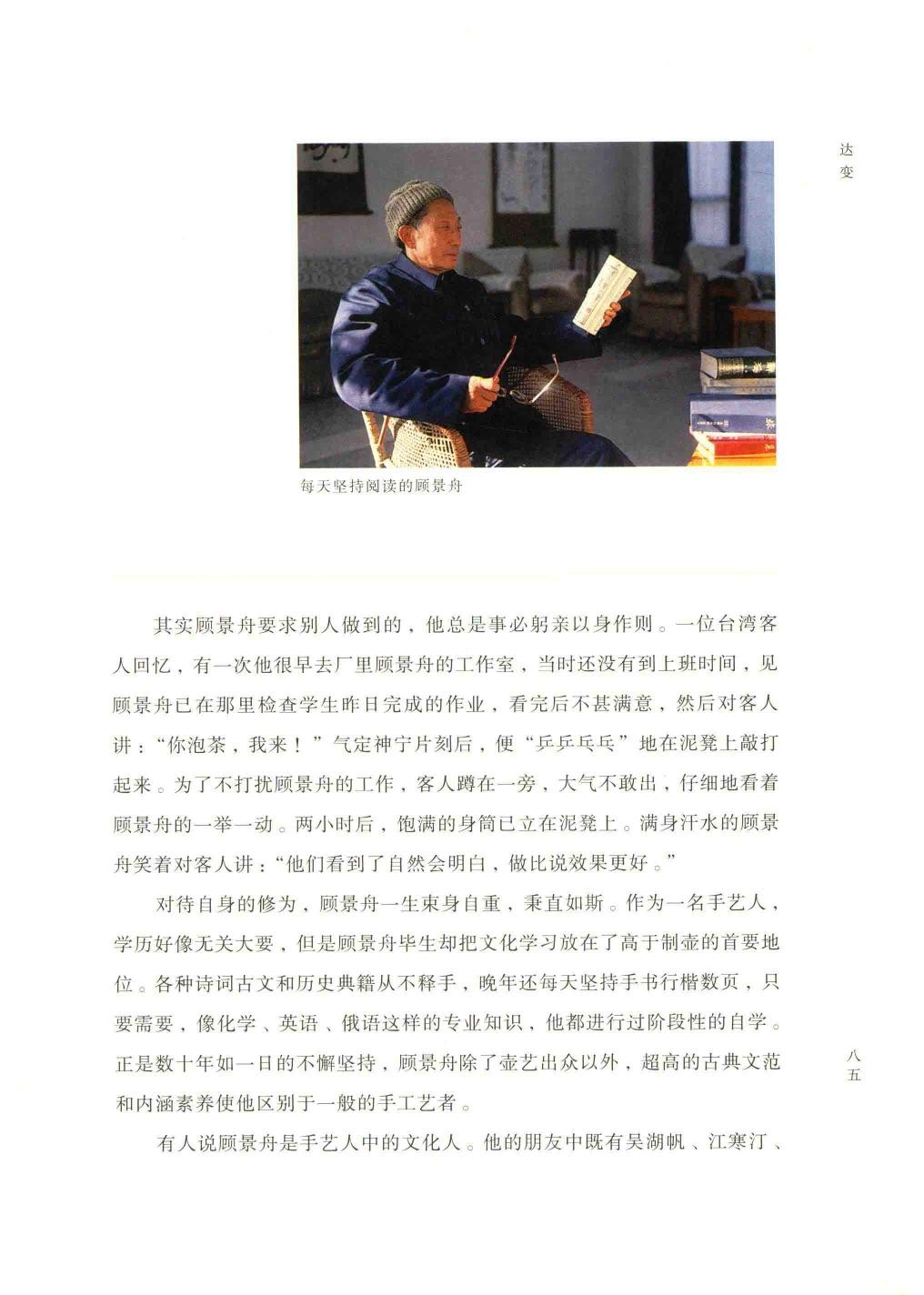
Regarding his own self-cultivation, Gu Jingzhou held himself to strict standards and remained upright throughout his life. Educational credentials seemed unimportant to him, but as a craftsman, Gu Jingzhou placed cultural learning at a higher priority than the craft of making teapots throughout his entire life. He never put down various classical poems, ancient texts, and historical classics, reading them every day. Whenever needed, he engaged in phased self-study of specialized knowledge in fields such as chemistry, English, and Russian. Even in his later years, he persisted in writing several pages of regular script calligraphy by hand each day.
It was precisely this unwavering persistence, day after day for decades, that distinguished Gu Jingzhou from ordinary craftsmen through his exceptionally high classical literary cultivation and inner refinement. Besides his outstanding teapot artistry, among his friends were Wu Hufan, Jiang Hanting, and others.[1]
Some say that Gu Jingzhou was a cultured person among craftspeople.
---
[1] Note: The text appears to reference additional names that were partially cut off in the original Chinese text.
Chapter 3
达变
Adaptation
Pages 32-133
View Chapter →
English Translation
In fact, what Gu Jingzhou demanded of others, he first demanded of himself. He always led by example in everything he did. Someone recalled that once they went to Gu Jingzhou's workshop at the factory very early in the morning, before work hours had even begun. They found Gu Jingzhou already there inspecting the work his students had completed the previous day. After carefully examining it, he was not entirely satisfied, so he began tapping and striking on the clay slab with a "bing bing bang bang" sound. After a moment of calm concentration, a full-bodied vessel form already stood upon the clay slab, covered in sweat. Gu Jingzhou then smiled and said to his guest: "You make the tea, I'll handle this!" The guest crouched to one side, not daring to breathe heavily, watching Gu Jingzhou's every move. Two hours later, in order not to disturb Gu Jingzhou's work, he laughed and said to the guest: "When they see this, they will naturally understand. Actions speak louder than words."
Regarding his own self-cultivation, Gu Jingzhou held himself to strict standards and remained upright throughout his life. Educational credentials seemed unimportant to him, but as a craftsman, Gu Jingzhou placed cultural learning at a higher priority than the craft of making teapots throughout his entire life. He never put down various classical poems, ancient texts, and historical classics, reading them every day. Whenever needed, he engaged in phased self-study of specialized knowledge in fields such as chemistry, English, and Russian. Even in his later years, he persisted in writing several pages of regular script calligraphy by hand each day.
It was precisely this unwavering persistence, day after day for decades, that distinguished Gu Jingzhou from ordinary craftsmen through his exceptionally high classical literary cultivation and inner refinement. Besides his outstanding teapot artistry, among his friends were Wu Hufan, Jiang Hanting, and others.[1]
Some say that Gu Jingzhou was a cultured person among craftspeople.
---
[1] Note: The text appears to reference additional names that were partially cut off in the original Chinese text.
章节导航 Chapter Navigation
Chapter 1
序文
Pages 6-6
Chapter 2
引言
Pages 28-31
Chapter 3
达变
Pages 32-133
Chapter 3
开宗立派
Pages 46-66
Chapter 3
传道授业
Pages 67-98
Chapter 3
大师淳友
Pages 99-120
Chapter 3
学艺谋生
Pages 121-133
Chapter 4
化神
Pages 134-141
Chapter 5
独妙
Pages 142-405
Chapter 5
匠心独运 不苟丝毫
Pages 142-179
Chapter 5
器利善事 物尽其用
Pages 180-199
Chapter 5
紫泥春华 研精究微
Pages 200-405
Chapter 6
驾简
Pages 406-427
Chapter 6
精雕细刻 文质合一
Pages 406-410
Chapter 6
师法自然 妙趣横生
Pages 411-415
Chapter 6
丝来线去 曲尽其妙
Pages 416-427
Chapter 7
明志
Pages 463-485
Chapter 7
高山仰止 淡泊明志
Pages 463-472
Chapter 7
啜墨看茶 气定神闲
Pages 473-478
Chapter 7
齿少心锐 怡志抒情
Pages 479-485
Chapter 8
存真
Pages 428-462
Chapter 8
规圆矩方 弃伪存真
Pages 428-436
Chapter 8
有物有则 钻尖仰高
Pages 437-462
Chapter 9
心营
Pages 506-525
Chapter 9
坚守传统 艺立潮头
Pages 506-513
Chapter 9
新型师承 桃李满园
Pages 514-525
Chapter 10
附录
Pages 526-651
Chapter 10
顾景舟紫艺论文
Pages 526-535
Chapter 10
技术课备课笔记
Pages 536-543
Chapter 10
顾景舟艺术年表
Pages 544-651
Chapter 11
参考文献
Pages 652-657
Chapter 12
鸣谢
Pages 658-659