Chapter 3
达变
Adaptation
101
of 659
English Translation
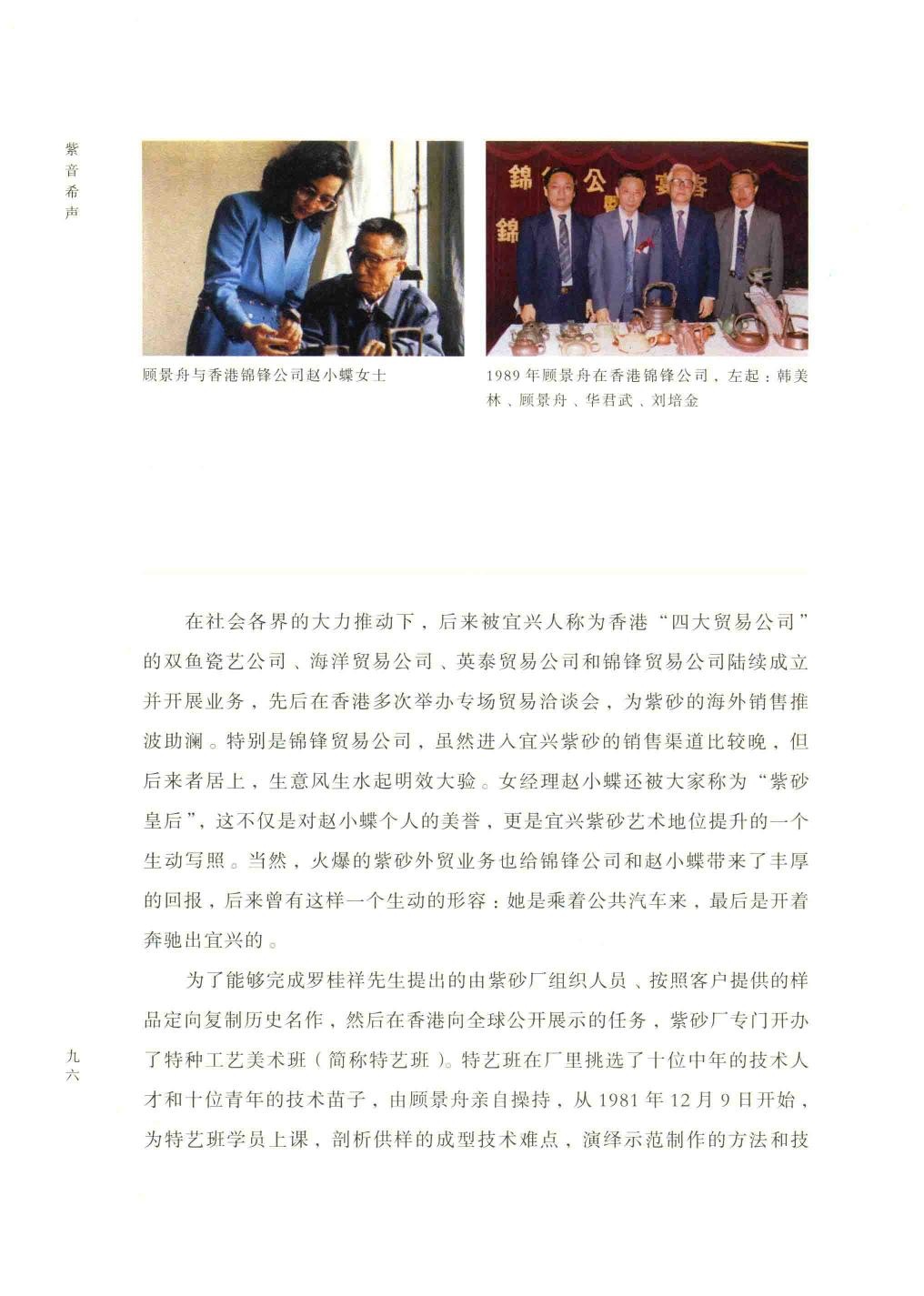
Gu Jingzhou with Ms. Zhao Xiaodie of Hong Kong's Jinfeng Company
In 1989, Gu Jingzhou at Hong Kong's Jinfeng Company. From left: Han Meilin, Gu Jingzhou, Hua Junwu, Liu Peijin
With strong promotion from all sectors of society, what would later be called by Yixing people the "Four Major Trading Companies" of Hong Kong—Shuangyu Arts Company, Ocean Trading Company, Yingtai Trading Company, and Jinfeng Trading Company—were successively established and began operations. They held multiple specialized trade fairs in Hong Kong, adding momentum to the overseas sales of zisha pottery. Jinfeng Trading Company in particular, although it entered the Yixing zisha sales channel relatively late, rose to prominence as a latecomer, with business flourishing and achieving remarkable results. The female manager Zhao Xiaodie was even called the "Zisha Queen" by everyone. This was not only a personal honor for Zhao Xiaodie, but also a vivid reflection of the elevated status of Yixing zisha art. Of course, the booming zisha foreign trade business also brought generous returns to Jinfeng Company and Zhao Xiaodie. There was later a vivid description: she arrived by public bus and eventually left Yixing driving a Mercedes-Benz.
In order to complete the task proposed by Mr. Lo Kwee-seong—to have the zisha factory organize personnel to reproduce historical masterpieces according to samples provided by clients, and then publicly display them globally in Hong Kong—the zisha factory specially established a Special Arts and Crafts Class (abbreviated as Special Arts Class). The Special Arts Class selected ten middle-aged technical talents and ten young technical prospects from the factory. Under the personal direction of Gu Jingzhou, starting from December 9, 1981, he taught classes for the Special Arts Class students, analyzing the technical difficulties in forming the supplied samples, and demonstrating the methods and techniques of production.
Chapter 3
达变
Adaptation
Pages 32-133
View Chapter →
English Translation
Gu Jingzhou with Ms. Zhao Xiaodie of Hong Kong's Jinfeng Company
In 1989, Gu Jingzhou at Hong Kong's Jinfeng Company. From left: Han Meilin, Gu Jingzhou, Hua Junwu, Liu Peijin
With strong promotion from all sectors of society, what would later be called by Yixing people the "Four Major Trading Companies" of Hong Kong—Shuangyu Arts Company, Ocean Trading Company, Yingtai Trading Company, and Jinfeng Trading Company—were successively established and began operations. They held multiple specialized trade fairs in Hong Kong, adding momentum to the overseas sales of zisha pottery. Jinfeng Trading Company in particular, although it entered the Yixing zisha sales channel relatively late, rose to prominence as a latecomer, with business flourishing and achieving remarkable results. The female manager Zhao Xiaodie was even called the "Zisha Queen" by everyone. This was not only a personal honor for Zhao Xiaodie, but also a vivid reflection of the elevated status of Yixing zisha art. Of course, the booming zisha foreign trade business also brought generous returns to Jinfeng Company and Zhao Xiaodie. There was later a vivid description: she arrived by public bus and eventually left Yixing driving a Mercedes-Benz.
In order to complete the task proposed by Mr. Lo Kwee-seong—to have the zisha factory organize personnel to reproduce historical masterpieces according to samples provided by clients, and then publicly display them globally in Hong Kong—the zisha factory specially established a Special Arts and Crafts Class (abbreviated as Special Arts Class). The Special Arts Class selected ten middle-aged technical talents and ten young technical prospects from the factory. Under the personal direction of Gu Jingzhou, starting from December 9, 1981, he taught classes for the Special Arts Class students, analyzing the technical difficulties in forming the supplied samples, and demonstrating the methods and techniques of production.
章节导航 Chapter Navigation
Chapter 1
序文
Pages 6-6
Chapter 2
引言
Pages 28-31
Chapter 3
达变
Pages 32-133
Chapter 3
开宗立派
Pages 46-66
Chapter 3
传道授业
Pages 67-98
Chapter 3
大师淳友
Pages 99-120
Chapter 3
学艺谋生
Pages 121-133
Chapter 4
化神
Pages 134-141
Chapter 5
独妙
Pages 142-405
Chapter 5
匠心独运 不苟丝毫
Pages 142-179
Chapter 5
器利善事 物尽其用
Pages 180-199
Chapter 5
紫泥春华 研精究微
Pages 200-405
Chapter 6
驾简
Pages 406-427
Chapter 6
精雕细刻 文质合一
Pages 406-410
Chapter 6
师法自然 妙趣横生
Pages 411-415
Chapter 6
丝来线去 曲尽其妙
Pages 416-427
Chapter 7
明志
Pages 463-485
Chapter 7
高山仰止 淡泊明志
Pages 463-472
Chapter 7
啜墨看茶 气定神闲
Pages 473-478
Chapter 7
齿少心锐 怡志抒情
Pages 479-485
Chapter 8
存真
Pages 428-462
Chapter 8
规圆矩方 弃伪存真
Pages 428-436
Chapter 8
有物有则 钻尖仰高
Pages 437-462
Chapter 9
心营
Pages 506-525
Chapter 9
坚守传统 艺立潮头
Pages 506-513
Chapter 9
新型师承 桃李满园
Pages 514-525
Chapter 10
附录
Pages 526-651
Chapter 10
顾景舟紫艺论文
Pages 526-535
Chapter 10
技术课备课笔记
Pages 536-543
Chapter 10
顾景舟艺术年表
Pages 544-651
Chapter 11
参考文献
Pages 652-657
Chapter 12
鸣谢
Pages 658-659