Chapter 3
达变
Adaptation
106
of 659
English Translation
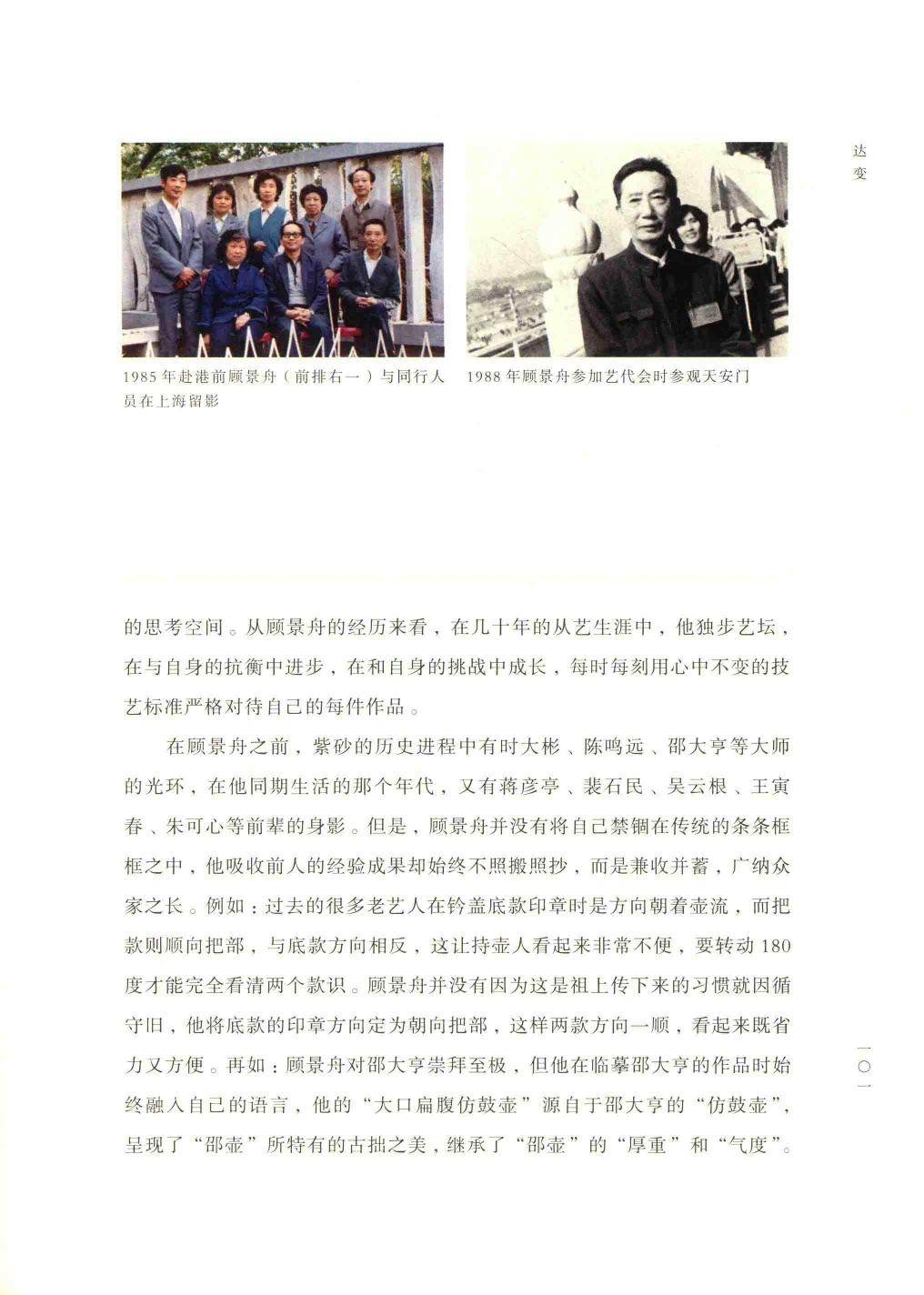
In 1985, before crossing the river, Gu Jingzhou (front row, right) photographed with colleagues in Shanghai. In 1988, Gu Jingzhou attended the Arts Congress and visited Tiananmen.
Throughout his decades-long artistic career, he progressed through contending with himself and grew through challenging himself. He stood alone in the art world, yet the unwavering technical and artistic standards in his heart led him to treat each of his works with strict criteria.
Before Gu Jingzhou, the history of Yixing pottery had already seen the brilliance of masters such as Shi Dabin, Chen Mingyuan, and Shao Daheng. In his own era, there were also the distinguished figures of Jiang Yanchun, Zhu Kexin, Wu Yungen, Wang Yinchun, Pei Shimin, and Fan Guangling. However, Gu Jingzhou did not confine himself within the rigid frameworks of tradition. While absorbing the experiential achievements of his predecessors, he never simply copied them mechanically. Instead, he embraced all approaches and incorporated the strengths of many schools.
For example: In the past, many old artisans would stamp the seal on the lid bottom facing toward the spout, while the handle inscription would face toward the handle, in the opposite direction from the bottom seal. This made it very inconvenient for the person holding the teapot, requiring a 180-degree rotation to see both inscriptions clearly. Gu Jingzhou did not blindly follow convention simply because this was an ancestral habit. He established that the seal direction on the bottom should face toward the handle, so that both inscriptions aligned in the same direction, making viewing both effortless and convenient.
Another example: Gu Jingzhou held Shao Daheng in the highest regard, but when copying Shao Daheng's works, he always incorporated his own artistic language. His "Large Mouth Fan Belly Imitation Drum Teapot" was derived from Shao Daheng's "Imitation Drum Teapot," presenting the distinctive archaic beauty characteristic of "Shao teapots" and inheriting the "solidity" and "momentum" that Shao had "passed down."
Chapter 3
达变
Adaptation
Pages 32-133
View Chapter →
English Translation
In 1985, before crossing the river, Gu Jingzhou (front row, right) photographed with colleagues in Shanghai. In 1988, Gu Jingzhou attended the Arts Congress and visited Tiananmen.
Throughout his decades-long artistic career, he progressed through contending with himself and grew through challenging himself. He stood alone in the art world, yet the unwavering technical and artistic standards in his heart led him to treat each of his works with strict criteria.
Before Gu Jingzhou, the history of Yixing pottery had already seen the brilliance of masters such as Shi Dabin, Chen Mingyuan, and Shao Daheng. In his own era, there were also the distinguished figures of Jiang Yanchun, Zhu Kexin, Wu Yungen, Wang Yinchun, Pei Shimin, and Fan Guangling. However, Gu Jingzhou did not confine himself within the rigid frameworks of tradition. While absorbing the experiential achievements of his predecessors, he never simply copied them mechanically. Instead, he embraced all approaches and incorporated the strengths of many schools.
For example: In the past, many old artisans would stamp the seal on the lid bottom facing toward the spout, while the handle inscription would face toward the handle, in the opposite direction from the bottom seal. This made it very inconvenient for the person holding the teapot, requiring a 180-degree rotation to see both inscriptions clearly. Gu Jingzhou did not blindly follow convention simply because this was an ancestral habit. He established that the seal direction on the bottom should face toward the handle, so that both inscriptions aligned in the same direction, making viewing both effortless and convenient.
Another example: Gu Jingzhou held Shao Daheng in the highest regard, but when copying Shao Daheng's works, he always incorporated his own artistic language. His "Large Mouth Fan Belly Imitation Drum Teapot" was derived from Shao Daheng's "Imitation Drum Teapot," presenting the distinctive archaic beauty characteristic of "Shao teapots" and inheriting the "solidity" and "momentum" that Shao had "passed down."
章节导航 Chapter Navigation
Chapter 1
序文
Pages 6-6
Chapter 2
引言
Pages 28-31
Chapter 3
达变
Pages 32-133
Chapter 3
开宗立派
Pages 46-66
Chapter 3
传道授业
Pages 67-98
Chapter 3
大师淳友
Pages 99-120
Chapter 3
学艺谋生
Pages 121-133
Chapter 4
化神
Pages 134-141
Chapter 5
独妙
Pages 142-405
Chapter 5
匠心独运 不苟丝毫
Pages 142-179
Chapter 5
器利善事 物尽其用
Pages 180-199
Chapter 5
紫泥春华 研精究微
Pages 200-405
Chapter 6
驾简
Pages 406-427
Chapter 6
精雕细刻 文质合一
Pages 406-410
Chapter 6
师法自然 妙趣横生
Pages 411-415
Chapter 6
丝来线去 曲尽其妙
Pages 416-427
Chapter 7
明志
Pages 463-485
Chapter 7
高山仰止 淡泊明志
Pages 463-472
Chapter 7
啜墨看茶 气定神闲
Pages 473-478
Chapter 7
齿少心锐 怡志抒情
Pages 479-485
Chapter 8
存真
Pages 428-462
Chapter 8
规圆矩方 弃伪存真
Pages 428-436
Chapter 8
有物有则 钻尖仰高
Pages 437-462
Chapter 9
心营
Pages 506-525
Chapter 9
坚守传统 艺立潮头
Pages 506-513
Chapter 9
新型师承 桃李满园
Pages 514-525
Chapter 10
附录
Pages 526-651
Chapter 10
顾景舟紫艺论文
Pages 526-535
Chapter 10
技术课备课笔记
Pages 536-543
Chapter 10
顾景舟艺术年表
Pages 544-651
Chapter 11
参考文献
Pages 652-657
Chapter 12
鸣谢
Pages 658-659