Chapter 3
达变
Adaptation
107
of 659
English Translation
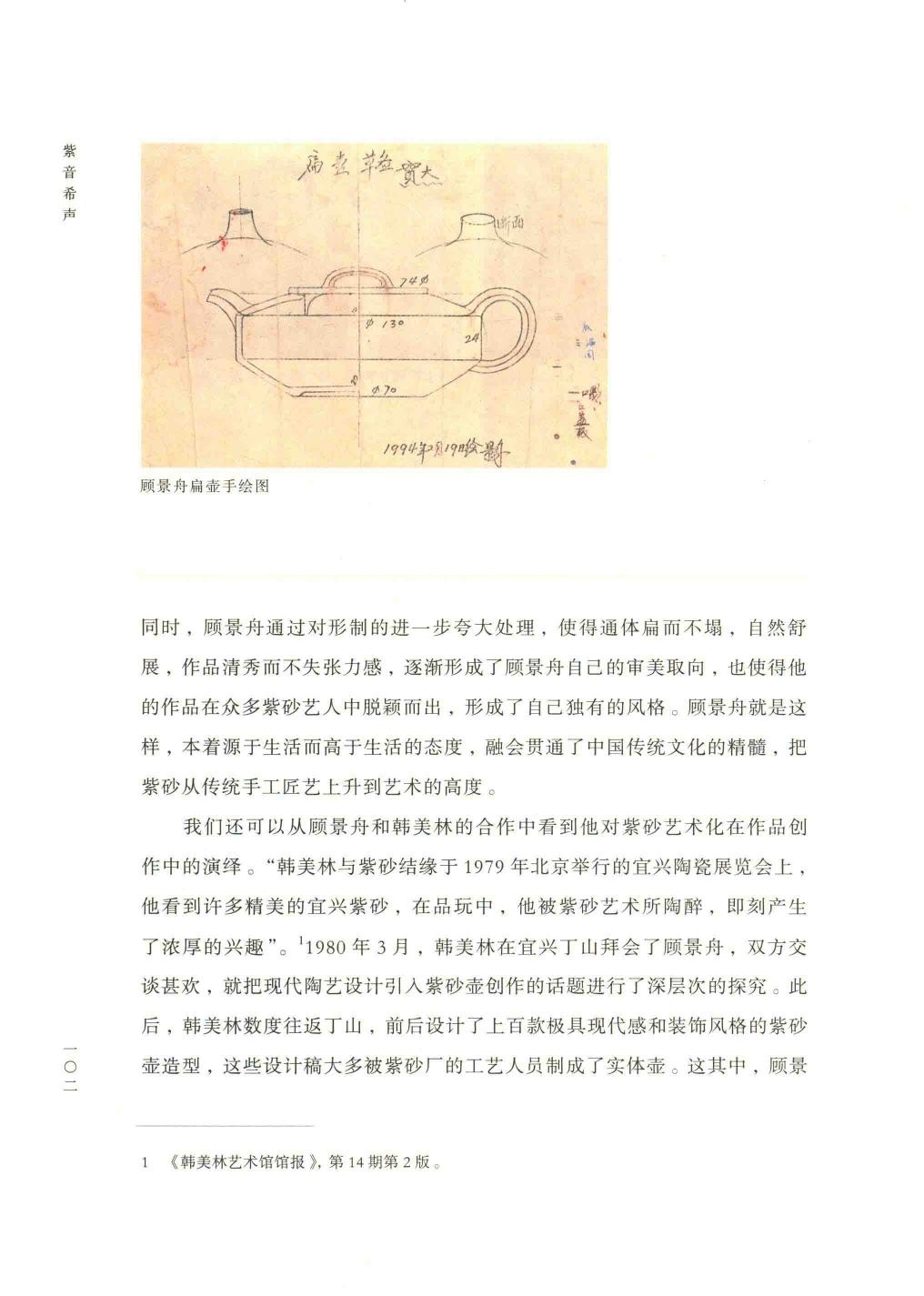
At the same time, through further exaggerated treatment of the form, Gu Jingzhou ensured that the entire body remained flat without collapsing, naturally stretching and extending. His works were elegant yet retained a sense of tension, gradually forming Gu Jingzhou's own aesthetic orientation. This also enabled his works to stand out among numerous Yixing pottery artisans, establishing his unique style. In this way, Gu Jingzhou, adhering to the principle of being rooted in life while transcending it, thoroughly integrated the essence of traditional Chinese culture, elevating Yixing pottery from traditional handicraft to the height of art.
We can also observe his interpretation of the artistic transformation of Yixing pottery through Gu Jingzhou's collaboration with Han Meilin. "Han Meilin's connection with Yixing pottery began at the Yixing Ceramics Exhibition held in Beijing in 1979. There, he saw many exquisite Yixing pottery pieces, and while appreciating and handling them, he became intoxicated by the art of Yixing pottery, immediately developing a strong interest."[1] In March 1980, Han Meilin visited Gu Jingzhou in Dingshan, Yixing. The two had a very pleasant conversation and conducted an in-depth exploration of the topic of introducing modern ceramic design into Yixing teapot creation. Subsequently, Han Meilin made several trips to Dingshan, designing over a hundred teapot forms with strong modern sensibility and decorative style. Most of these design drafts were transformed into physical objects by the craftspeople of Yixing Pottery Factory No. 3. Among these, Gu Jingzhou...
---
[1] *Han Meilin Art Museum Newsletter*, Issue 14, Page 2.
Chapter 3
达变
Adaptation
Pages 32-133
View Chapter →
English Translation
At the same time, through further exaggerated treatment of the form, Gu Jingzhou ensured that the entire body remained flat without collapsing, naturally stretching and extending. His works were elegant yet retained a sense of tension, gradually forming Gu Jingzhou's own aesthetic orientation. This also enabled his works to stand out among numerous Yixing pottery artisans, establishing his unique style. In this way, Gu Jingzhou, adhering to the principle of being rooted in life while transcending it, thoroughly integrated the essence of traditional Chinese culture, elevating Yixing pottery from traditional handicraft to the height of art.
We can also observe his interpretation of the artistic transformation of Yixing pottery through Gu Jingzhou's collaboration with Han Meilin. "Han Meilin's connection with Yixing pottery began at the Yixing Ceramics Exhibition held in Beijing in 1979. There, he saw many exquisite Yixing pottery pieces, and while appreciating and handling them, he became intoxicated by the art of Yixing pottery, immediately developing a strong interest."[1] In March 1980, Han Meilin visited Gu Jingzhou in Dingshan, Yixing. The two had a very pleasant conversation and conducted an in-depth exploration of the topic of introducing modern ceramic design into Yixing teapot creation. Subsequently, Han Meilin made several trips to Dingshan, designing over a hundred teapot forms with strong modern sensibility and decorative style. Most of these design drafts were transformed into physical objects by the craftspeople of Yixing Pottery Factory No. 3. Among these, Gu Jingzhou...
---
[1] *Han Meilin Art Museum Newsletter*, Issue 14, Page 2.
章节导航 Chapter Navigation
Chapter 1
序文
Pages 6-6
Chapter 2
引言
Pages 28-31
Chapter 3
达变
Pages 32-133
Chapter 3
开宗立派
Pages 46-66
Chapter 3
传道授业
Pages 67-98
Chapter 3
大师淳友
Pages 99-120
Chapter 3
学艺谋生
Pages 121-133
Chapter 4
化神
Pages 134-141
Chapter 5
独妙
Pages 142-405
Chapter 5
匠心独运 不苟丝毫
Pages 142-179
Chapter 5
器利善事 物尽其用
Pages 180-199
Chapter 5
紫泥春华 研精究微
Pages 200-405
Chapter 6
驾简
Pages 406-427
Chapter 6
精雕细刻 文质合一
Pages 406-410
Chapter 6
师法自然 妙趣横生
Pages 411-415
Chapter 6
丝来线去 曲尽其妙
Pages 416-427
Chapter 7
明志
Pages 463-485
Chapter 7
高山仰止 淡泊明志
Pages 463-472
Chapter 7
啜墨看茶 气定神闲
Pages 473-478
Chapter 7
齿少心锐 怡志抒情
Pages 479-485
Chapter 8
存真
Pages 428-462
Chapter 8
规圆矩方 弃伪存真
Pages 428-436
Chapter 8
有物有则 钻尖仰高
Pages 437-462
Chapter 9
心营
Pages 506-525
Chapter 9
坚守传统 艺立潮头
Pages 506-513
Chapter 9
新型师承 桃李满园
Pages 514-525
Chapter 10
附录
Pages 526-651
Chapter 10
顾景舟紫艺论文
Pages 526-535
Chapter 10
技术课备课笔记
Pages 536-543
Chapter 10
顾景舟艺术年表
Pages 544-651
Chapter 11
参考文献
Pages 652-657
Chapter 12
鸣谢
Pages 658-659