Chapter 3
达变
Adaptation
109
of 659
English Translation
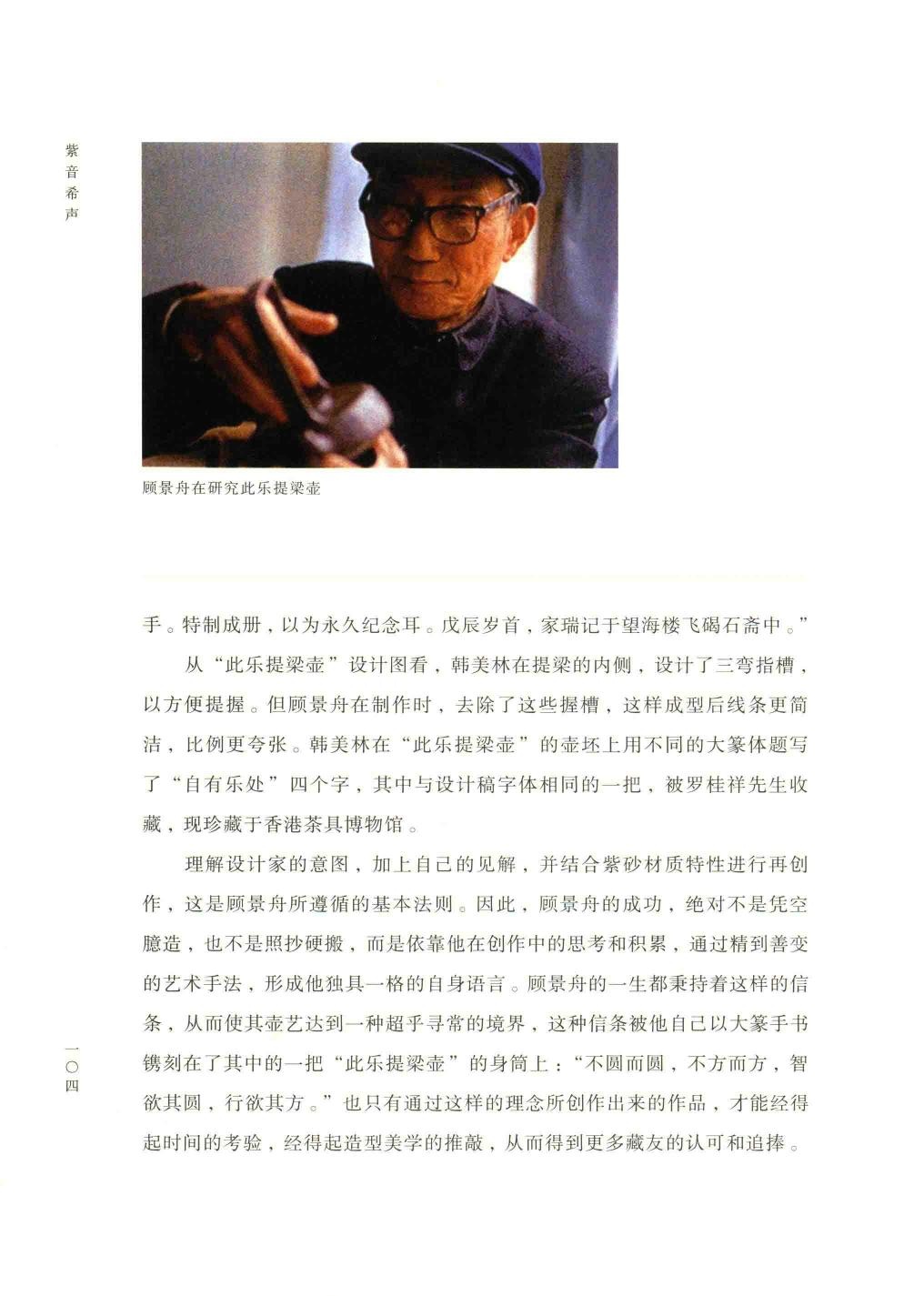
Gu Jingzhou, while researching this "Ci Le" handled teapot, specially compiled it into a volume as a permanent commemoration. Written at the beginning of the year by Jia Rui at Wanghai Lou Fei'ai Shi Studio.
From the design drawings of the "Ci Le Handled Teapot No. 1," Han Meilin designed three curved finger grips on the inner side of the handle for ease of holding. However, when Gu Jingzhou crafted it, he removed these grip grooves, resulting in cleaner lines and more exaggerated proportions after forming. Han Meilin inscribed four characters "zi you le chu" (finding joy within oneself) in different styles of large seal script on the clay body of the "Ci Le Handled Teapot No. 1." The piece with calligraphy matching the design draft was collected by Mr. Lo Kwee-seong and is now treasured in the Hong Kong Museum of Tea Ware.
Understanding the designer's intent, adding one's own insights, and recreating in combination with the characteristics of Yixing clay—this was the fundamental principle Gu Jingzhou followed. Therefore, Gu Jingzhou's success was absolutely not conjured from thin air, nor was it rigid copying, but rather relied on his contemplation and accumulation during creation. Through refined and adaptable artistic techniques, he formed his uniquely distinctive personal language. Gu Jingzhou upheld this creed throughout his life, thereby elevating his artistic achievement to an extraordinarily transcendent realm. This creed was inscribed by him in large seal script on the body of one of the "Ci Le Handled Teapots": "Not round yet round, not square yet square. Wisdom seeks roundness, action seeks squareness." Only works created through such a philosophy can withstand the test of time and the scrutiny of aesthetic principles, thereby gaining recognition and admiration from more collectors.
Chapter 3
达变
Adaptation
Pages 32-133
View Chapter →
English Translation
Gu Jingzhou, while researching this "Ci Le" handled teapot, specially compiled it into a volume as a permanent commemoration. Written at the beginning of the year by Jia Rui at Wanghai Lou Fei'ai Shi Studio.
From the design drawings of the "Ci Le Handled Teapot No. 1," Han Meilin designed three curved finger grips on the inner side of the handle for ease of holding. However, when Gu Jingzhou crafted it, he removed these grip grooves, resulting in cleaner lines and more exaggerated proportions after forming. Han Meilin inscribed four characters "zi you le chu" (finding joy within oneself) in different styles of large seal script on the clay body of the "Ci Le Handled Teapot No. 1." The piece with calligraphy matching the design draft was collected by Mr. Lo Kwee-seong and is now treasured in the Hong Kong Museum of Tea Ware.
Understanding the designer's intent, adding one's own insights, and recreating in combination with the characteristics of Yixing clay—this was the fundamental principle Gu Jingzhou followed. Therefore, Gu Jingzhou's success was absolutely not conjured from thin air, nor was it rigid copying, but rather relied on his contemplation and accumulation during creation. Through refined and adaptable artistic techniques, he formed his uniquely distinctive personal language. Gu Jingzhou upheld this creed throughout his life, thereby elevating his artistic achievement to an extraordinarily transcendent realm. This creed was inscribed by him in large seal script on the body of one of the "Ci Le Handled Teapots": "Not round yet round, not square yet square. Wisdom seeks roundness, action seeks squareness." Only works created through such a philosophy can withstand the test of time and the scrutiny of aesthetic principles, thereby gaining recognition and admiration from more collectors.
章节导航 Chapter Navigation
Chapter 1
序文
Pages 6-6
Chapter 2
引言
Pages 28-31
Chapter 3
达变
Pages 32-133
Chapter 3
开宗立派
Pages 46-66
Chapter 3
传道授业
Pages 67-98
Chapter 3
大师淳友
Pages 99-120
Chapter 3
学艺谋生
Pages 121-133
Chapter 4
化神
Pages 134-141
Chapter 5
独妙
Pages 142-405
Chapter 5
匠心独运 不苟丝毫
Pages 142-179
Chapter 5
器利善事 物尽其用
Pages 180-199
Chapter 5
紫泥春华 研精究微
Pages 200-405
Chapter 6
驾简
Pages 406-427
Chapter 6
精雕细刻 文质合一
Pages 406-410
Chapter 6
师法自然 妙趣横生
Pages 411-415
Chapter 6
丝来线去 曲尽其妙
Pages 416-427
Chapter 7
明志
Pages 463-485
Chapter 7
高山仰止 淡泊明志
Pages 463-472
Chapter 7
啜墨看茶 气定神闲
Pages 473-478
Chapter 7
齿少心锐 怡志抒情
Pages 479-485
Chapter 8
存真
Pages 428-462
Chapter 8
规圆矩方 弃伪存真
Pages 428-436
Chapter 8
有物有则 钻尖仰高
Pages 437-462
Chapter 9
心营
Pages 506-525
Chapter 9
坚守传统 艺立潮头
Pages 506-513
Chapter 9
新型师承 桃李满园
Pages 514-525
Chapter 10
附录
Pages 526-651
Chapter 10
顾景舟紫艺论文
Pages 526-535
Chapter 10
技术课备课笔记
Pages 536-543
Chapter 10
顾景舟艺术年表
Pages 544-651
Chapter 11
参考文献
Pages 652-657
Chapter 12
鸣谢
Pages 658-659