21
of 659
English Translation
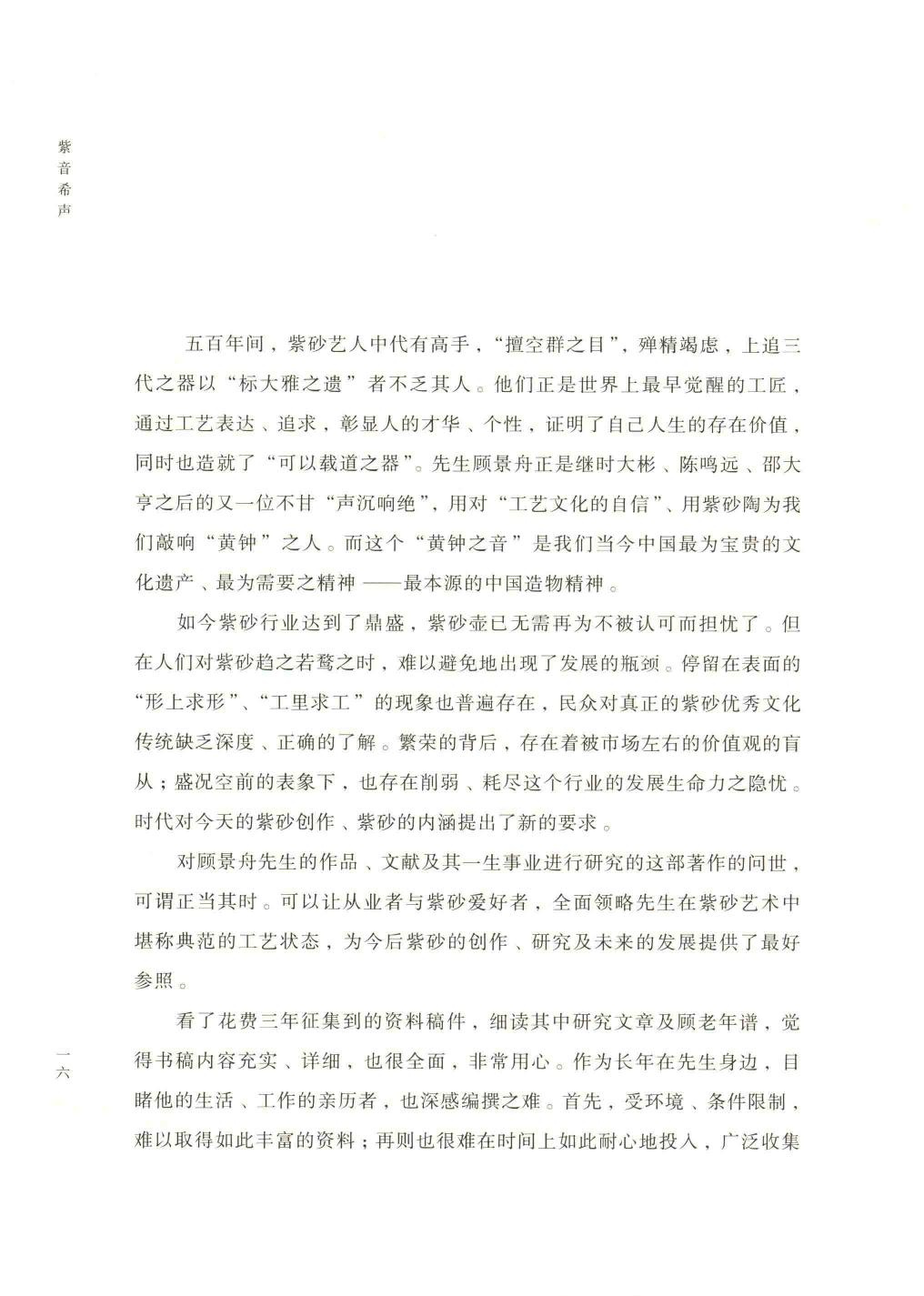
Over five hundred years, there has been no shortage of masters among Yixing pottery artisans who "excelled above all others," exhausting their精力 in pursuit of excellence, reaching back to the vessels of the Three Dynasties to "establish the legacy of great refinement." They were the world's earliest awakened craftsmen who, through their craft, expressed and pursued their talents and individuality, proving the existential value of their lives while creating "vessels capable of carrying the Way." Master Gu Jingzhou was precisely such a person—following in the footsteps of Shi Dabin, Chen Mingyuan, and Shao Daxiang—unwilling to let his "voice fade into silence," using his "confidence in craft culture" and Yixing pottery to sound the "yellow bell" for us. And this "sound of the yellow bell" represents the most precious cultural heritage and most needed spiritual essence of contemporary China.
It embodies the most fundamental Chinese spirit of creation.
Today the Yixing pottery industry has reached its peak prosperity, and Yixing teapots no longer need to worry about lack of recognition. However, as people flock to Yixing pottery, bottlenecks in development have inevitably emerged. The phenomenon of "seeking form through form" and "seeking craft through craft" that remains on the surface is also widespread, and the public lacks deep and accurate understanding of the truly excellent cultural traditions of Yixing pottery. Behind the prosperity lies a blind following of market-driven values; beneath the unprecedented flourishing also exists the hidden concern of weakening and exhausting the developmental vitality of this industry. The times have put forward new requirements for today's Yixing pottery creation and its inner meaning.
The publication of this work researching Master Gu Jingzhou's works, documents, and lifelong career comes at precisely the right time. It allows practitioners and Yixing pottery enthusiasts to fully appreciate the master's exemplary craftsmanship and artistic state in Yixing pottery art, providing the best reference for future Yixing pottery creation, research, and development.
Having reviewed the materials and manuscripts collected over three years, and carefully read the research articles and Master Gu's chronological biography, I find the manuscript content substantial, detailed, comprehensive, and very thoughtfully prepared. As someone who spent many years by the master's side, witnessing his life and work firsthand, I deeply appreciate the difficulty of compilation. First, limited by environment and conditions, it is difficult to obtain such rich materials; furthermore, it is also difficult to invest so patiently in time to widely collect [materials].
English Translation
Over five hundred years, there has been no shortage of masters among Yixing pottery artisans who "excelled above all others," exhausting their精力 in pursuit of excellence, reaching back to the vessels of the Three Dynasties to "establish the legacy of great refinement." They were the world's earliest awakened craftsmen who, through their craft, expressed and pursued their talents and individuality, proving the existential value of their lives while creating "vessels capable of carrying the Way." Master Gu Jingzhou was precisely such a person—following in the footsteps of Shi Dabin, Chen Mingyuan, and Shao Daxiang—unwilling to let his "voice fade into silence," using his "confidence in craft culture" and Yixing pottery to sound the "yellow bell" for us. And this "sound of the yellow bell" represents the most precious cultural heritage and most needed spiritual essence of contemporary China.
It embodies the most fundamental Chinese spirit of creation.
Today the Yixing pottery industry has reached its peak prosperity, and Yixing teapots no longer need to worry about lack of recognition. However, as people flock to Yixing pottery, bottlenecks in development have inevitably emerged. The phenomenon of "seeking form through form" and "seeking craft through craft" that remains on the surface is also widespread, and the public lacks deep and accurate understanding of the truly excellent cultural traditions of Yixing pottery. Behind the prosperity lies a blind following of market-driven values; beneath the unprecedented flourishing also exists the hidden concern of weakening and exhausting the developmental vitality of this industry. The times have put forward new requirements for today's Yixing pottery creation and its inner meaning.
The publication of this work researching Master Gu Jingzhou's works, documents, and lifelong career comes at precisely the right time. It allows practitioners and Yixing pottery enthusiasts to fully appreciate the master's exemplary craftsmanship and artistic state in Yixing pottery art, providing the best reference for future Yixing pottery creation, research, and development.
Having reviewed the materials and manuscripts collected over three years, and carefully read the research articles and Master Gu's chronological biography, I find the manuscript content substantial, detailed, comprehensive, and very thoughtfully prepared. As someone who spent many years by the master's side, witnessing his life and work firsthand, I deeply appreciate the difficulty of compilation. First, limited by environment and conditions, it is difficult to obtain such rich materials; furthermore, it is also difficult to invest so patiently in time to widely collect [materials].
章节导航 Chapter Navigation
Chapter 1
序文
Pages 6-6
Chapter 2
引言
Pages 28-31
Chapter 3
达变
Pages 32-133
Chapter 3
开宗立派
Pages 46-66
Chapter 3
传道授业
Pages 67-98
Chapter 3
大师淳友
Pages 99-120
Chapter 3
学艺谋生
Pages 121-133
Chapter 4
化神
Pages 134-141
Chapter 5
独妙
Pages 142-405
Chapter 5
匠心独运 不苟丝毫
Pages 142-179
Chapter 5
器利善事 物尽其用
Pages 180-199
Chapter 5
紫泥春华 研精究微
Pages 200-405
Chapter 6
驾简
Pages 406-427
Chapter 6
精雕细刻 文质合一
Pages 406-410
Chapter 6
师法自然 妙趣横生
Pages 411-415
Chapter 6
丝来线去 曲尽其妙
Pages 416-427
Chapter 7
明志
Pages 463-485
Chapter 7
高山仰止 淡泊明志
Pages 463-472
Chapter 7
啜墨看茶 气定神闲
Pages 473-478
Chapter 7
齿少心锐 怡志抒情
Pages 479-485
Chapter 8
存真
Pages 428-462
Chapter 8
规圆矩方 弃伪存真
Pages 428-436
Chapter 8
有物有则 钻尖仰高
Pages 437-462
Chapter 9
心营
Pages 506-525
Chapter 9
坚守传统 艺立潮头
Pages 506-513
Chapter 9
新型师承 桃李满园
Pages 514-525
Chapter 10
附录
Pages 526-651
Chapter 10
顾景舟紫艺论文
Pages 526-535
Chapter 10
技术课备课笔记
Pages 536-543
Chapter 10
顾景舟艺术年表
Pages 544-651
Chapter 11
参考文献
Pages 652-657
Chapter 12
鸣谢
Pages 658-659