27
of 659
English Translation
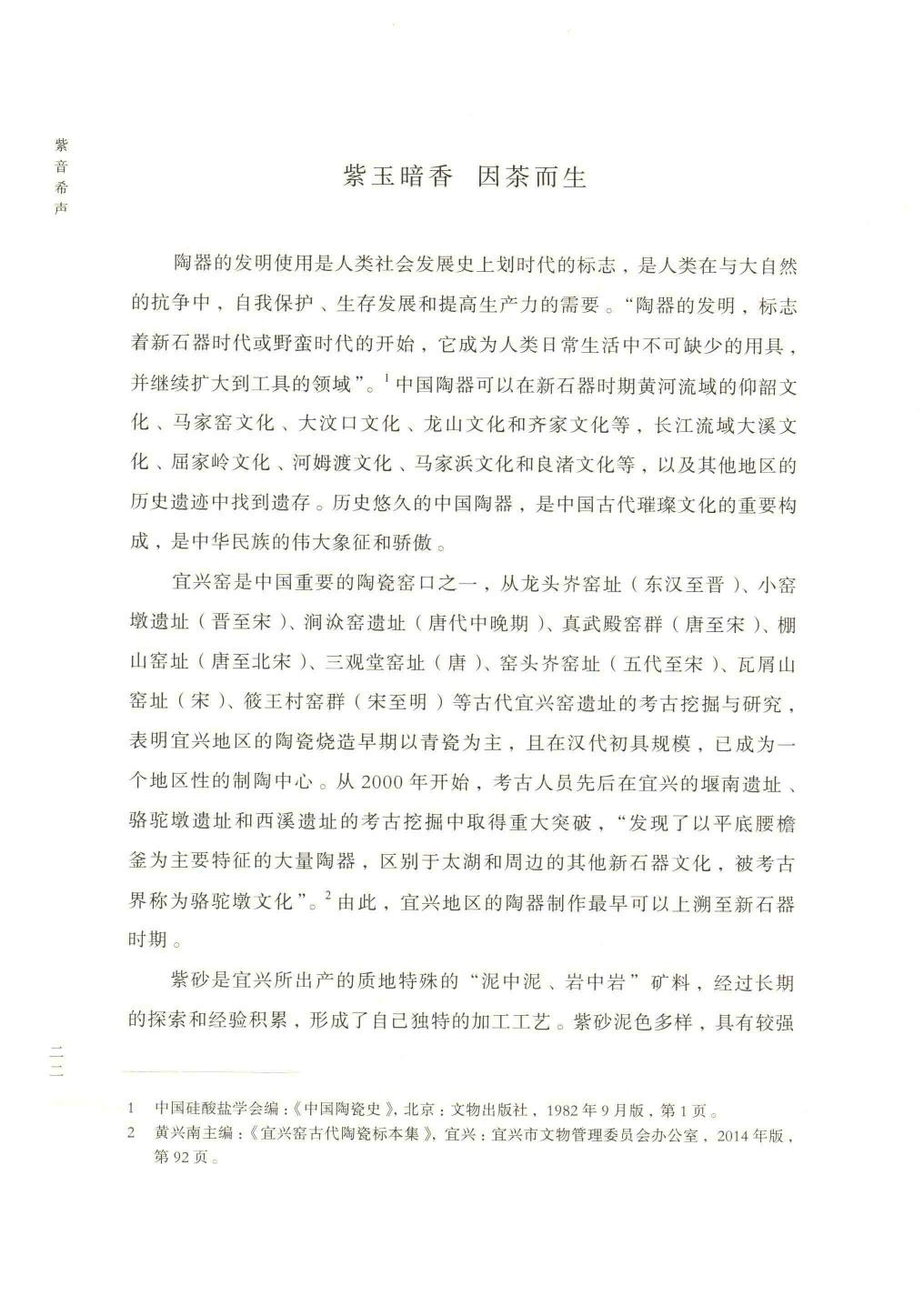
The invention and use of pottery marks an epoch-making milestone in the history of human social development. It arose from humanity's struggle with nature, driven by the need for self-protection, survival, development, and increased productivity. "The invention of pottery marks the beginning of the Neolithic Age or the Age of Barbarism. It became an indispensable tool in daily human life and continued to expand into the realm of implements."[1] Chinese pottery can be found in historical remains from the Neolithic period, including the Yangshao culture, Majiayao culture, Dawenkou culture, Longshan culture, and Qijia culture of the Yellow River basin; the Daxi culture, Qujialing culture, Hemudu culture, Majiabang culture, and Liangzhu culture of the Yangtze River basin; as well as other regional archaeological sites. Chinese pottery, with its long history, is an important component of ancient Chinese splendid culture and a great symbol and source of pride for the Chinese nation.
Yixing is one of China's important ceramic centers. Archaeological excavations and research at ancient Yixing kiln sites—including Longtouqiao (Eastern Han to Jin), Xiaoyaodun (Jin to Song), Runjiao (mid-to-late Tang), Zhenwudun kiln complex (Tang to Song), Pengshan (Tang to Northern Song), Sanguantang (Tang), Yaotouwan (Five Dynasties to Song), Wadaoshan (Song), and Xiaowangcun kiln complex (Song to Ming)—demonstrate that ceramic production in the Yixing region initially focused primarily on celadon. By the Han dynasty, it had already achieved considerable scale and become a regional pottery-making center. Beginning in 2000, archaeologists made major breakthroughs in excavations at the Yannan site, Luotuodun site, and Xixi site in Yixing, "discovering large quantities of pottery characterized primarily by flat-bottomed waisted jars, distinct from other Neolithic cultures around Taihu Lake and its surroundings. This has been designated by the archaeological community as the Luotuodun culture."[2] Thus, pottery production in the Yixing region can be traced back as early as the Neolithic period.
Zisha (purple sand) is a special mineral material produced in Yixing, described as "clay within clay, rock within rock." Through long-term exploration and accumulated experience, a unique processing technique has been developed. Zisha clay comes in diverse colors and possesses strong
---
[1] Chinese Ceramic Society, ed., *History of Chinese Ceramics* (Beijing: Cultural Relics Publishing House, September 1982), p. 1.
[2] Huang Xingnan, ed., *Collection of Ancient Ceramic Specimens from Yixing Kilns* (Yixing: Office of the Yixing Cultural Relics Management Committee, 2014), p. 92.
English Translation
The invention and use of pottery marks an epoch-making milestone in the history of human social development. It arose from humanity's struggle with nature, driven by the need for self-protection, survival, development, and increased productivity. "The invention of pottery marks the beginning of the Neolithic Age or the Age of Barbarism. It became an indispensable tool in daily human life and continued to expand into the realm of implements."[1] Chinese pottery can be found in historical remains from the Neolithic period, including the Yangshao culture, Majiayao culture, Dawenkou culture, Longshan culture, and Qijia culture of the Yellow River basin; the Daxi culture, Qujialing culture, Hemudu culture, Majiabang culture, and Liangzhu culture of the Yangtze River basin; as well as other regional archaeological sites. Chinese pottery, with its long history, is an important component of ancient Chinese splendid culture and a great symbol and source of pride for the Chinese nation.
Yixing is one of China's important ceramic centers. Archaeological excavations and research at ancient Yixing kiln sites—including Longtouqiao (Eastern Han to Jin), Xiaoyaodun (Jin to Song), Runjiao (mid-to-late Tang), Zhenwudun kiln complex (Tang to Song), Pengshan (Tang to Northern Song), Sanguantang (Tang), Yaotouwan (Five Dynasties to Song), Wadaoshan (Song), and Xiaowangcun kiln complex (Song to Ming)—demonstrate that ceramic production in the Yixing region initially focused primarily on celadon. By the Han dynasty, it had already achieved considerable scale and become a regional pottery-making center. Beginning in 2000, archaeologists made major breakthroughs in excavations at the Yannan site, Luotuodun site, and Xixi site in Yixing, "discovering large quantities of pottery characterized primarily by flat-bottomed waisted jars, distinct from other Neolithic cultures around Taihu Lake and its surroundings. This has been designated by the archaeological community as the Luotuodun culture."[2] Thus, pottery production in the Yixing region can be traced back as early as the Neolithic period.
Zisha (purple sand) is a special mineral material produced in Yixing, described as "clay within clay, rock within rock." Through long-term exploration and accumulated experience, a unique processing technique has been developed. Zisha clay comes in diverse colors and possesses strong
---
[1] Chinese Ceramic Society, ed., *History of Chinese Ceramics* (Beijing: Cultural Relics Publishing House, September 1982), p. 1.
[2] Huang Xingnan, ed., *Collection of Ancient Ceramic Specimens from Yixing Kilns* (Yixing: Office of the Yixing Cultural Relics Management Committee, 2014), p. 92.
章节导航 Chapter Navigation
Chapter 1
序文
Pages 6-6
Chapter 2
引言
Pages 28-31
Chapter 3
达变
Pages 32-133
Chapter 3
开宗立派
Pages 46-66
Chapter 3
传道授业
Pages 67-98
Chapter 3
大师淳友
Pages 99-120
Chapter 3
学艺谋生
Pages 121-133
Chapter 4
化神
Pages 134-141
Chapter 5
独妙
Pages 142-405
Chapter 5
匠心独运 不苟丝毫
Pages 142-179
Chapter 5
器利善事 物尽其用
Pages 180-199
Chapter 5
紫泥春华 研精究微
Pages 200-405
Chapter 6
驾简
Pages 406-427
Chapter 6
精雕细刻 文质合一
Pages 406-410
Chapter 6
师法自然 妙趣横生
Pages 411-415
Chapter 6
丝来线去 曲尽其妙
Pages 416-427
Chapter 7
明志
Pages 463-485
Chapter 7
高山仰止 淡泊明志
Pages 463-472
Chapter 7
啜墨看茶 气定神闲
Pages 473-478
Chapter 7
齿少心锐 怡志抒情
Pages 479-485
Chapter 8
存真
Pages 428-462
Chapter 8
规圆矩方 弃伪存真
Pages 428-436
Chapter 8
有物有则 钻尖仰高
Pages 437-462
Chapter 9
心营
Pages 506-525
Chapter 9
坚守传统 艺立潮头
Pages 506-513
Chapter 9
新型师承 桃李满园
Pages 514-525
Chapter 10
附录
Pages 526-651
Chapter 10
顾景舟紫艺论文
Pages 526-535
Chapter 10
技术课备课笔记
Pages 536-543
Chapter 10
顾景舟艺术年表
Pages 544-651
Chapter 11
参考文献
Pages 652-657
Chapter 12
鸣谢
Pages 658-659